

Dsigngo is a Graphic Design and Digital Marketing Company.
Write what you are looking for and press enter to begin your search!

Near Lahugala, The East
Magul Maha Vihara
A royal wedding celebrated over two thousand years ago left behind a moonstone found nowhere else in Sri Lanka, carved with elephants carrying riders on their backs.
Magul Maha Vihara’s Sinhala name translates directly to ‘Wedding Great Monastery,’ commemorating a royal marriage so historically significant that the site was subsequently transformed into a sprawling 10,000-acre monastic complex, and, according to tradition, became the birthplace of the man who would go on to unify Sri Lanka.
Quick Facts
| Location | On the northern edge of Lahugala National Park |
| Legendary event | Marriage of King Kavantissa and Princess Viharamahadevi, 2nd century BCE |
| Name meaning | ‘Magul’ means wedding or auspicious occasion in Sinhala |
| Original complex size | Around 10,000 acres |
| Notable feature | The only Sri Lankan moonstone depicting elephants with riders |
| Later renovations | By King Dhatusena (5th century) and further restoration in the 14th century |
Commonly searched as: Magul Maha Viharaya · Viharamahadevi wedding site · King Kavantissa temple · Lahugala ruins · things to do near Arugam Bay
A Wedding That Shaped a Kingdom’s Future
According to tradition, King Kavantissa of Ruhuna married Princess Viharamahadevi at this site in the 2nd century BCE, a union already carrying genuine legend on the princess’s side, she was said to have sacrificed herself at sea to save her father’s kingdom, only to wash ashore near Mahagama and marry the local king. Their son, born and raised nearby, would grow up to become King Dutugemunu, the ruler who eventually unified Sri Lanka under Sinhalese rule after defeating the Tamil king Elara. Foundations of the couple’s unexcavated palace lie just south of the temple, marking, according to local tradition, the very place where Dutugemunu spent his early years before the family relocated to Tissamaharama during his teens.
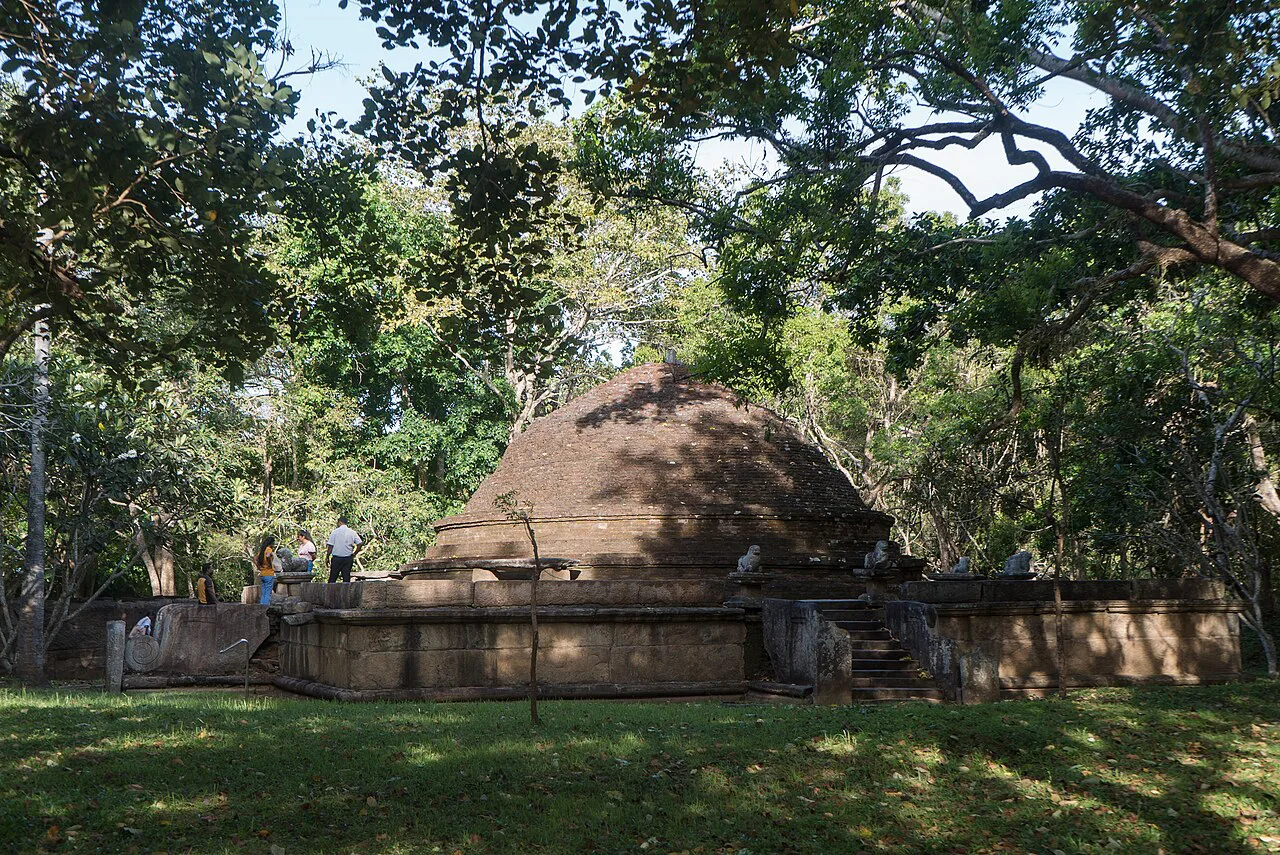
Following the wedding, the site was formally enclosed and gifted to the Buddhist monastic community, the Sangha, transforming what had briefly been a royal ceremonial ground into an extensive monastery. At its peak, the complex covered an area of roughly 10,000 acres, encompassing a palace, monastery buildings, a Bo tree terrace, stupas and ponds, scattered across a landscape now largely reclaimed by the surrounding forest of Lahugala National Park.
A Moonstone Unlike Any Other in Sri Lanka
Among Magul Maha Vihara’s ruins, one detail draws particular attention from art historians: its carved moonstone (sandakada pahana) is the only known example in Sri Lanka depicting elephants carrying riders on their backs, a genuinely unique variation on this traditional decorative Buddhist architectural feature. That distinctive detail, combined with the site’s overall design, similar in broad style to monastic complexes found in the Cultural Triangle yet displaying distinct regional variations, makes Magul Maha Vihara a genuinely valuable case study in how far ancient Sinhalese Buddhist architectural conventions spread from Anuradhapura, and how they adapted at the fringes of the civilisation.
The stupa itself sits atop a raised terrace reached by three staircases, each guarded by carved lion figures, a formal, ceremonial approach reflecting the site’s originally elevated royal and religious status. A causeway crossing a small surrounding reservoir provides access to the temple complex, itself circled by water in a deliberate echo of the site’s founding as a place of both royal celebration and subsequent religious devotion.
Restored Across the Centuries
Magul Maha Vihara received significant renovation under King Dhatusena in the 5th century CE, the same ruler responsible for the Kala Wewa reservoir and, according to legend, the Aukana Buddha statue, and further restoration followed in the mid-14th century. A 14th-century stone inscription found on the temple grounds references a later queen, also confusingly named Viharamahadevi, wife of successive Gampola kings, who donated land and funded renovations, adding yet another royal layer to the site’s already rich historical record.
Visiting Tips
- Combine with a safari at neighbouring Lahugala National Park, given the site’s location right on the park’s edge.
- Look closely at the unique moonstone depicting elephants with riders, found nowhere else in Sri Lanka.
- Allow time to appreciate the scale of the original complex, even though most of its 10,000 acres has returned to forest.
- Base yourself in Arugam Bay, Pottuvil, or Monaragala for convenient access to both the temple and the national park.
Where It Sits on the Map
Magul Maha Vihara, northern edge of Lahugala National Park Open in Google Maps ↗
Frequently Asked Questions
What does Magul Maha Vihara mean?
‘Wedding Great Monastery,’ commemorating the marriage of King Kavantissa and Princess Viharamahadevi at this site in the 2nd century BCE.
Why is this site historically significant?
It’s traditionally identified as the birthplace and childhood home of King Dutugemunu, the ruler who later unified Sri Lanka under Sinhalese rule.
What makes the site’s moonstone unique?
It’s the only known moonstone in Sri Lanka depicting elephants carrying riders on their backs, a genuinely distinctive variation on this traditional architectural feature.
How large was the original monastic complex?
Around 10,000 acres, including a palace, monastery, Bo tree terrace, stupas and ponds, much of which has since returned to surrounding forest.
← Sri Lanka: The Complete Guide — see all 258 places by region
Related News
A guide to Sri Lanka's East Coast: Trincomalee, Batticaloa, Arugam Bay, wildlife parks, and the region's unique dry-season timing.
A guide to Trincomalee: one of the world's finest natural harbours, its ancient temple, colonial and WWII history, visiting tips and map.
A guide to Fort Frederick in Trincomalee: built from a demolished temple's stones, still an active Sri Lankan military base, its resident deer, visiting tips...













