

Dsigngo is a Graphic Design and Digital Marketing Company.
Write what you are looking for and press enter to begin your search!

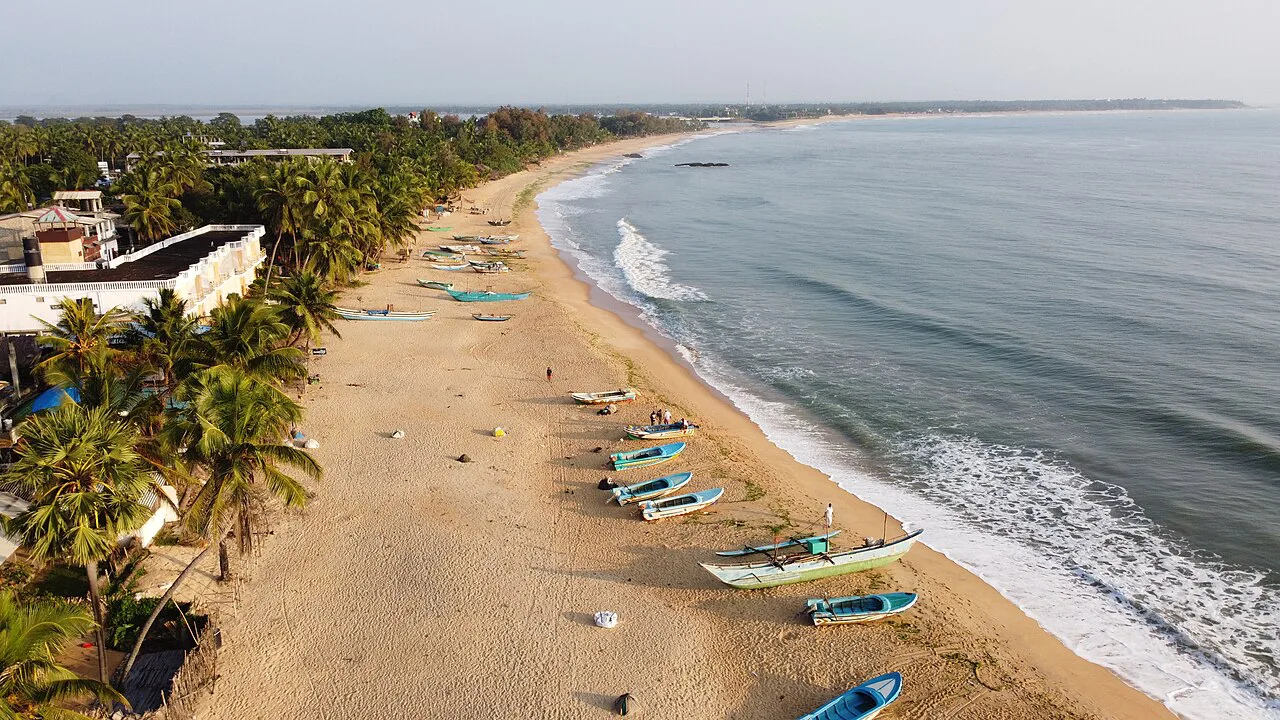
The East, Sri Lanka
Arugam Bay
In the 1970s, a bed and dinner here cost five rupees, and the only accommodation was a government bungalow and a few thatched huts. By 2010, the town was hosting World Surf League competitions.
Arugam Bay’s transformation from an obscure fishing village to one of Asia’s most celebrated surf destinations happened almost entirely within living memory, driven by word of mouth among travelling surfers who borrowed boards from each other decades before the town ever appeared on a World Surf League schedule.
Quick Facts
| Location | Eastern Province, about 320 km from Colombo |
| Local name | Arugam Kudah |
| Surf season | April to October, best waves June to September |
| Signature break | Main Point, a famous right-hand point break |
| First international competition | 2010, World Surf League |
| 2004 tsunami | Destroyed many of the town’s buildings |
Commonly searched as: Arugam Bay · Arugam Bay surfing · Arugam Bay history · Main Point surf break · things to do in Arugam Bay
From Cadjan Huts to a Surf Season
Long-time locals describe Arugam Bay’s 1970s incarnation in genuinely stark terms: a small fishing village with coconut trees and the odd thatched cadjan hut along the shorefront, no electricity, no running water, and nothing built above the tree line. A government circuit bungalow and a handful of homestay huts with sandy floors were the only accommodation options, and a bed for the night plus dinner cost around five rupees. Basic tea shops served roti, fruit and tea by day and rice and curry at night, with plenty of coconuts but no cold drinks and no bakery.
It was during this period that a handful of local surfers, remembered by names like Nagas, Upali and Jaya, began learning to ride waves by borrowing boards left behind by travelling surfers, prized possessions at the time given how few were actually available locally. That grassroots beginning, learning on borrowed equipment from passing travellers, planted the seeds of what would eventually become a genuinely significant local surf culture.
From Local Secret to World Surf League Host
Arugam Bay’s international surf reputation grew steadily in the following decades, interrupted by both Sri Lanka’s civil war and, devastatingly, the December 2004 Indian Ocean tsunami, which destroyed many of the town’s buildings. Recovery followed the war’s end in 2009, and Arugam Bay, alongside Hikkaduwa, became one of the first two Sri Lankan surf destinations to see consistent visitor numbers return. That renewed momentum culminated in 2010, when the World Surf League hosted its first international surf competition at Arugam Bay, repeated in 2011 with an added women’s longboard championship, putting the town firmly on the global surfing map and exposing local surfers, for the first time, to the wider potential of the sport at an international level.
What Makes the Waves So Good
Arugam Bay’s position on Sri Lanka’s east coast gives it a genuine seasonal advantage: its surf season, roughly April through October and most reliable June through September, runs opposite the southwest coast’s monsoon, meaning Sri Lanka effectively offers surfable waves somewhere on the island throughout the year. Main Point, the celebrated right-hand break that established the town’s reputation, remains the headline attraction, complemented by gentler breaks nearby suited to beginners, along with beach breaks and reef options offering genuine variety for surfers of every level.
Beyond the Surf
Arugam Bay’s growth as a tourist destination has also opened up its surroundings: Pottuvil Lagoon boat safaris for spotting crocodiles and water birds, the historic Muhudu Maha Vihara temple ruins near the beach, and easy access to Lahugala and Kumana National Parks, all giving visitors a broader set of reasons to extend their stay beyond the surf itself.
Visiting Tips
- Visit June to September for the most reliable, highest-quality waves, though March and October offer good surf with fewer crowds.
- Book surf lessons through established local schools, many run by surfers with decades of experience on these exact breaks.
- Combine with day trips to Lahugala or Kumana National Parks, both within reasonable reach.
- Stay along the main road for easy access to guesthouses, restaurants and surf schools, most surf town amenities cluster here.
Where It Sits on the Map
Arugam Bay, Eastern Province, Sri Lanka Open in Google Maps ↗
Frequently Asked Questions
What was Arugam Bay like before it became a surf destination?
A small 1970s fishing village with no electricity or running water, only basic thatched-hut accommodation and a government circuit bungalow.
When did Arugam Bay host its first international surf competition?
In 2010, the World Surf League hosted its first event there, repeated in 2011 with an added women’s longboard championship.
When is Arugam Bay’s surf season?
Roughly April to October, with the most reliable, highest-quality waves from June to September.
How was Arugam Bay affected by the 2004 tsunami?
It suffered severe destruction to many of its buildings, part of the broader devastation along Sri Lanka’s east coast that year.
← Sri Lanka: The Complete Guide — see all 258 places by region
Related News
A guide to Sri Lanka's East Coast: Trincomalee, Batticaloa, Arugam Bay, wildlife parks, and the region's unique dry-season timing.
A guide to Trincomalee: one of the world's finest natural harbours, its ancient temple, colonial and WWII history, visiting tips and map.
A guide to Fort Frederick in Trincomalee: built from a demolished temple's stones, still an active Sri Lankan military base, its resident deer, visiting tips...













