

Dsigngo is a Graphic Design and Digital Marketing Company.
Write what you are looking for and press enter to begin your search!

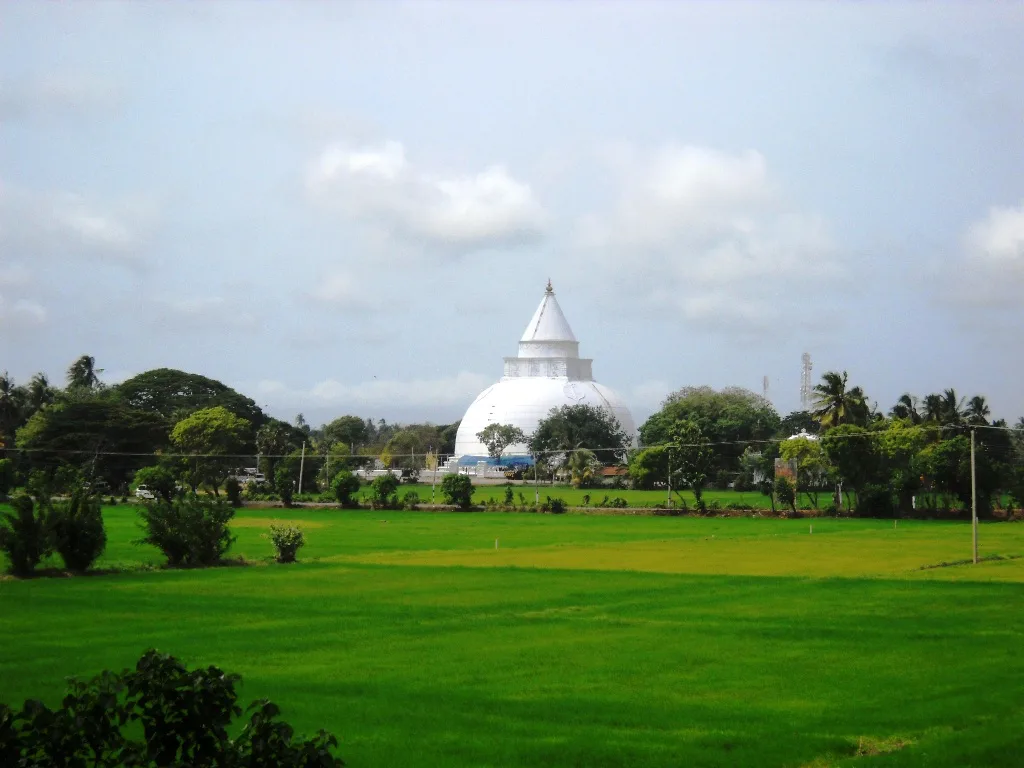
The South, Sri Lanka
Tissamaharama
A 3rd-century BCE capital where a princess who sacrificed herself at sea washed ashore, married a king, and raised the son who would one day unify Sri Lanka.
Long before it became known as a convenient overnight stop for Yala safaris, Tissamaharama, then called Mahagama, was the capital of an entire kingdom, the seat of Ruhuna, and the childhood home of one of Sri Lankan history’s most celebrated figures.
Quick Facts
| Location | Hambantota District, Southern Province |
| Ancient name | Mahagama |
| Founded | 3rd century BCE, by King Mahanaga |
| Historical role | Capital of the Ruhuna Kingdom, roughly 3rd century BCE to 11th century CE |
| Key monuments | Tissamaharama Dagoba, Yatala Wehera, Sandagiri Wehera, Tissa Wewa |
| Modern role | Gateway town for Yala and Bundala National Parks |
Commonly searched as: Tissamaharama Sri Lanka · Ruhuna Kingdom capital · Tissamaharama Dagoba · Yala safari gateway · things to do in Tissamaharama
The Capital of a Kingdom That Never Fell
Tissamaharama, known in antiquity as Mahagama, was founded in the 3rd century BCE by King Mahanaga, brother of King Devanampiya Tissa of Anuradhapura, who fled south after an assassination attempt by his sister-in-law and established a new seat of power in the region known as Ruhuna. That kingdom went on to hold a unique place in Sri Lankan history: while the northern Rajarata kingdom, centred on Anuradhapura, repeatedly fell to foreign invasion, Ruhuna remained a stronghold of Sinhalese sovereignty, a base from which southern kings could regroup and eventually reclaim the north.
The most celebrated of those kings was Dutugemunu, whose parents’ story is one of the most cherished legends in Sri Lankan history. His mother, Viharamahadevi, is said to have set sail alone on the ocean as a sacrifice to appease the gods and save her father’s kingdom from a natural disaster, drifting ashore near Mahagama, where King Kavantissa found and married her. Their son, Dutugemunu, grew up in this city preparing for the campaign that would eventually see him defeat the Chola king Elara and unify Sri Lanka under Sinhalese rule, a foundational episode still recounted throughout the country today, and the reason a major Colombo park bears his mother’s name.
Monuments From a Golden Age
King Kavantissa is credited with building the massive white dagoba and monastic centre on the banks of Tissa Wewa, the reservoir lake that still dominates the town, along with the nearby Sandagiri Wehera. Even older is the Yatala Wehera, built roughly 2,300 years ago by Yatala Tissa, the very brother who fled the assassination plot that founded the city, who is said to have vowed to build the temple in gratitude for the refuge Mahagama provided while his wife gave birth.
Archaeological excavations at nearby Akurugoda, about a kilometre from the main dagoba, have revealed that ancient Mahagama’s citadel was laid out with a street system oriented to the four cardinal directions, complete with stone-paved pavements, a scale of urban planning second in ancient Sri Lanka only to Anuradhapura itself, underscoring just how significant this southern capital once was.
A Living Site, Not Just Ruins
Unlike some ancient capitals reduced entirely to archaeological remains, the Tissamaharama Raja Maha Vihara functions today as an active temple, drawing devotees who worship here much as pilgrims have for over two thousand years. A small museum behind the main dagoba displays artefacts recovered from the site, offering additional context for the extensive ruins scattered across the surrounding area.
A Modern Safari Gateway
Today, most visitors know Tissamaharama primarily as the launching point for Yala National Park safaris, with plentiful jeep operators, guides and hotels catering to travellers heading into the park. Tissa Wewa itself has become a wildlife draw of its own, its waters home to large flocks of openbill storks and egrets, water buffalo, and views extending toward the southern highlands in the distance.
Visiting Tips
- Allow time to properly explore the dagobas and museum, not just pass through en route to a safari.
- Visit Tissa Wewa at dawn or dusk for the best light and birdlife activity.
- Try locally sold buffalo curd, a well-known regional specialty, from roadside stalls.
- Combine with nearby Kataragama, a short drive away, for a fuller sense of the region’s layered religious history.
Where It Sits on the Map
Tissamaharama, Hambantota District, Southern Province Open in Google Maps ↗
Frequently Asked Questions
Why was Tissamaharama historically significant?
As Mahagama, it served as the capital of the ancient Ruhuna Kingdom, a stronghold of Sinhalese sovereignty from the 3rd century BCE to the 11th century CE, and the childhood home of King Dutugemunu.
Who is Viharamahadevi and how does she connect to Tissamaharama?
According to legend, Viharamahadevi sacrificed herself at sea to save her father’s kingdom, washed ashore near Mahagama, and married King Kavantissa there; their son Dutugemunu later unified Sri Lanka.
What are the main ancient monuments in Tissamaharama?
The Tissamaharama Dagoba, Yatala Wehera (about 2,300 years old), Sandagiri Wehera, and the Akurugoda citadel excavation site.
Why do most visitors go to Tissamaharama today?
It functions as the main gateway town for safaris into Yala National Park, alongside its ancient temples and Tissa Wewa lake.
← Sri Lanka: The Complete Guide — see all 258 places by region
Related News
A guide to Southern Sri Lanka, from Galle to Kataragama: beaches, wildlife safaris, colonial forts, and travel tips.

A complete guide to Galle Fort: history from Ptolemy to the Dutch, walking the ramparts, top sights, and visiting tips.
A guide to the Dutch Reformed Church in Galle Fort: the story behind its 1755 completion, the tombstone floor, visiting tips and map.













