

Dsigngo is a Graphic Design and Digital Marketing Company.
Write what you are looking for and press enter to begin your search!

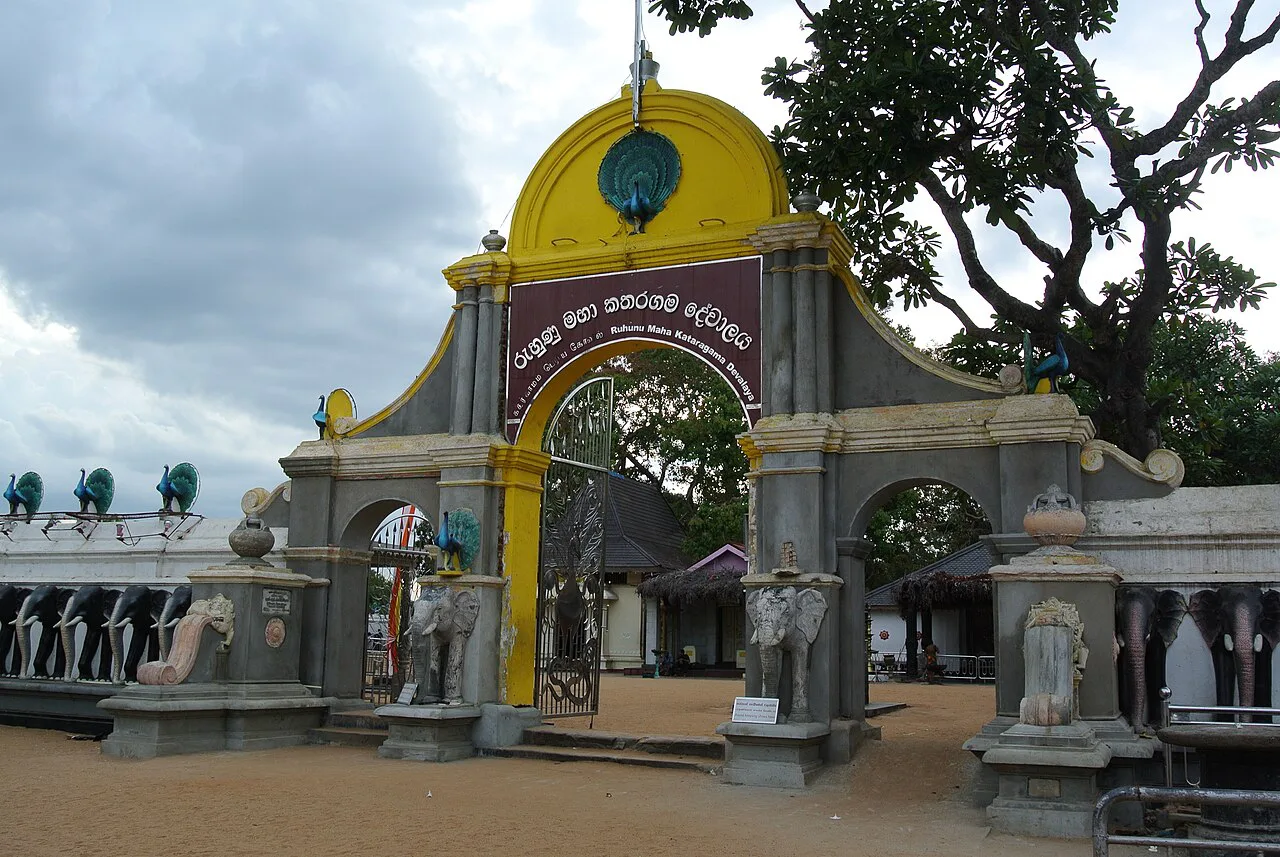
The South, Sri Lanka
Kataragama
A pilgrimage town where Buddhists, Hindus, Muslims and the indigenous Vedda people all worship the same deity under different names, home to fire-walking rituals and a pilgrimage tradition over two thousand years old.
Few places anywhere manage to be simultaneously important to four distinct religious traditions without conflict. Kataragama pulls it off, a pilgrimage town where the same deity is worshipped by Buddhists as a guardian spirit, by Hindus as the war god Murugan, by Muslims through the figure of Al-Khidr, and by the indigenous Vedda people as Kande Yaka, all sharing the same sacred ground.
Quick Facts
| Location | Hambantota District, about 235 km southeast of Colombo |
| Sacred to | Buddhists, Hindus, Muslims, and the indigenous Vedda community |
| Buddhist significance | One of the Solosmasthana, 16 sites said to have been visited by the Buddha |
| Hindu significance | A major shrine to Murugan (Skanda), the war god |
| Key sites | Maha Devale, Kiri Vehera, Sri Thevani Amman Temple, Khizr Mosque |
| Main festival | Esala Festival / Kataragama Perahera, July or August |
Commonly searched as: Kataragama Sri Lanka · Kataragama festival · Kataragama fire walking · multi-faith pilgrimage Sri Lanka · things to do in the South Sri Lanka
A Village That Became a Sacred Centre
Kataragama’s religious significance traces back to the pre-Christian era, with legend linking the settlement’s origins to Prince Vijaya’s arrival in Sri Lanka in 543 BCE, when some of his followers are said to have established a village called Kajara-Gama, believed to be the ancestor of modern Kataragama. The site’s central shrine, the Maha Devale, is traditionally credited to King Dutugemunu (161 to 131 BCE), built following his victory over the Tamil invader Elara, an event central to the Mahavamsa, Sri Lanka’s ancient chronicle.
Over subsequent centuries, particularly during periods of foreign occupation, the shrine went through cycles of decay and restoration. The 19th-century British colonial official and writer John Davy, in his 1821 account of the island’s interior, described Kataragama as a renowned pilgrimage destination that drew devotees not just from across Sri Lanka but from parts of India as well, evidence that its cross-border religious pull long predates modern tourism.
One Deity, Many Names
What makes Kataragama genuinely unusual is that its central deity is worshipped under different names and forms by each faith community without apparent conflict. Hindus know the deity as Skanda-Murugan, or Subrahmanya, typically depicted with six faces and twelve hands. Sinhalese Buddhists revere Kataragama Deviyo as a guardian deity who assists devotees in need, framed within Buddhist cosmology rather than as a separate Hindu god. Muslims associate the site with Al-Khidr (referred to locally as Khizr), a mystical figure venerated as a saint in Islamic tradition, worshipped at the town’s Khizr Mosque. The indigenous Vedda people, meanwhile, know the same presence as Kande Yaka, a guardian spirit of the surrounding hills.
The Sacred Precinct
The town’s religious geography centres on the Maha Devale, flanked by the Sri Thevani Amman Temple (dedicated to one of the deity’s consorts) and, a short walk away, the ancient Buddhist stupa Kiri Vehera. Pilgrims traditionally purify themselves by bathing in the Manik Ganga, the sacred river running past the precinct, before entering the temples to make offerings of fruit, flowers, coconuts and incense. Three daily pujas are held at the Maha Devale, at dawn, late morning, and dusk, each drawing devoted crowds.
The Esala Festival
Kataragama’s most dramatic annual event is its Esala Festival, held in July or August, when the town transforms from a quiet pilgrimage centre into a site of intense devotional activity. Pilgrims undertake the traditional Pada Yatra, a walking pilgrimage covering over 500 kilometres from as far away as Jaffna in the island’s north, arriving on foot after weeks of travel. The festival features elaborate processions, cultural dancing, and fire-walking, a ritual in which devotees walk across burning coals, believed to cleanse illness and demonstrate spiritual devotion.
Visiting Tips
- Dress modestly when visiting any of the temples, regardless of your own faith background.
- Visiting during the Esala Festival offers a far more vivid experience, but expect very large crowds and book accommodation well in advance.
- Combine with a visit to nearby Tissamaharama and, for wildlife enthusiasts, Yala National Park, both a short distance away.
- Approach the site’s multi-faith character with genuine respect; Kataragama’s harmony between traditions is part of what makes it significant.
Where It Sits on the Map
Kataragama, Hambantota District, Sri Lanka Open in Google Maps ↗
Frequently Asked Questions
Why is Kataragama sacred to multiple religions?
The town’s central deity is worshipped under different names and forms by Buddhists, Hindus, Muslims and the indigenous Vedda people alike, a rare example of shared, harmonious multi-faith pilgrimage in Sri Lanka.
What is the Esala Festival?
Kataragama’s major annual festival, held in July or August, featuring processions, cultural performances, and fire-walking rituals, drawing pilgrims who walk hundreds of kilometres to attend.
What are the key religious sites in Kataragama?
The Maha Devale (main shrine), Kiri Vehera (ancient Buddhist stupa), the Sri Thevani Amman Temple, and the Khizr Mosque.
How old is Kataragama as a pilgrimage site?
Its origins trace to the pre-Christian era, with the main shrine traditionally credited to King Dutugemunu in the 2nd century BCE.
← Sri Lanka: The Complete Guide — see all 258 places by region
Related News
A guide to Southern Sri Lanka, from Galle to Kataragama: beaches, wildlife safaris, colonial forts, and travel tips.

A complete guide to Galle Fort: history from Ptolemy to the Dutch, walking the ramparts, top sights, and visiting tips.
A guide to the Dutch Reformed Church in Galle Fort: the story behind its 1755 completion, the tombstone floor, visiting tips and map.













