

Dsigngo is a Graphic Design and Digital Marketing Company.
Write what you are looking for and press enter to begin your search!

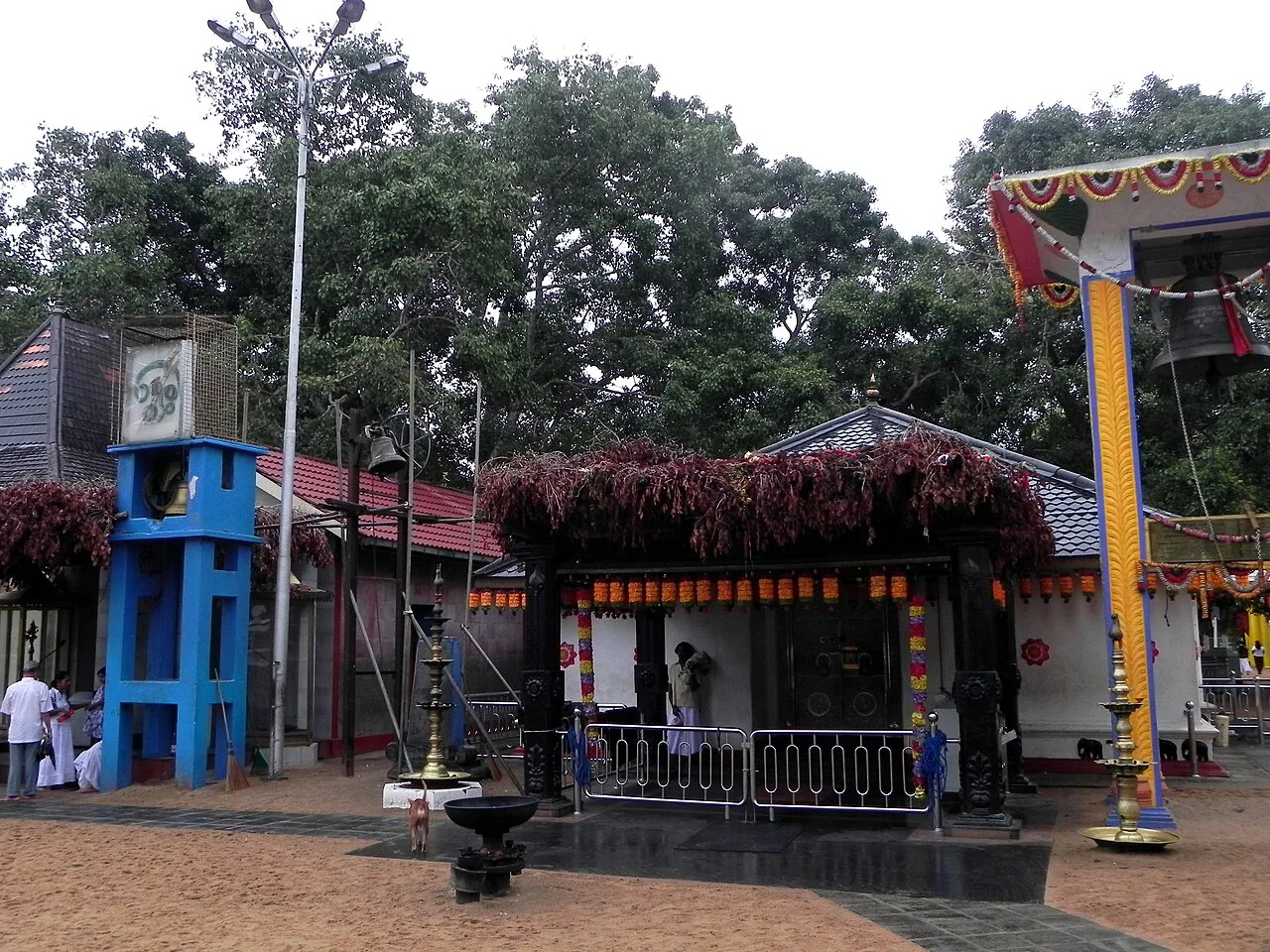
Kataragama, The South
Maha Devale
The spiritual heart of Kataragama, a shrine credited to King Dutugemunu over two thousand years ago, dedicated to a deity worshipped simultaneously as Skanda, Kataragama Deviyo, and beyond.
Every visitor to Kataragama passes through the same golden gate before reaching the Maha Devale, and that first glimpse sets the tone for everything that follows: a shrine that has functioned continuously as this pilgrimage town’s spiritual centre for over two thousand years.
Quick Facts
| Location | Central Kataragama, Hambantota District |
| Traditional founder | King Dutugemunu, 2nd century BCE |
| Dedicated to | Kataragama Deviyo / Skanda-Murugan |
| Adjacent shrine | Sri Thevani Amman Temple, dedicated to a consort of the deity |
| Daily rituals | Three pujas: dawn (~5 am), late morning (~11 am), dusk (~7 pm) |
| Sacred river | Manik Ganga, used for ritual bathing before entering the shrine |
Commonly searched as: Maha Devale Kataragama · Kataragama main shrine · Kataragama pujas · Sri Lanka multi-faith temple · things to do in Kataragama
A Shrine Rebuilt Across Centuries
Tradition credits the Maha Devale’s founding to King Dutugemunu, who reigned in the 2nd century BCE and is said to have built the original shrine after his celebrated victory over the Tamil invader Elara, an event recorded in the Mahavamsa as one of the defining moments in early Sri Lankan history. Over the following centuries, particularly during periods of foreign occupation and neglect, the shrine deteriorated and was rebuilt multiple times, its continuous religious use across more than two thousand years making it one of the longest continuously venerated sacred sites on the island.
British colonial writer John Davy documented the shrine’s continuing prestige in his 1821 account of Ceylon’s interior, describing Kataragama as a pilgrimage destination whose reputation extended well beyond the island’s own shores and into parts of India, a detail that underscores just how established the site’s pull already was two centuries ago.
What Happens at the Shrine
The Maha Devale operates on a rhythm of three daily pujas, held at dawn around 5 am, late morning around 11 am, and dusk around 7 pm, each drawing devotees who gather to make offerings of fruit, flowers, coconuts and incense. Before entering, most pilgrims first bathe in the Manik Ganga, the sacred river flowing past the temple precinct, a ritual act of purification that precedes formal worship. Immediately beside the Maha Devale stands the Sri Thevani Amman Temple, dedicated to one of the deity’s consorts, forming part of the same interconnected sacred complex.
A Shrine for Every Faith
What sets the Maha Devale apart from most temples is that its congregation isn’t limited to one religious tradition. Hindu devotees come to worship Skanda-Murugan, the war god with six faces and twelve hands; Sinhalese Buddhists venerate the same presence as Kataragama Deviyo, a guardian deity operating within Buddhist cosmology; and even Muslim devotees sometimes visit out of respect for the site’s broader sacred reputation. Watching the different forms of devotion unfold side by side, often within the same hour, is part of what makes a visit here memorable regardless of the visitor’s own beliefs.
Visiting Tips
- Time your visit around one of the three daily pujas for the fullest sense of the shrine’s living devotional life.
- Dress modestly and be prepared to remove footwear before entering the temple grounds.
- Combine with a short walk to nearby Kiri Vehera, the ancient Buddhist stupa just a few hundred metres away.
- Visiting during the Esala Festival period (July/August) offers a dramatically more intense experience, though with significantly larger crowds.
A Shrine That Reflects the Whole Town’s Character
In many ways, the Maha Devale is a microcosm of Kataragama itself: a single sacred site that means genuinely different things to different communities, without any one interpretation displacing the others. That’s a rarer arrangement than it might sound. Many sites with overlapping religious significance around the world have, at various points in history, become contested ground between the traditions that claim them. Kataragama’s Maha Devale instead functions as shared ground, its three daily pujas drawing devotees across faith lines without the kind of friction that might be expected elsewhere. For visitors interested in how religious pluralism can work in practice rather than just in theory, the shrine offers a genuinely instructive example.
Where It Sits on the Map
Maha Devale, Kataragama, Hambantota District Open in Google Maps ↗
Frequently Asked Questions
Who is traditionally credited with founding the Maha Devale?
King Dutugemunu, in the 2nd century BCE, following his victory over the Tamil invader Elara.
What deity is worshipped at the Maha Devale?
A deity worshipped under multiple names and forms: Skanda-Murugan by Hindus, and Kataragama Deviyo by Sinhalese Buddhists.
How often are rituals held at the shrine?
Three daily pujas take place, at dawn, late morning, and dusk.
Do pilgrims perform any rituals before entering?
Yes, most bathe in the nearby Manik Ganga river as an act of purification before entering the temple grounds.
← Sri Lanka: The Complete Guide — see all 258 places by region
Related News
A guide to Southern Sri Lanka, from Galle to Kataragama: beaches, wildlife safaris, colonial forts, and travel tips.

A complete guide to Galle Fort: history from Ptolemy to the Dutch, walking the ramparts, top sights, and visiting tips.
A guide to the Dutch Reformed Church in Galle Fort: the story behind its 1755 completion, the tombstone floor, visiting tips and map.













