

Dsigngo is a Graphic Design and Digital Marketing Company.
Write what you are looking for and press enter to begin your search!

Key takeaways
- CTC means cut, tear, curl: machines turn leaf into small, round granules.
- Ceylon's CTC grades are BPS, BP1, BPL, PF1 and PD.
- BP1 matches a high-grown BOP in size; PF1 matches a grainy BOPF.
- CTC tea brews fast, strong and coloury, ideal for tea bags and chai.
- Many blends combine orthodox brightness with CTC strength.
Introduction
Not all black tea looks like twisted leaves. Pour a spoonful of CTC tea into your hand and you will see small, round, dark granules, a little like coffee grounds or tiny beads. CTC stands for cut, tear, curl, the three actions of the machines that make it. CTC tea brews fast, strong and coloury, and it fills a huge share of the world’s tea bags.
Sri Lanka is best known for orthodox tea, but it also produces CTC tea, mostly in the low-grown regions. The Tea Exporters Association Sri Lanka lists five CTC grades: BPS, BP1, BPL, PF1 and PD. This article explains how CTC tea is made, what each grade means, how CTC compares with orthodox tea, and where CTC grades are used.
This is the fourth article in the Ceylon Tea Grade series from Hakgala, the Ceylon tea brand of Raiden (Pvt) Ltd, written with Dsigngo Marketing. Grade Articles 2 and 3 covered the orthodox black tea grades.
What is CTC tea?
The CTC method was developed in the 1930s in Assam, India, as a faster way to produce strong tea for the growing tea bag and blending market. It has since spread to Kenya, India, Bangladesh, Indonesia, Sri Lanka and other producing countries. Today, a large share of the world’s black tea is made by the CTC method.
How CTC tea is made
Orthodox and CTC compared
Orthodox
Pluck → Wither → Roll and twist → Oxidise → Fire → Sift into leaf grades
CTC
Pluck → Wither lightly → Cut, tear, curl → Oxidise evenly → Dry into granules → Sift into CTC grades
- Plucking: fresh leaf is plucked as for orthodox tea.
- Withering: the leaf is withered, usually more lightly than for orthodox tea.
- Cut, tear, curl: the leaf passes between pairs of steel rollers with sharp teeth, rotating at different speeds. The rollers cut, tear and curl the leaf into small particles. The leaf may pass through several sets of rollers.
- Oxidation: the small particles oxidise quickly and evenly, often on a continuous conveyor.
- Drying: hot air dries the particles into firm, round granules.
- Sorting: the granules are sifted into grades by size.
Because the leaf is broken into small pieces before oxidation, every particle oxidises evenly and quickly. The result is a tea that releases its colour and strength almost instantly in hot water.
Inside a CTC machine
A CTC machine looks simple, but its design has a big effect on the tea. Each unit has two stainless steel rollers, set very close together. Their surfaces are cut with fine, sharp grooves or teeth. One roller turns much faster than the other, so leaf passing between them is cut, torn and squeezed at the same time. The torn leaf then curls into small pellets as it leaves the rollers.
Most factories run the leaf through three or more CTC units in a row, so it is cut several times. The number of passes, the gap between the rollers and the sharpness of the teeth all decide the final size of the granules. Worn rollers produce flaky, uneven particles, so factories regrind or replace them regularly. Before the leaf reaches the CTC units, many factories pass it through a “rotorvane”, a machine that pre-cuts and conditions the withered leaf so that it feeds evenly into the rollers.
CTC grades and tea bag performance
Tea bag packers choose CTC grades by how they behave in the bag:
- Infusion speed: PF1 and PD release colour within seconds, which consumers see as strength.
- Particle size and filter paper: particles must be larger than the pores of the filter paper, or fine powder will pass through into the cup. This is one reason clean, even grades are valued.
- Fill weight: dense granules fill bags accurately, so each bag contains the same weight of tea.
- Flow in machines: round granules flow smoothly through high-speed tea bag machines, which improves efficiency.
These qualities explain why CTC grades are found in so many tea bags worldwide.
CTC and orthodox compared
| Feature | Orthodox | CTC |
|---|---|---|
| Rolling | Leaf is twisted and rolled | Leaf is cut, torn and curled by toothed rollers |
| Appearance | Twisted, wiry or broken leaf | Small, round, even granules |
| Brewing | 3–5 minutes | 2–3 minutes |
| Cup | Bright, brisk, aromatic, with regional character | Strong, coloury, robust, more uniform |
| With milk | Bright golden-brown | Deep, rich colour |
| Main uses | Loose tea, speciality tea, premium tea bags | Tea bags, milk tea, catering, chai |
Orthodox tea expresses more of the region and season; CTC tea expresses more strength and consistency. Many blends combine both: orthodox for aroma and brightness, CTC for colour and strength.
The five Ceylon CTC grades
Broken Pekoe Special (BPS)
BPS is made of even, curled pieces. It is the largest of the CTC grades in the nomenclature: bold, curled granules that brew a full, strong cup.
Best for: strong loose tea, milk tea and blends that need body.
Broken Pekoe One (BP1)
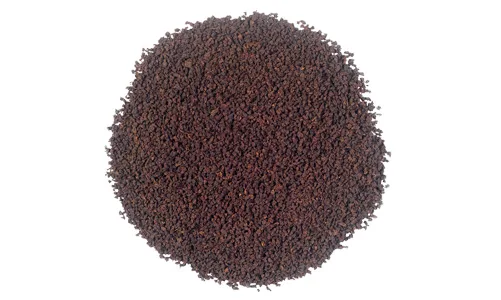
BP1 is a little smaller than BPS. The nomenclature describes it as a larger-size leaf with bold, round particles, giving a full-bodied, bright tea. In size, it is equivalent to a high-grown BOP, but granular rather than leafy.
In the cup: bright, full-bodied and strong.
Best for: loose tea, strong blends and catering.
Broken Pekoe Leaf (BPL)
BPL consists of even leaf pieces: a CTC grade with a more leafy, flat appearance than the round BP1 granules.
Best for: blends and loose tea where a slightly leafier CTC is wanted.
Pekoe Fannings One (PF1)
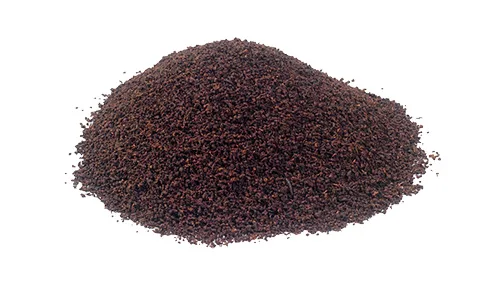
PF1 is similar to BP1 but in smaller pieces. It is described as a smaller leaf size with a strong-tasting tea, equivalent in size to a grainy high-grown BOPF, but granular.
PF1 is one of the most important grades for tea bags, because its small, even granules fill bags neatly and brew strong in two to three minutes.
In the cup: strong, coloury and quick.
Best for: tea bags, catering and strong milk tea.
Pekoe Dust (PD)
PD is the smallest of the CTC particles, smaller than PF1 leaves. It brews almost instantly and gives a very strong, dark cup.
Compared with the orthodox Dust 1 (Small-Leaf Ceylon Black Tea Grades: BOP, BOPF, FBOP, the Flowery Fannings and Dust), PD is grainier; the nomenclature describes Dust 1 as less grainy than PD and clean.
Best for: tea bags and very strong, quick tea.
Ceylon CTC grades, largest to smallest
- 1BPSEven, curled pieces
- 2BP1Bold, round; size of high-grown BOP
- 3BPLEven leaf pieces
- 4PF1Small; size of grainy high-grown BOPF
- 5PDThe smallest CTC particles
CTC grades at a glance
| Grade | Full name | Appearance | Orthodox size equivalent | Typical use |
|---|---|---|---|---|
| BPS | Broken Pekoe Special | Even, curled pieces; the largest | Larger than BOP | Strong loose tea, blends |
| BP1 | Broken Pekoe One | Bold, round granules | High-grown BOP, but granular | Loose tea, catering |
| BPL | Broken Pekoe Leaf | Even leaf pieces | Similar to BP1 | Blends |
| PF1 | Pekoe Fannings One | Small granules | Grainy high-grown BOPF | Tea bags |
| PD | Pekoe Dust | The smallest granules | Dust, but grainier than Dust 1 | Tea bags |
Why buyers choose CTC
- Strength and colour: CTC teas give a deep colour and robust flavour, especially with milk.
- Speed: they brew in two to three minutes, ideal for tea bags and busy kitchens.
- Consistency: the even granules make it easier to keep the same taste across batches.
- Efficiency: compact granules mean more cups per kilogram and denser packing.
- Chai and milk tea: CTC is the classic base for spiced milk tea, because its strength stands up to boiling with milk and spices.
Why some buyers prefer orthodox
- Aroma and brightness: orthodox teas show more fragrance and regional character.
- Appearance: whole and broken leaves look more attractive in loose tea and premium tea bags.
- Ceylon identity: orthodox tea is what Ceylon is famous for, and many buyers want that traditional style.
For many brands, the best answer is a blend. A tea bag blend might combine orthodox BOPF for brightness with CTC PF1 for colour and strength.
CTC in the global tea market
Around the world, CTC is the dominant style of black tea for everyday drinking. India produces most of its black tea by the CTC method, and Kenya, one of the world’s largest tea exporters, makes almost all of its tea as CTC. Large tea bag brands rely on CTC teas from these and other origins because of their strength, colour and consistency.
In this market, Ceylon tea stands out as the leading origin of orthodox black tea. That is part of Ceylon’s appeal: buyers come to Sri Lanka for the bright, brisk, aromatic orthodox teas that CTC origins cannot provide. Ceylon CTC teas give buyers an extra option within the same origin.
Blending CTC and orthodox: a practical guide
Blending lets a brand combine the strengths of both styles. The table shows how different blends behave. The percentages are a starting point only; every blend should be tested by tasting.
| Blend goal | Suggested approach | Result |
|---|---|---|
| Bright everyday tea bag | Mostly orthodox BOPF and Dust 1, with a small share of CTC PF1 | Ceylon brightness with extra colour |
| Strong milk tea | Mostly CTC PF1 or BP1, with some orthodox BOPF | Deep colour and strength, with some aroma |
| Chai and spiced tea | CTC BP1 or PF1 as the base | Strength that survives boiling with milk and spices |
| Premium tea bag | Orthodox BOPF and BOP only | Classic Ceylon character |
| Catering urns | CTC PF1 and PD with orthodox Dust 1 | Fast, strong, consistent |
When blending, buyers also consider particle size. Mixing very different sizes can cause the smaller particles to settle at the bottom of the pack or tea bag hopper, which leads to uneven tea bags. Blenders therefore match particle sizes as closely as possible, for example orthodox BOPF with CTC PF1, or orthodox BOP with CTC BP1.
Storing CTC tea
CTC granules are firm and compact, but like all tea they absorb moisture and odours. Store CTC tea in airtight containers in a cool, dry place, away from spices, coffee and cleaning products. In catering, keep bulk bags sealed between uses and avoid scooping with wet utensils. Well-stored CTC tea keeps its strength and colour until its best-before date.
CTC tea in Sri Lanka
Sri Lanka’s CTC production is small compared with its orthodox output. It is concentrated in the low-grown regions, where some factories have installed CTC lines to meet demand from tea bag packers and from markets that prefer strong, coloury tea. Ceylon CTC teas are known for combining the strength of CTC with some of the brightness of Ceylon leaf.
CTC and import rules
Sri Lanka controls tea imports carefully to protect the Ceylon name. Over the years, the rules have allowed limited imports of non-orthodox teas, such as CTC, for blending and re-export, while restricting orthodox imports. Packs that contain teas from other origins must say so, for example “A blend of Ceylon and other origin teas packed in Sri Lanka”, and cannot carry the Sri Lanka Tea Board’s Lion logo. These rules change from time to time; our Ceylon Tea Import and Export guide explains more. Hakgala teas are 100% pure Ceylon tea from Raiden’s own plantations.
How to brew CTC tea
Plain or with milk
- Use about 2 grams of CTC tea (a level teaspoon) or one tea bag per cup.
- Pour on freshly boiled water.
- Brew for 2–3 minutes: CTC releases colour very quickly.
- Add milk and sugar to taste.
Milk tea and chai
- Bring equal parts water and milk to the boil, with spices such as crushed cardamom, ginger, cinnamon and cloves if you like.
- Add 1–2 teaspoons of CTC tea per cup.
- Simmer for 2–3 minutes, add sugar to taste, strain and serve.
How to judge CTC tea
| What to check | What good looks like |
|---|---|
| Granules | Even, round, firm and black or blackish-brown |
| Cleanliness | No fibre, stalk or excessive powder |
| Infusion | Bright, coppery, even colour |
| Liquor | Bright and strong, not dull or muddy |
| With milk | A rich, bright colour, not grey |
| Taste | Strong and brisk, without harsh bitterness |
Hakgala and CTC
Hakgala’s own tea bags use orthodox BOPF and Dust 1, which give the bright character Ceylon is known for. For importers and private label clients who want extra colour and strength, for example for milk tea, chai or catering, Raiden (Pvt) Ltd can advise on Ceylon CTC grades and blends, and Dsigngo can design tea bag packs and catering formats.
An example in practice
The following example is illustrative and does not describe a real client.
A café chain wants a house chai that can be made quickly in large batches and still taste rich after milk and spices are added. Its current orthodox tea gives a pale, weak chai.
Raiden suggests a blend built around a Ceylon CTC grade, with a small amount of orthodox BOPF for brightness. In a side-by-side test, the CTC-based blend gives a deep colour and strong flavour after five minutes of simmering with milk, cardamom and ginger. The café adopts it, and Dsigngo designs a catering pack and recipe card for its baristas.
Frequently asked questions
What does CTC stand for?
Cut, tear, curl: the three actions of the machines that turn withered leaf into small, round granules.
Is CTC tea lower quality than orthodox tea?
No. It is a different style. CTC tea is stronger and more coloury; orthodox tea is brighter and more aromatic. Quality depends on the leaf and the manufacture.
Which CTC grade is best for tea bags?
PF1 and PD are the most common CTC tea bag grades, because their small granules brew quickly.
What is the difference between BP1 and PF1?
BP1 has larger, bold granules, similar in size to a high-grown BOP. PF1 has smaller granules, similar in size to a BOPF, and gives a stronger cup.
Does Sri Lanka make CTC tea?
Yes, in smaller quantities than orthodox tea, mainly in the low-grown regions.
Can CTC tea be used for iced tea?
It can, but orthodox Ceylon tea usually makes clearer iced tea. Strong CTC teas can turn cloudy when chilled, an effect known as “creaming down”. For iced tea, many brands prefer orthodox Ceylon grades or a blend with only a small share of CTC.
Does Hakgala use CTC tea?
Hakgala’s own range uses orthodox Ceylon grades, including BOPF and Dust 1 in its tea bags. Raiden (Pvt) Ltd can advise importers and private label clients on Ceylon CTC grades when a stronger, more coloury cup is needed.
Is CTC good for chai?
Yes. CTC is the classic base for chai and milk tea, because its strength stands up to milk, spices and boiling.
Conclusion
CTC tea is made by cutting, tearing and curling the leaf into small granules that oxidise evenly and brew fast. Ceylon’s five CTC grades run from the bold, curled BPS through BP1 and BPL to the small PF1 and the finest, Pekoe Dust. CTC grades are prized for strength, colour and consistency, and they often work best blended with orthodox Ceylon tea.
Hakgala, the Ceylon tea brand of Raiden (Pvt) Ltd, focuses on orthodox Ceylon tea, while Raiden and Dsigngo Marketing can help importers and private label clients choose and present CTC grades. Continue with Ceylon White Tea Grades: Silver Tips and Golden Tips Explained to discover Ceylon white tea grades.
Need a strong tea for tea bags, chai or catering? Contact Raiden (Pvt) Ltd and Dsigngo Marketing for samples and specifications.
Ask about CTC and tea bag grades
Related reading
- Ceylon Tea Grade Nomenclature: The Complete Guide to Every Tea Grade
- Small-Leaf Ceylon Black Tea Grades: BOP, BOPF, FBOP, the Flowery Fannings and Dust
- Leafy Ceylon Black Tea Grades: OP, OP1, OPA, BOP1, Pekoe and Flowery Pekoe
- Ceylon White Tea Grades: Silver Tips and Golden Tips Explained
- Ceylon Tea Off Grades Explained: BOP1A, Broken Mix, Fannings and Broken Pekoe
- Ceylon Green Tea Grades: Chunmee, Gunpowder, Young Hyson, Sencha and More
- Ceylon Black Tea: Regions, Grades, Flavour and How to Brew
- Arabica Coffee: Flavour, Growing Conditions and Why It Leads the World
- English Breakfast Tea: History, Flavour and the Hakgala Ceylon Blend
- Ceylon Tea Import and Export: How Raiden (Pvt) Ltd and Dsigngo Bring Pure Ceylon Tea to the World
Sources
- Tea Exporters Association Sri Lanka, Tea Grade Nomenclature (text and grade photographs): https://teasrilanka.org/tea-grade
- Daily FT, "Tea trips on blending ban" (tea import and blending rules): https://ft.lk/top-story/Tea-trips-on-blending-ban/26-648399
- Sri Lanka Export Development Board, types of tea: https://www.srilankabusiness.com/faq/tea/buyer/what-are-types-of-tea.html
- Raiden (Pvt) Ltd company profile: https://www.raiden.lk
Related News

What is Ceylon oolong tea? How partial oxidation creates its floral, fruity flavour, how it is made in Sri Lanka, how to brew it gongfu...
How is jasmine tea made? The ancient art of scenting green tea with jasmine flowers, how to brew it without bitterness, and Hakgala's jasmine green...
A complete guide to Ceylon tea: regions, grades, the Colombo auction, export rules and import into the UAE and Gulf, and how Raiden (Pvt) Ltd...













