

Dsigngo is a Graphic Design and Digital Marketing Company.
Write what you are looking for and press enter to begin your search!

Key takeaways
- Sri Lanka exported about 257 million kg of tea in 2025, earning just over US$1.5bn.
- Ceylon tea comes from seven regions and is graded under the Tea Exporters Association's nomenclature.
- Exporters must register with the Sri Lanka Tea Board and obtain approval for each shipment.
- UAE imports need product registration, approved labels and certificates before shipping.
- Raiden (Pvt) Ltd and Dsigngo supply own-plantation tea, Hakgala, private label, documents and marketing.
Introduction
Few products carry the name of a country as proudly as Ceylon tea. For more than 150 years, tea from Sri Lanka has been sold to the world under the island’s old name, and it remains one of the most recognised origins in the global tea trade. In 2025, Sri Lanka produced about 264 million kilograms of tea and exported about 257 million kilograms, earning just over US$1.5 billion, according to Sri Lanka Tea Board figures reported in the national business press. Ceylon tea reaches well over a hundred countries, from Iraq, Russia and Türkiye to the United Arab Emirates, Libya, China and Chile.
Raiden (Pvt) Ltd and its creative and marketing arm, Dsigngo, are part of that trade. Raiden is the parent company of Dsigngo Group, based in Kelaniya, Sri Lanka, with operations in Sri Lanka and the United Arab Emirates. The group grows tea on its own plantations, owns the Hakgala Ceylon tea brand, and supports tea export from Sri Lanka and tea import into the UAE and the wider Gulf, together with the branding, packaging, documentation and marketing that international tea buyers need.
This article explains Ceylon tea from end to end. It covers what makes Ceylon tea special, the seven growing regions, how tea is made and graded, how the Colombo Tea Auction works, what exporters must do to ship tea from Sri Lanka, what importers in the UAE and Gulf need to know, which formats buyers can order, and how Raiden (Pvt) Ltd and Dsigngo work with importers, distributors, hotels, retailers and private label clients. It also introduces our seven-part Ceylon Tea Grade series, which explains every grade in the Tea Exporters Association Sri Lanka’s grade nomenclature, starting with Ceylon Tea Grade Nomenclature: The Complete Guide to Every Tea Grade.
What is Ceylon tea?
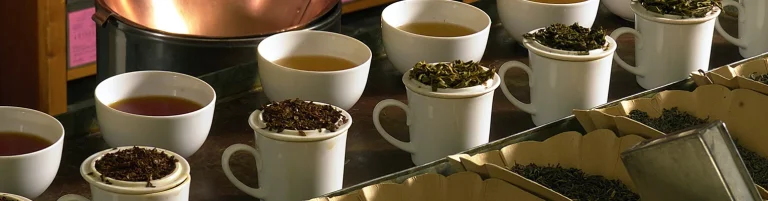
“Ceylon tea” means tea grown and manufactured in Sri Lanka. All true teas come from one plant, Camellia sinensis. What makes Ceylon tea distinctive is where and how it is grown: on the slopes of a tropical island, from sea level to more than 2,000 metres, under two monsoons, and made mostly by the orthodox method that preserves the structure of the leaf.
The result is a family of teas known for being bright, brisk and clean. Ceylon black teas brew a lively, golden-to-coppery liquor that takes milk well and stays clear when iced. Sri Lanka also produces green tea, white tea (silver tips and golden tips), oolong and a wide range of value-added teas, including tea bags, flavoured teas and instant tea.
A short history
Sri Lanka was a coffee island before it was a tea island. In the 1860s and 1870s, coffee leaf rust destroyed the plantations, and planters searched for a new crop. In 1867, James Taylor planted tea on the Loolecondera estate near Kandy, and within two decades tea had replaced coffee across the hill country. The first public tea auction in Colombo was held in 1883. By the twentieth century, Ceylon tea had become one of the world’s best-known tea origins, and it has kept its name even since the country became Sri Lanka in 1972.
The Ceylon tea name and the Lion logo
The words “Ceylon tea” are protected as a mark of origin. The Sri Lanka Tea Board also owns the Lion logo, which may be printed only on consumer packs of 100% pure Ceylon tea that are packed in Sri Lanka, and only with the Board’s approval. Overseas packers cannot use it, even if the tea inside is pure Ceylon. For importers, a Lion logo pack is the clearest proof of genuine Ceylon tea packed at origin.
The seven tea-growing regions
The Sri Lanka Tea Board recognises seven agro-climatic regions: Nuwara Eliya, Uda Pussellawa, Dimbula, Uva, Kandy, Sabaragamuwa and Ruhuna. The industry also groups teas by elevation.
| Elevation class | Approximate altitude | Regions | Typical character |
|---|---|---|---|
| High-grown | Above about 1,200m | Nuwara Eliya, Uda Pussellawa, Dimbula, higher Uva | Light, bright, fragrant, delicate; golden liquor |
| Mid-grown | About 600–1,200m | Kandy, lower Uva | Full-bodied, strong, coppery |
| Low-grown | Below about 600m | Sabaragamuwa, Ruhuna | Rich, sweet, dark liquor, large black leaf; many tippy grades |
Importers often choose by elevation as much as by grade. High-grown teas suit premium black tea and iced tea. Mid-grown teas suit everyday strong tea. Low-grown teas, which are especially popular in the Middle East, give a dark, sweet, full cup and include the “flowery” tippy grades described in Small-Leaf Ceylon Black Tea Grades: BOP, BOPF, FBOP, the Flowery Fannings and Dust.
How tea is made: orthodox and CTC
Most Ceylon tea is made by the orthodox method:
- Plucking: usually two leaves and a bud, by hand.
- Withering: the leaf softens and loses moisture in troughs of moving air.
- Rolling: the leaf is twisted to break its cells and release its juices.
- Oxidation: the rolled leaf turns coppery in cool, humid air.
- Firing: hot air dries the leaf and stops oxidation.
- Sifting and grading: sieves separate the tea into grades by particle size and appearance.
Some factories also make CTC tea (cut, tear, curl), where machines cut the leaf into small, round, granular particles that brew quickly and strongly. CTC tea is popular for tea bags and for markets that like a strong, coloury cup. CTC Tea Grades Explained: BPS, BP1, BPL, PF1 and PD in Ceylon Tea explains the CTC grades.
Green tea is heated soon after plucking to stop oxidation, then rolled and dried. White tea is made from buds that are withered and dried with almost no processing. Grade Articles 5 and 7 cover white and green tea grades.
From Raiden's plantations to an overseas buyer
- 1Own plantationsTea grown and plucked
- 2FactoryMade and graded
- 3Tasting and QCChecked against the specification
- 4PackingBulk, packets, bags or private label
- 5Tea Board approvalExport documents prepared
- 6ShippingFrom the Port of Colombo
- 7Import clearanceRegistration, labels, customs
- 8Market launchDistribution and Dsigngo marketing
Understanding Ceylon tea grades
Every batch of tea leaving a factory is sifted into grades. A grade describes the size and appearance of the leaf, not its quality. The Tea Exporters Association Sri Lanka (TEA) publishes a standard grade nomenclature that the trade uses in catalogues, contracts and shipping documents. It is organised into five families:
| Family | Example grades | What they are |
|---|---|---|
| Orthodox black tea: main grades | BOP, BOPF, OP, OP1, OPA, FBOP, Pekoe, Dust 1 | Whole-leaf, broken-leaf, fannings and dust grades made by the orthodox method |
| CTC teas | BPS, BP1, BPL, PF1, PD | Granular teas made by cut, tear and curl machines |
| White tea | Silver Tips, Golden Tips | Hand-plucked buds, naturally dried |
| Off grades | BOP1A, BM, FNGS, PFNGS, BP | By-product grades from sifting, sold at lower value for blending |
| Green tea | Chunmee, Gunpowder, Young Hyson, Sencha, GTFF, Green Tea Powder | Green tea shapes and sizes |
Grades matter to buyers because they decide how a tea brews, what it looks like, which packing format it suits and what it is worth. Our Ceylon Tea Grade series explains all of them in detail:
| Article | What it covers |
|---|---|
| Ceylon Tea Grade Nomenclature: The Complete Guide to Every Tea Grade | The complete grade nomenclature: every grade in one guide |
| Small-Leaf Ceylon Black Tea Grades: BOP, BOPF, FBOP, the Flowery Fannings and Dust | Small-leaf black tea grades: BOP, BOPF, FBOP, the flowery fannings and dust |
| Leafy Ceylon Black Tea Grades: OP, OP1, OPA, BOP1, Pekoe and Flowery Pekoe | Leafy black tea grades: OP, OP1, OPA, BOP1, Pekoe and Flowery Pekoe |
| CTC Tea Grades Explained: BPS, BP1, BPL, PF1 and PD in Ceylon Tea | CTC grades: BPS, BP1, BPL, PF1 and PD |
| Ceylon White Tea Grades: Silver Tips and Golden Tips Explained | White tea grades: Silver Tips and Golden Tips |
| Ceylon Tea Off Grades Explained: BOP1A, Broken Mix, Fannings and Broken Pekoe | Off grades: BOP1A, BM, fannings and Broken Pekoe |
| Ceylon Green Tea Grades: Chunmee, Gunpowder, Young Hyson, Sencha and More | Green tea grades: Chunmee, Gunpowder, Young Hyson, Sencha and more |
Which grades sell where?
Different markets prefer different grades, and an importer should know what its customers expect:
- Middle East and North Africa: strong demand for low-grown leafy and semi-leafy teas such as OP, OPA, Pekoe, FBOP and the tippy FBOPF family, often brewed strong and sweet.
- Russia, Central Asia and the CIS: a mix of leafy and broken grades, plus packeted and bagged tea.
- Europe and North America: tea bag grades (BOPF, Dust 1, PF1) for everyday tea, and high-grown teas and speciality grades for premium ranges.
- Speciality and gift markets everywhere: Silver Tips, Golden Tips, high-grown OP1 and seasonal teas.
These are general patterns; every importer’s customers are different, and our team can recommend grades for a specific market.
The Colombo Tea Auction
Most Sri Lankan tea is sold through the Colombo Tea Auction, one of the largest tea auctions in the world. It has run since 1883. Factories send their graded tea to licensed brokers, who taste and value every lot, publish catalogues and sell the tea to registered buyers and exporters at weekly sales. Bidding now takes place electronically.
The auction gives the trade a transparent market price for each grade, region and quality, and it allows exporters to buy exactly the teas they need to build blends for their customers. Exporters can also buy some teas directly from producers through private sales, within the rules set by the Sri Lanka Tea Board.
For importers, the auction system has two benefits. First, it means Sri Lankan exporters can source a very wide range of grades and qualities, every week. Second, it creates a clear reference value for Ceylon tea, which supports fair pricing and trust in the origin.
Who regulates Ceylon tea exports?
Three organisations shape the Ceylon tea export trade:
- The Sri Lanka Tea Board (SLTB) is the government body that regulates and promotes the tea industry. Its Tea Export Division registers exporters, approves export documents, checks tea quality and controls the use of the Lion logo.
- The Tea Exporters Association Sri Lanka (TEA) represents tea exporters and publishes industry information, including the standard tea grade nomenclature used in this series.
- Sri Lanka Customs clears export shipments through its electronic declaration system.
How tea is exported from Sri Lanka
The exact procedure and fees change from time to time, so exporters must check the current rules with the Sri Lanka Tea Board. In general, the main steps are as follows.
1. Register as an exporter
A business must hold its company registration and tax registration, and it must register with Sri Lanka Customs for electronic declarations. Tea exporters must also register with the Sri Lanka Tea Board, and the registration must be renewed every year. Businesses that pack tea, for export or for the local market, must also register as tea packers with the Tea Board.
2. Source and prepare the tea
The exporter buys tea at the auction, buys directly from producers within the rules, or uses tea from its own estates. The tea is then blended if necessary, and packed in the format the buyer has ordered: bulk sacks, retail packets, tea bags or private label packs.
3. Quality checks and approvals
Ceylon tea for export must meet the required quality standards, including the ISO 3720 minimum standard for black tea. The Sri Lanka Tea Board inspects and approves export shipments, and buyers in some countries require pre-shipment samples or analysis certificates. Some markets, such as China, also require the exporter and products to be registered with the importing country’s authorities.
4. Export documents
A typical tea export shipment needs:
- A commercial invoice and packing list.
- The customs export declaration.
- Sri Lanka Tea Board approval for the shipment and any applicable export levy.
- A certificate of origin, which can help the importer claim lower duties under trade agreements.
- A bill of lading or air waybill.
- Health, phytosanitary or analysis certificates where the buyer or market requires them.
- Halal certificates and other product certificates where requested.
5. Samples
Small quantities of tea, up to the limit set in the export procedures (commonly cited as 10 kilograms), can be sent as samples without the full export permit. This makes it easy to send samples to new buyers before an order is placed.
6. Shipping
Most bulk tea is shipped by sea in containers from the Port of Colombo, one of the busiest transhipment ports in South Asia, with frequent connections to the Gulf, Europe, Africa and East Asia. Small, urgent or high-value consignments, such as white tea or samples, may travel by air.
Importing Ceylon tea into the UAE and Gulf
The United Arab Emirates is one of Sri Lanka’s leading tea markets and a major re-export hub for the Gulf, Africa and Central Asia. Sri Lanka’s tea exports to the UAE reached about 18.3 million kilograms in 2025, up from about 17.7 million kilograms in 2024, according to industry figures reported in Sri Lanka.
Food imports into the UAE are regulated at federal and emirate level. Requirements vary by emirate and port of entry, and they change over time, so importers should always confirm them with the authorities or a licensed consultant before shipping. In general, importers should plan for:
- A trade licence that covers food or tea trading, issued by the relevant authority or free zone.
- Product registration of each food product and label before import, through the systems used by the emirate of entry, such as Dubai Municipality’s food import systems.
- Label approval: labels must show the required information, including product name, ingredients, net weight, country of origin, production and expiry dates, storage conditions and the importer’s details, with Arabic text for products sold in retail.
- Certificates: a certificate of origin, and health or analysis certificates if requested.
- Halal certification where the product or market requires it.
- Shelf life and dating: the remaining shelf life on arrival should meet the buyer’s and regulator’s requirements.
A common mistake is to ship goods before registration and label approvals are complete. Approvals should be in place before the container leaves Colombo.
Export and import checklist
Export from Sri Lanka
- Company, tax and customs registration
- Sri Lanka Tea Board exporter registration
- Commercial invoice and packing list
- Customs export declaration
- Tea Board approval for the shipment
- Certificate of origin
- Bill of lading or air waybill
- Health, analysis or Halal certificates if required
Import into the UAE
- Trade licence covering food or tea
- Product and label registration before shipping
- Arabic and English label content
- Certificate of origin
- Health or analysis certificates if requested
- Halal certificate where required
- Shelf life on arrival
- Customs clearance at the port of entry
Can Sri Lanka import tea?
Sri Lanka is a tea-producing country, and it controls tea imports closely to protect the Ceylon tea name. Over the years, the rules have allowed limited imports of certain non-orthodox teas, such as CTC teas, for blending, packing and re-export, while restricting the import and blending of orthodox teas. Packs containing teas from other origins must be labelled accordingly, for example “A blend of Ceylon and other origin teas packed in Sri Lanka”, and they cannot carry the Lion logo.
These rules have been debated and revised several times, so any business that plans to import tea into Sri Lanka must check the current regulations with the Sri Lanka Tea Board. For Raiden (Pvt) Ltd and Dsigngo, the focus is on pure Ceylon tea exported from Sri Lanka and imported into markets such as the UAE.
Protecting tea quality in transit and storage
Tea is a dry, stable product, but it is sensitive to moisture, heat, light, air and strong odours. A shipment can lose quality if it is packed or stored badly, especially on long sea voyages through hot, humid climates. Good exporters and importers take a few simple precautions:
- Moisture-proof packing: bulk tea is packed in multi-wall paper sacks with an inner liner, and retail packs use foil-lined or high-barrier materials.
- Clean, dry containers: containers should be inspected before loading. Desiccants or container liners help prevent condensation, known as “container rain”.
- No mixed cargo with strong smells: tea easily absorbs odours from spices, chemicals, fuel or detergents, so it should never be stowed or stored next to them.
- Cool, dry warehouses: on arrival, tea should be stored off the floor, away from walls, out of direct sunlight and away from heat sources.
- First in, first out: stock should be rotated so that older batches are sold first, with best-before dates clearly marked on every pack.
Raiden packs every export order for the conditions of its route, and our documents record batch codes so that every pack can be traced back to its production lot.
Ceylon tea and responsible production
Sri Lanka promotes Ceylon tea as one of the cleanest teas in the world. The Ceylon tea industry was among the first to stop using methyl bromide, an ozone-depleting fumigant, which is why the industry describes its tea as “ozone friendly”. Importing countries also set strict limits on pesticide residues, and Sri Lankan exporters test their teas to meet the requirements of markets such as the European Union, Japan and the Gulf states.
Most Sri Lankan tea is still plucked by hand, which supports careful plucking standards and better leaf quality. Many plantations also invest in soil conservation, replanting and worker welfare. For importers, responsible production is increasingly part of the brand story that consumers expect.
Trends in the global tea trade
Several trends are shaping demand for Ceylon tea:
- Value addition: more tea is exported as tea bags, retail packs and branded products rather than bulk, because packing in Sri Lanka adds value and protects the origin.
- Premiumisation: consumers are paying more for single-origin, high-grown, white and speciality teas, and for attractive packaging.
- Health and wellness interest: green tea, herbal blends and low-sugar iced teas continue to grow, although sellers must avoid unproven health claims.
- E-commerce: online shops and marketplaces make it easier for brands to reach consumers directly, which increases the importance of photography, content and digital marketing.
- Traceability: retailers want to know where tea comes from and how it was produced, which favours suppliers with their own plantations.
These trends play to the strengths of Raiden and Dsigngo, which combine own-plantation tea with in-house branding, packaging and digital marketing.
Export formats: what buyers can order
| Format | What it is | Typical buyers |
|---|---|---|
| Bulk tea | Graded tea packed in multi-wall paper sacks or bulk bags | Packers, blenders and brands in the importing country |
| Retail packets | Loose-leaf tea in boxes, pouches or tins | Supermarkets, shops, distributors |
| Tea bags | Tea bags in boxes, enveloped or unenveloped | Retailers, hotels, offices, airlines |
| Private label | Tea packed under the buyer’s own brand | Retailers, distributors, hotel groups, corporate gifts |
| Speciality teas | White tea, high-grown single-estate teas, green and oolong teas | Speciality shops, hotels, gift companies |
| Branded Ceylon tea | Hakgala tea, packed in Sri Lanka | Importers and distributors who want a ready Ceylon brand |
How Raiden (Pvt) Ltd and Dsigngo trade tea
Raiden (Pvt) Ltd and Dsigngo combine tea supply with brand and marketing services, which makes them unusual among tea suppliers. Here is how the group works with international buyers.
Our own plantations
Hakgala and our export teas come from Raiden’s own plantations in Sri Lanka. Growing our own tea gives us control over plucking standards, freshness and traceability, from the field to the shipment.
Hakgala, our Ceylon tea brand
Hakgala is the Ceylon tea brand of Raiden (Pvt) Ltd, offering black, green, white and oolong teas. Hakgala black tea is offered in classic Ceylon grades: BOP for strong, bright loose tea, OP for a lighter whole-leaf cup, and BOPF and Dust 1 for tea bags. Hakgala green tea is made in the Chun Mee style, Hakgala white tea is classic silver tips, and Hakgala oolong is a medium-oxidised, twisted-leaf tea. Importers can distribute Hakgala as a ready-made Ceylon brand.
Private label and bulk
For importers who want their own brand, we supply private label tea and bulk tea in the grades and formats their market needs. Dsigngo’s in-house creative studio designs brand identities, pack artwork and bilingual English and Arabic labels, and our packaging and print services produce boxes, pouches and gift packs.
Certifications and quality
Our teas are produced and packed under local and international certifications for quality and food safety. Each batch is tasted, checked against its grade and packed in Sri Lanka, and our team prepares the certificates and documents that importers need.
Export from Sri Lanka, import into the UAE
With operations in Sri Lanka and the UAE, Raiden and Dsigngo can support both sides of a shipment:
- In Sri Lanka: grade selection, samples, packing, Tea Board approvals, export documents and shipping.
- In the UAE: support with label design and product registration requirements, coordination with importers and distributors, and local marketing.
Marketing support
Because Dsigngo is a creative and digital marketing agency, buyers can also access branding, product photography, websites, social media, digital advertising and trade show materials. This means an importer can launch a Ceylon tea range with one partner for supply and marketing.
Our process for a new tea buyer
- Enquiry: you tell us your market, customers, formats, grades and volumes.
- Recommendation: we suggest suitable grades, elevations and pack formats, using the Tea Grade series as a shared reference.
- Samples: we send samples of the proposed teas for your team to taste.
- Specification: we agree the grade, blend, packing, labelling and documents in writing.
- Artwork: for private label or Hakgala packs, Dsigngo prepares and approves the artwork, including Arabic text where needed.
- Production and checks: the tea is packed, checked and approved for export.
- Shipping and documents: we ship from Colombo and send the full document set.
- Launch support: if required, Dsigngo supports your launch with marketing materials and digital campaigns.
How to choose a Ceylon tea supplier
| Question to ask | Why it matters |
|---|---|
| Where does the tea come from? | Own plantations give better control of quality and traceability |
| Which grades and elevations do you offer? | Grades decide brewing, appearance and suitability for your market |
| Are you registered with the Sri Lanka Tea Board? | Registered exporters can ship legally and obtain approvals |
| What certifications do you hold? | Buyers and regulators expect proof of food safety and quality |
| Can you supply samples and specifications? | You should taste and approve before ordering |
| Can you pack under my brand? | Private label lets you build your own brand |
| Can you help with labels for my market? | Correct labels avoid delays at import |
| How do you ship and document orders? | Complete documents speed up customs clearance |
An example in practice
The following example is illustrative and does not describe a real client.
A food distributor in the UAE wants to launch its own Ceylon tea brand for supermarkets and restaurants. It needs a strong leafy black tea for traditional customers, a tea bag range for modern retail, and a premium gift line.
Raiden recommends a low-grown OP for the leafy tea, a BOPF blend for tea bags, and Hakgala silver tips for the gift range. Samples are tasted in Dubai, and the distributor approves the specifications. Dsigngo designs the brand identity and bilingual packaging and checks the label content against the distributor’s registration requirements. The tea is packed in Sri Lanka, approved for export and shipped from Colombo with a full document set. Dsigngo then creates launch visuals and social media content for the distributor’s first campaign.
The result is a new Ceylon tea brand on UAE shelves, with one partner responsible for tea, packaging, documents and marketing.
Frequently asked questions
What is the difference between Ceylon tea and other black teas?
Ceylon tea is grown and made in Sri Lanka. It is usually brighter and brisker than Assam and fuller than Darjeeling, with flavours that vary by region and elevation.
Which Ceylon tea grade is best for export?
There is no single best grade. BOP is one of the most popular grades, OP and OPA suit leafy-tea markets, and BOPF, Dust 1 and PF1 suit tea bags. The right grade depends on your market and format.
Do you export to the UAE?
Yes. Raiden (Pvt) Ltd and Dsigngo support tea export from Sri Lanka and tea import into the UAE and Gulf, including packing, labels and documents.
Can you pack tea under our own brand?
Yes. We supply private label tea, and Dsigngo designs the brand and packaging in-house.
Can I get samples before ordering?
Yes. Small sample quantities can be sent from Sri Lanka for tasting before you place an order.
What certifications do your teas have?
Our teas are produced and packed under local and international certifications for quality and food safety. Contact us for the certificates relevant to your market.
Conclusion
Ceylon tea is the product of seven distinct regions, a careful orthodox process, a detailed grading system and a century-old auction that sets its value. Exporting it means meeting the standards of the Sri Lanka Tea Board, and importing it, especially into the UAE and Gulf, means planning registrations, labels and certificates before shipping. Understanding grades is the key to buying well, which is why our seven-part Tea Grade series explains every grade in the trade’s nomenclature.
Raiden (Pvt) Ltd and Dsigngo bring all of this together: tea from our own plantations, the Hakgala brand, private label and bulk supply, local and international certifications, export from Sri Lanka, support for import into the UAE, and the branding and marketing expertise of a full creative agency.
Looking for a Ceylon tea supplier for your market? Contact Raiden (Pvt) Ltd and Dsigngo for samples, specifications and support with export and import.
Related reading
- Ceylon Black Tea: Regions, Grades, Flavour and How to Brew
- Arabica Coffee: Flavour, Growing Conditions and Why It Leads the World
- Ceylon Tea Grade Nomenclature: The Complete Guide to Every Tea Grade
- English Breakfast Tea: History, Flavour and the Hakgala Ceylon Blend
Sources
- Tea Exporters Association Sri Lanka, Tea Grade Nomenclature: https://teasrilanka.org/tea-grade
- Daily Mirror, "Sri Lanka's tea exports cross US$ 1.5bn mark in 2025" (Sri Lanka Tea Board figures): https://www.dailymirror.lk/business-news/Sri-Lankas-tea-exports-cross-US-1-5bn-mark-in-2025/273-331072
- Daily FT, "Tea industry in 2025: An overview": https://www.ft.lk/agriculture/Tea-industry-in-2025-An-overview/31-787557
- Hiru News, "Sri Lanka's tea exports to UAE rise amid strong demand": https://hirunews.lk/goldfmnews/471681/sri-lankas-tea-exports-to-uae-rise-amid-strong-demand
- Sri Lanka Tea Board, Tea Export Division: https://srilankateaboard.lk/sri-lanka-tea-board/division-and-units/tea-export-division/
- Sri Lanka Export Development Board, export procedure guide: https://www.srilankabusiness.com/pdf/export-procedure-2020.pdf
- Sri Lanka Export Development Board, Ceylon tea geographical indication and Lion logo: https://srilankabusiness.com/blog/ceylon-tea-geographical-indication.html
- Daily FT, "Tea trips on blending ban" (tea import and blending rules): https://ft.lk/top-story/Tea-trips-on-blending-ban/26-648399
- Gourmet Pro, UAE food import regulations guide: https://www.gourmetpro.co/blog/uae-food-import-regulations-guide
- Raiden (Pvt) Ltd company profile: https://www.raiden.lk
Related News

What is Lapsang Souchong? The story of the world's famous smoked tea, how smoking works, how to brew and cook with it, and Hakgala's Lapsang...
A complete guide to Ceylon black tea: Sri Lanka's seven regions, orthodox processing, leaf grades, flavour, quality marks and brewing, from Hakgala by Raiden.
What is masala tea? The history of masala chai, the spices that make it, why Sri Lanka's spices are special, and how to brew Hakgala...













