

Dsigngo is a Graphic Design and Digital Marketing Company.
Write what you are looking for and press enter to begin your search!

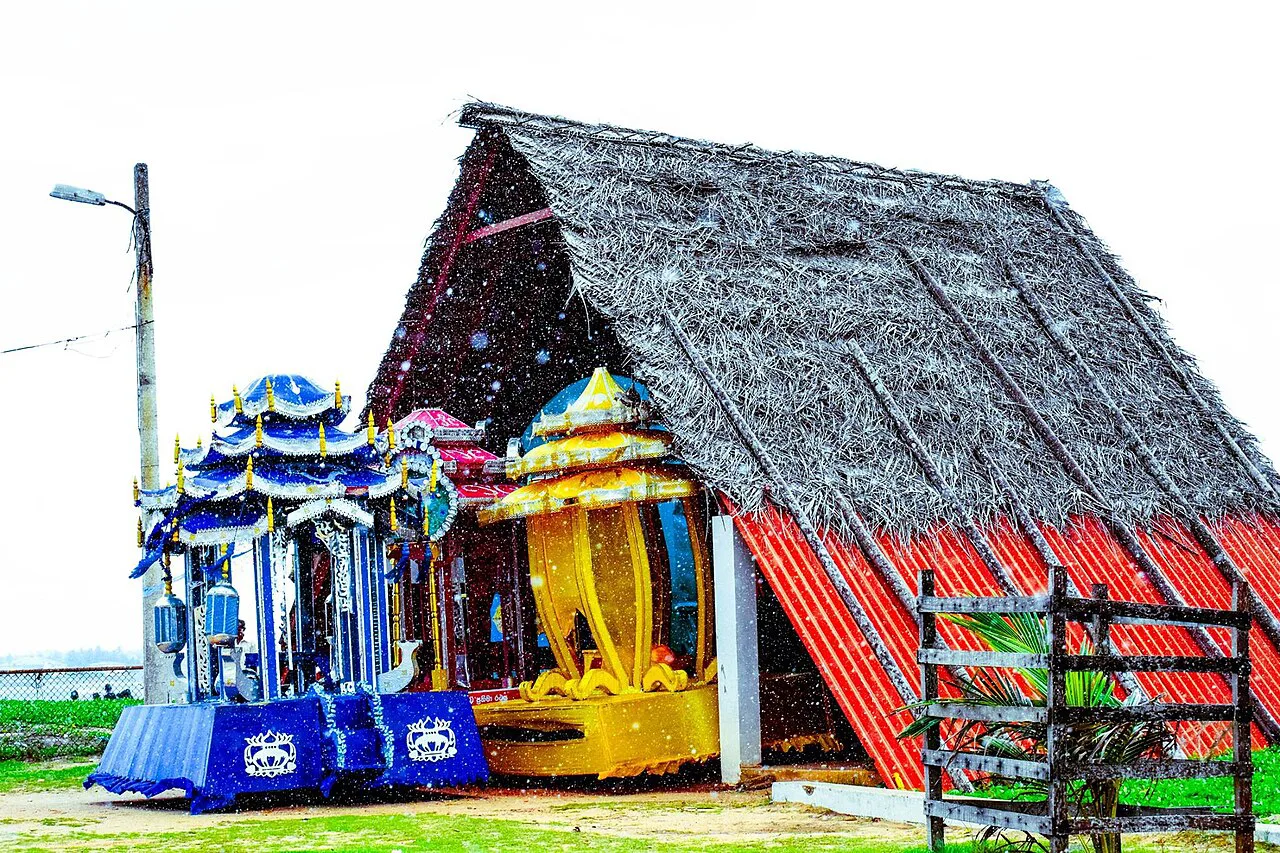
Near Hikkaduwa, West Coast
Seenigama Temple
A twin-part shrine near Hikkaduwa, one temple on the mainland and one on a rocky islet 100 metres offshore, dedicated to the guardian deity of fishermen and famed for its curse-lifting rituals.
Just north of Hikkaduwa, along the main Galle Road, a small rocky islet sits barely a hundred metres offshore, its modest shrine buildings surrounded by a protective wall against the waves. Nearly every passing vehicle slows down here, because Seenigama isn’t just scenic, it’s one of the few places in Sri Lanka where locals believe you can formally ask the gods to punish someone who’s wronged you.
Quick Facts
| Location | Peraliya, on the Galle Road, just north of Hikkaduwa |
| Structure | Two parts, a mainland devalaya and an offshore island shrine (Muhudu Viharaya) |
| Deity | Devol Deviyo, guardian deity of fishermen and coastal communities |
| Age | Structurally dated to around 300 years, with local claims of a far older origin |
| Distinctive practice | Rituals for justice against wrongdoers, including thieves |
| Access to island shrine | By short paid boat ride from the mainland |
Commonly searched as: Seenigama Devalaya · Seenigama Muhudu Viharaya · Hikkaduwa island temple · Devol Deviyo temple · things to do near Hikkaduwa
A Temple in Two Parts
Seenigama’s structure is unusual even among Sri Lanka’s many coastal shrines. A substantial devalaya sits on the mainland, right beside the main Colombo to Galle highway, easily accessible on foot and visited constantly by passing travellers and pilgrims. About 100 to 200 metres out to sea sits the original shrine, Seenigama Muhudu Viharaya, “Muhudu” meaning sea, built on a small rocky islet and reachable only by a short boat crossing. The island shrine consists of two unpretentious buildings enclosed by a protective wall built to withstand high waves, with a short flight of steps leading down to the water for boat landings.
Both mainland and island shrines are dedicated to Devol Deviyo, a guardian deity closely associated with fishermen and coastal communities across Sri Lanka’s southern and western lowlands. The mainland complex also includes smaller shrine rooms for other widely worshipped deities, Kataragama, Vishnu, Natha and Pattini, alongside a Buddha statue, image house and Bo tree, giving the site the full complement of features expected at a Sri Lankan Buddhist-Hindu devalaya.
How Old Is It, Really?
Local tradition claims Seenigama’s origins stretch back well over a thousand years, with some accounts linking the site to Ramayana-era legend as the place where Sugriva, an ally of Rama, is said to have begun his campaign to free Sita from the demon king Ravana. Structural and archaeological evidence, however, only supports a more modest age of around 300 years for the buildings visitors see today. Whichever timeline is accurate, Seenigama has functioned as an important stop for travellers heading along the southern coast for a very long time, its location right on the main highway ensuring a steady flow of visitors and offerings.
The Curse Ritual
Seenigama’s most distinctive local reputation involves justice rather than blessing. According to widespread belief, victims of theft or wrongdoing can purchase a special pepper-infused oil at the temple, pour it into a lamp at home, light it, and recite a specific request for retribution. Locals believe the wrongdoer will subsequently suffer misfortune, illness or accident as a result. It’s one of only a small number of sites in Sri Lanka associated with this kind of formal curse-lifting practice, and the steady stream of visitors performing the ritual suggests it’s taken seriously by a meaningful portion of the local population.
Visiting Tips
- Expect to negotiate a boat fare (typically a few hundred rupees) if you want to visit the island shrine itself; bargaining is normal.
- The island shrine’s interior is modest, some visitors feel the mainland devalaya and the view from shore are actually more rewarding than the crossing itself.
- Sunset offers the most photogenic view of the island temple silhouetted against the sea.
- Combine with nearby Hikkaduwa‘s beaches, the turtle hatchery, and the Peraliya tsunami memorial for a fuller stretch of coastal sightseeing.
Where It Sits on the Map
Seenigama Muhudu Viharaya, Peraliya, near Hikkaduwa Open in Google Maps ↗
Frequently Asked Questions
Why does Seenigama have two temple locations?
The main shrine, Seenigama Muhudu Viharaya, sits on a small rocky island about 100 metres offshore, while a larger devalaya on the mainland serves as the primary point of worship and offerings for passing visitors.
What deity is Seenigama dedicated to?
Devol Deviyo, a guardian deity strongly associated with fishermen and coastal protection in Sri Lankan Sinhalese Buddhist tradition.
What is Seenigama known for beyond its offshore location?
A local belief that victims of theft or wrongdoing can perform a specific ritual at the temple to bring misfortune upon the person who wronged them.
How do visitors reach the island shrine?
By a short paid boat ride from the mainland shore, with fares typically negotiated on the spot.
← Sri Lanka: The Complete Guide — see all 258 places by region
Related News
A guide to Sri Lanka's West Coast region, from Kalpitiya to Hikkaduwa: beaches, history, wildlife and travel tips.
A complete guide to Negombo, Sri Lanka: history, the fish market, Dutch canal, churches, and visiting tips near the airport.

A guide to Sri Munneswaram Temple near Chilaw, Sri Lanka: history, the Ramayana legend, festivals, visiting tips and map.













