

Dsigngo is a Graphic Design and Digital Marketing Company.
Write what you are looking for and press enter to begin your search!

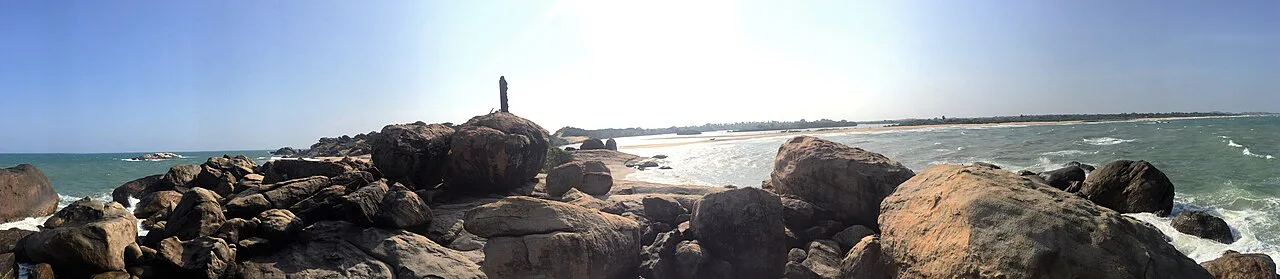
Near Arugam Bay, The East
Panama
A farming village that has existed for over a thousand years, and one whose more recent history includes being driven from its own land by conflict, only for its families to return and reclaim it.
Panama is easy to drive past, a modest farming and fishing village along the road south from Arugam Bay, but it holds a genuinely deep history of continuous settlement, and a more recent story of displacement and return that gives the quiet fields surrounding it real weight.
Quick Facts
| Location | South of Arugam Bay, Ampara District, on the Panama Road |
| Character | A farming village existing for over 1,000 years |
| Role | The last coastal village with basic facilities before Okanda and Kumana |
| Nearby landmarks | Elephant Rock, Peanut Farm Beach |
| Recent history | Residents were displaced during conflict, later returned to reclaim their land |
| Gateway to | Kudumbigala Hermitage, Okanda Devalaya, Kumana National Park |
Commonly searched as: Panama village Sri Lanka · Panama Ampara · Panama Road Arugam Bay · gateway to Kumana · things to do near Arugam Bay
A Community With a Thousand-Year Footprint
Long before Arugam Bay drew international surfers, and long before Kumana and Kudumbigala became names on a wildlife-and-heritage circuit, Panama existed simply as a farming settlement, its roots reaching back over a thousand years according to local accounts. That deep continuity places Panama within the same broader pattern found throughout Sri Lanka’s ancient dry-zone regions, communities sustained for centuries by rice cultivation and, along this particular stretch of coast, fishing, their daily rhythms shaped by land and water rather than any single dramatic historical event.
The Panama Road itself has become the practical spine connecting this quieter, older world to the more recently developed surf and tourism economy further north: all visitors travelling south from Pottuvil pass through or near Panama en route to Elephant Rock, Peanut Farm Beach, and eventually the village of Panama itself before the road terminates at Kumana National Park.
Displaced, Then Reclaimed
Panama’s more recent history carries genuine weight. During Sri Lanka’s period of conflict, villagers were driven from their land, part of the broader disruption that affected communities across much of the Eastern Province during those years. Unlike some communities whose displacement proved permanent, Panama’s residents eventually returned, reclaiming their fields and resuming what’s now described as a “happy farming life,” a quiet but genuinely significant story of resilience playing out in a village most visitors barely register as they pass through toward more famous destinations further along the road.
The Last Stop Before Genuine Wilderness
Panama’s practical significance for travellers lies in its position as the final settlement offering basic facilities before the road continues into considerably wilder territory, toward Okanda‘s ancient temple, the Kudumbigala forest hermitage’s more than 200 meditation caves, and the entrance to Kumana National Park itself. For pilgrims undertaking the Pada Yatra foot pilgrimage toward Kataragama, Panama similarly represents one of the last points of genuine civilisation before the difficult jungle crossing through Yala and Kumana begins.
Everyday Village Life Worth Slowing Down For
For travellers willing to pause rather than simply pass through, Panama offers a genuine, unpolished glimpse of rural Eastern Province life, rice paddies, fishing boats, and a community rhythm shaped by agriculture and season rather than tourism, a real contrast to the surf-town energy of Arugam Bay just a short drive north.
Visiting Tips
- Use Panama as a practical staging point before continuing to Okanda, Kudumbigala or Kumana National Park.
- Stock up on any essentials here, since facilities become considerably sparser further south along the road.
- Stop to appreciate the village’s genuine, working agricultural character rather than treating it purely as a pass-through point.
- Combine with a visit to nearby Elephant Rock and Peanut Farm Beach along the same Panama Road.
Where It Sits on the Map
Panama village, Ampara District, Eastern Province Open in Google Maps ↗
Frequently Asked Questions
How old is Panama village?
Local accounts describe it as a farming settlement existing for over 1,000 years, one of the region’s older continuous communities.
What happened to Panama’s residents during Sri Lanka’s conflict?
Villagers were displaced from their land during a period of conflict, but later returned to reclaim their fields and resume farming.
Why is Panama significant for travellers heading further south?
It’s the last village offering basic facilities before the road continues into Kumana National Park, Okanda, and the Kudumbigala forest hermitage.
What else is near Panama?
Elephant Rock and Peanut Farm Beach, both along the Panama Road connecting Pottuvil to the more remote southern attractions.
← Sri Lanka: The Complete Guide — see all 258 places by region
Related News
A guide to Sri Lanka's East Coast: Trincomalee, Batticaloa, Arugam Bay, wildlife parks, and the region's unique dry-season timing.
A guide to Trincomalee: one of the world's finest natural harbours, its ancient temple, colonial and WWII history, visiting tips and map.
A guide to Fort Frederick in Trincomalee: built from a demolished temple's stones, still an active Sri Lankan military base, its resident deer, visiting tips...













