

Dsigngo is a Graphic Design and Digital Marketing Company.
Write what you are looking for and press enter to begin your search!

Dickwella, The South
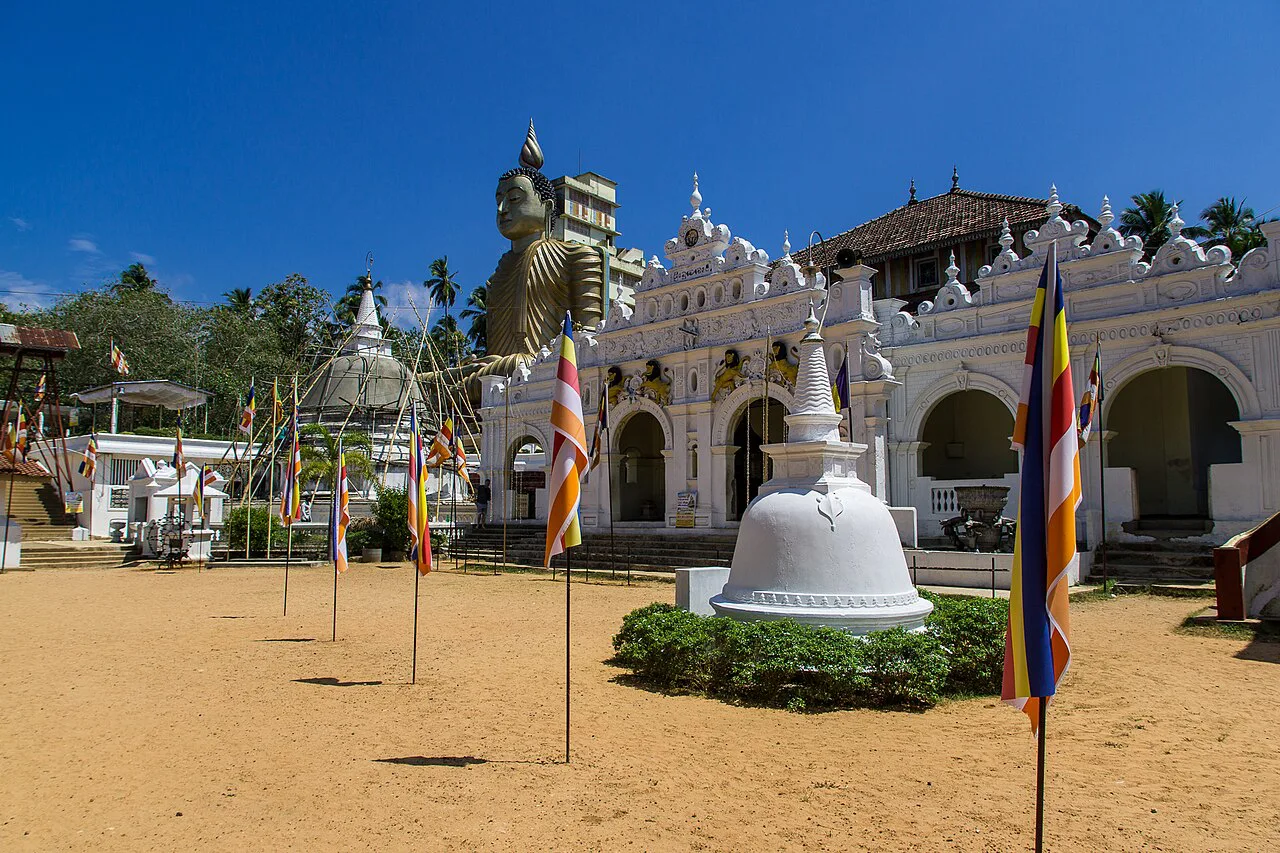
Wewurukannala Vihara
An 18th-century temple near Dickwella dominated by Sri Lanka’s tallest Buddha statue, reached only after passing through a genuinely unsettling gallery of graphic hell-realm sculptures.
Most temples build anticipation with a quiet approach. Wewurukannala Vihara does the opposite, forcing visitors through a graphic gallery of sinners being boiled, sawn in half and disembowelled before finally arriving at Sri Lanka’s tallest Buddha statue, a deliberate and genuinely startling contrast between earthly consequence and eventual enlightenment.
Quick Facts
| Location | About 1.5 km inland from Dickwella, toward Beliatta |
| Original temple | Founded during the reign of King Rajadhi Rajasinha (1782 to 1798) |
| Former name | Sudassanananda Viharaya |
| Statue unveiled | 2 March 1969, after which the temple was renamed |
| Statue height | 160 feet (48.8 metres), Sri Lanka’s tallest seated Buddha statue |
| Statue posture | Samadhi Mudra, the meditation gesture |
Commonly searched as: Wewurukannala Vihara · Dickwella giant Buddha · Tunnel of Hell Sri Lanka · largest Buddha statue Sri Lanka · things to do in Dickwella
An 18th-Century Temple With a 20th-Century Icon
The temple’s origins trace to the reign of King Sri Rajadhi Rajasinha of Kandy, between 1782 and 1798, when it was known as Sudassanananda Viharaya. Local tradition connects the site’s founding to a genuinely royal story: the king’s son, born to Queen Madakumbura Wasala Deviya, is said to have taken up life as a Buddhist monk under the name Rajakumara Himi, residing at an ambalama (rest house) in Wewurukannala. This Rajakumara Himi is remembered as one of seven monks sent as delegates to Burma to obtain higher ordination for the Sri Lankan Buddhist order, a significant historical episode in the island’s religious history.
The temple’s modern fame, though, dates to a specific and much later addition. On 2 March 1969, temple authorities unveiled a colossal seated Buddha statue on the grounds, and the temple was subsequently renamed Wewurukannala Budu Rajamaha Vehera in the statue’s honour. At 160 feet, roughly the height of an eight-storey building, it became and remains the tallest Buddha statue in Sri Lanka, depicted in Samadhi Mudra, the meditation gesture associated with the moment of enlightenment.
Three Sections, Building to a Climax
Visitors experience the temple as three distinct sections. The oldest, roughly 250 years old, holds genuine historical value but modest visual drama, a relatively understated Buddha image worked into the original architecture. The second section is where things get memorable: life-sized models depicting demons and sinners in vivid, sometimes shocking detail, illustrating the consequences of straying from the Buddhist path, punishments including being dropped into boiling cauldrons, sawn in half, and disembowelled. This gallery, sometimes nicknamed the “Tunnel of Hell,” functions as a kind of moral cautionary tale rendered in three dimensions rather than sermon.
Only after passing through this unsettling gauntlet do visitors reach the third and largest element: the giant seated Buddha itself, its surrounding walls covered in extensive murals depicting the Buddha’s life and various Jataka tales in a sequential, almost comic-strip style. One notable mural depicts the Culla Dhammapala Jataka, the story of King Maha Pratapa of Varanasi, who, feeling ignored by his queen’s devotion to their infant son, ordered the child’s execution, a story used within Buddhist teaching to illustrate themes of attachment, jealousy and karmic consequence.
Climbing Inside the Buddha’s Head
One of the temple’s more unusual features is the ability to climb inside the giant statue itself, ascending a stairway that leads up through the interior to a viewpoint near the Buddha’s head, offering visitors a genuinely unique vantage point and panoramic views over the surrounding countryside.
Visiting Tips
- Be prepared for the graphic nature of the hell-realm sculptures, they’re intentionally unsettling and may not suit young children or sensitive visitors.
- Allow at least an hour to properly take in all three sections of the temple.
- Combine with Dickwella beach, just 1.5 km away, for a fuller day in the area.
- Dress modestly and remove shoes before entering shrine areas, as at any active Buddhist temple.
A Deliberate Emotional Journey
What sets Wewurukannala apart from most large Buddha statue sites elsewhere in Sri Lanka is how deliberately its layout manipulates visitor emotion before delivering its final message. Rather than a straightforward walk to an impressive monument, the temple architects built genuine discomfort into the experience, forcing a confrontation with graphic depictions of suffering before offering the serene, monumental calm of the seated Buddha as a kind of resolution. That structure, dread followed by relief, mirrors a common device in Buddhist teaching more broadly, using vivid imagery of consequence to underscore the value of following a better path. Few temples anywhere execute that narrative arc quite so literally, or with quite as much theatrical commitment to the unsettling middle act.
Where It Sits on the Map
Wewurukannala Vihara, near Dickwella, Matara District Open in Google Maps ↗
Frequently Asked Questions
How tall is the Wewurukannala Buddha statue?
160 feet (48.8 metres), making it the tallest seated Buddha statue in Sri Lanka, unveiled on 2 March 1969.
What is the ‘Tunnel of Hell’?
A gallery of life-sized models depicting demons and sinners undergoing graphic punishments, illustrating the consequences of straying from the Buddhist path, that visitors pass through before reaching the giant statue.
How old is the temple itself?
Its origins trace to the reign of King Rajadhi Rajasinha, between 1782 and 1798, though the famous giant statue was only added in 1969.
Can visitors go inside the statue?
Yes, a stairway inside the statue leads up to a viewpoint near the Buddha’s head, offering panoramic views of the surrounding area.
← Sri Lanka: The Complete Guide — see all 258 places by region
Related News
A guide to Southern Sri Lanka, from Galle to Kataragama: beaches, wildlife safaris, colonial forts, and travel tips.

A complete guide to Galle Fort: history from Ptolemy to the Dutch, walking the ramparts, top sights, and visiting tips.
A guide to the Dutch Reformed Church in Galle Fort: the story behind its 1755 completion, the tombstone floor, visiting tips and map.













