

Dsigngo is a Graphic Design and Digital Marketing Company.
Write what you are looking for and press enter to begin your search!

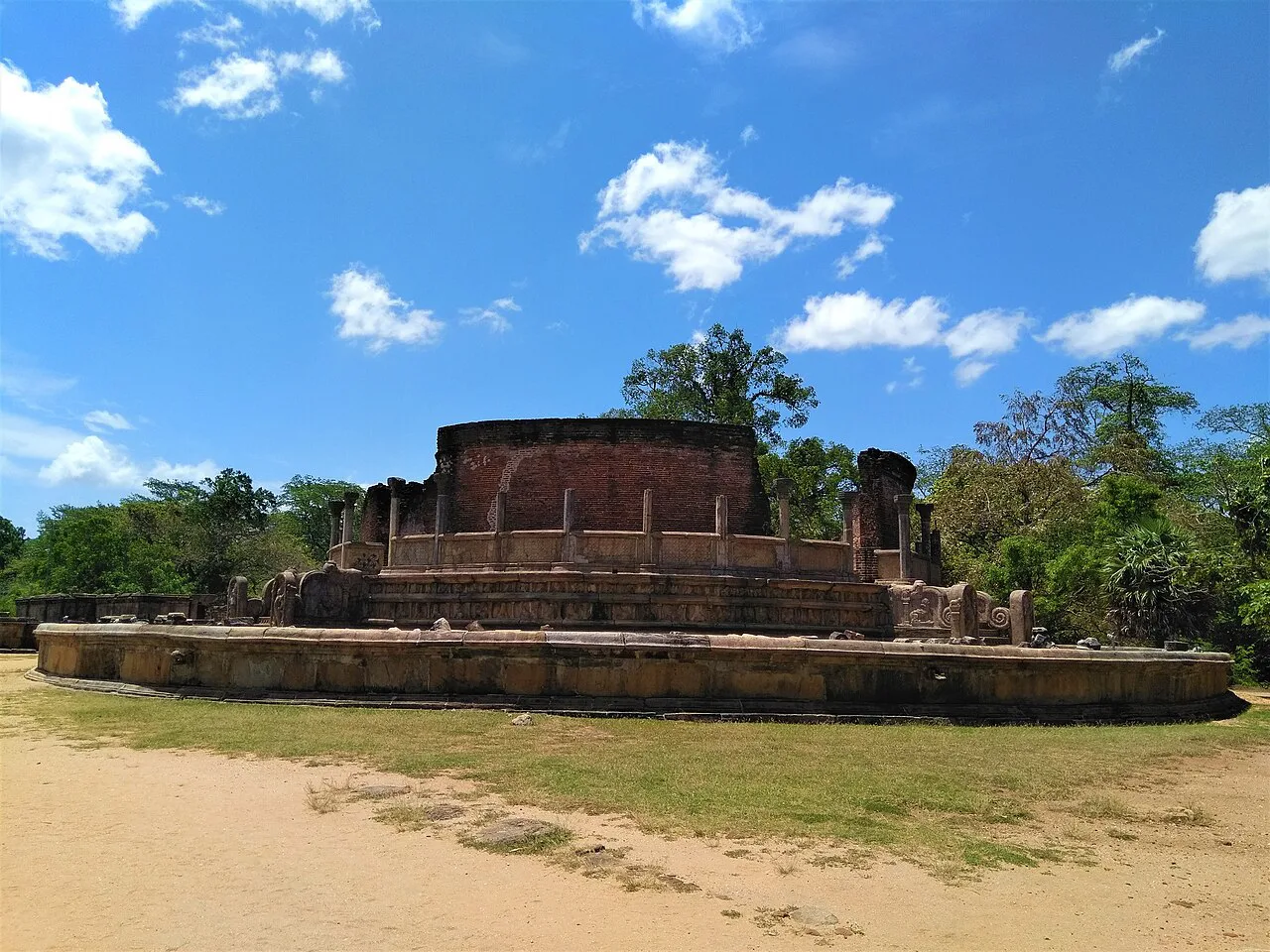
Polonnaruwa, Cultural Triangle
The Quadrangle
A single raised platform packed with more monuments built by more competing kings than almost anywhere else in Polonnaruwa, all clustered around a shrine believed to have once held the Buddha’s Tooth Relic.
If Polonnaruwa had a greatest-hits collection, the Sacred Quadrangle would be it: a single raised platform holding the Vatadage, the Hatadage, the Satmahal Prasada, the Nissanka Latha Mandapaya and the Gal Potha, a genuinely dense concentration of monuments built by at least three different kings competing to leave their mark on the same sacred ground.
Quick Facts
| Location | Central Polonnaruwa, on a raised platform |
| Also known as | Dalada Maluwa (‘Terrace of the Tooth Relic’) |
| Oldest building | Atadage, built by King Vijayabahu I (1055 to 1110) |
| Centrepiece | The Vatadage, a circular relic house |
| Notable feature | The Gal Potha, a giant stone ‘book’ inscription |
| Builders represented | Vijayabahu I, Parakramabahu I, and Nissanka Malla |
Commonly searched as: Polonnaruwa Quadrangle · Vatadage Polonnaruwa · Dalada Maluwa · Gal Potha stone book · things to do in Polonnaruwa
Layers of Royal Rivalry on One Platform
The Quadrangle’s oldest structure, the Atadage, was built by King Vijayabahu I, the ruler who reunified Sri Lanka and re-established Polonnaruwa as its capital in 1070, and is believed to have housed the Sacred Tooth Relic of the Buddha during his reign. Decades later, King Nissanka Malla, ruling from 1187 to 1196, built the neighbouring Hatadage as a competing shrine for the same relic, alongside the Nissanka Latha Mandapaya, an unusually designed pillared structure topped with a small stone stupa, reportedly used by the king specifically to sit and listen to Buddhist chanting.
That layering of successive royal contributions to a single sacred platform reflects a broader pattern across Polonnaruwa: each king sought not simply to maintain existing religious infrastructure but to visibly add his own monument to the kingdom’s most sacred ground, a form of architectural competition for religious legitimacy playing out across generations on the same compact terrace.
The Vatadage: The Quadrangle’s Centrepiece
At the heart of the complex stands the Vatadage, a distinctively Sri Lankan architectural form, essentially a circular relic house built to enclose and protect a smaller stupa. Sources differ on its exact origin, some attribute it to Parakramabahu I as a home for the Tooth Relic, others to Nissanka Malla as a shrine for the Buddha’s alms bowl, but its two stone platforms, elaborate moonstone entrance, and finely carved stone screens make it widely regarded as the single most accomplished piece of architecture anywhere in the Quadrangle.
The Gal Potha, or ‘Stone Book’
Among the Quadrangle’s more unusual monuments is the Gal Potha, an enormous stone slab carved to resemble the pages of a book, inscribed with text recording the achievements of King Nissanka Malla’s reign. Reportedly transported from Mihintale, some 100 km away, the sheer scale of moving such a massive stone slab across that distance stands as its own testament to the resources a Polonnaruwa-era king could command for a purely commemorative purpose.
The Satmahal Prasada
Another distinctive structure within the Quadrangle is the Satmahal Prasada, a stepped, pyramidal tower whose form has drawn comparisons to Southeast Asian, particularly Cambodian and Thai, architecture, leading some visitors and historians to speculate about possible foreign influence or foreign workers involved in its construction, though this remains a matter of interpretation rather than confirmed historical record.
That speculative cross-cultural connection fits within a broader historical reality: Polonnaruwa-era Sri Lanka maintained active diplomatic and religious contact with mainland Southeast Asian Buddhist kingdoms, exchanging monks, relics and religious texts as part of a wider Theravada Buddhist world stretching from Sri Lanka through Burma, Thailand and beyond. Whether or not the Satmahal Prasada’s stepped design directly reflects imported expertise, its unusual form is a visible reminder that Polonnaruwa’s architects were working within, and drawing inspiration from, a genuinely international religious and artistic network rather than a purely isolated local tradition.
Visiting Tips
- Allow at least 45 minutes to an hour, given the sheer density of individual monuments packed onto the platform.
- Look for the differences in architectural style between structures built under different kings, a useful way to trace the site’s layered construction history.
- Remove shoes before stepping onto the platform itself, treated as sacred ground.
- Visit alongside the nearby Royal Palace Group for a combined sense of Polonnaruwa’s religious and administrative centres.
Where It Sits on the Map
The Quadrangle (Dalada Maluwa), Polonnaruwa archaeological park Open in Google Maps ↗
Frequently Asked Questions
What is the Sacred Quadrangle?
A raised platform in central Polonnaruwa holding a dense cluster of monuments, including the Vatadage, Hatadage, Satmahal Prasada and Gal Potha, built by several different kings.
What is the Vatadage?
A circular relic house at the centre of the Quadrangle, believed to have enshrined either the Buddha’s Tooth Relic or his alms bowl, widely regarded as the finest architectural achievement in the complex.
What is the Gal Potha?
A massive stone slab carved to resemble a book, inscribed with text recording King Nissanka Malla’s achievements, reportedly transported from Mihintale, roughly 100 km away.
Which is the oldest building in the Quadrangle?
The Atadage, built by King Vijayabahu I during his 1055 to 1110 reign.
← Sri Lanka: The Complete Guide — see all 258 places by region
Related News
A guide to Sri Lanka's Cultural Triangle: Sigiriya, Polonnaruwa, Anuradhapura, Dambulla and Mihintale, with travel tips.

A complete guide to Sigiriya Rock Fortress: King Kashyapa's parricide, the water gardens, the famous frescoes, visiting tips and map.
A guide to the ancient city of Polonnaruwa: from Chola conquest to Parakramabahu the Great's garden-city, visiting tips and map.













