

Dsigngo is a Graphic Design and Digital Marketing Company.
Write what you are looking for and press enter to begin your search!

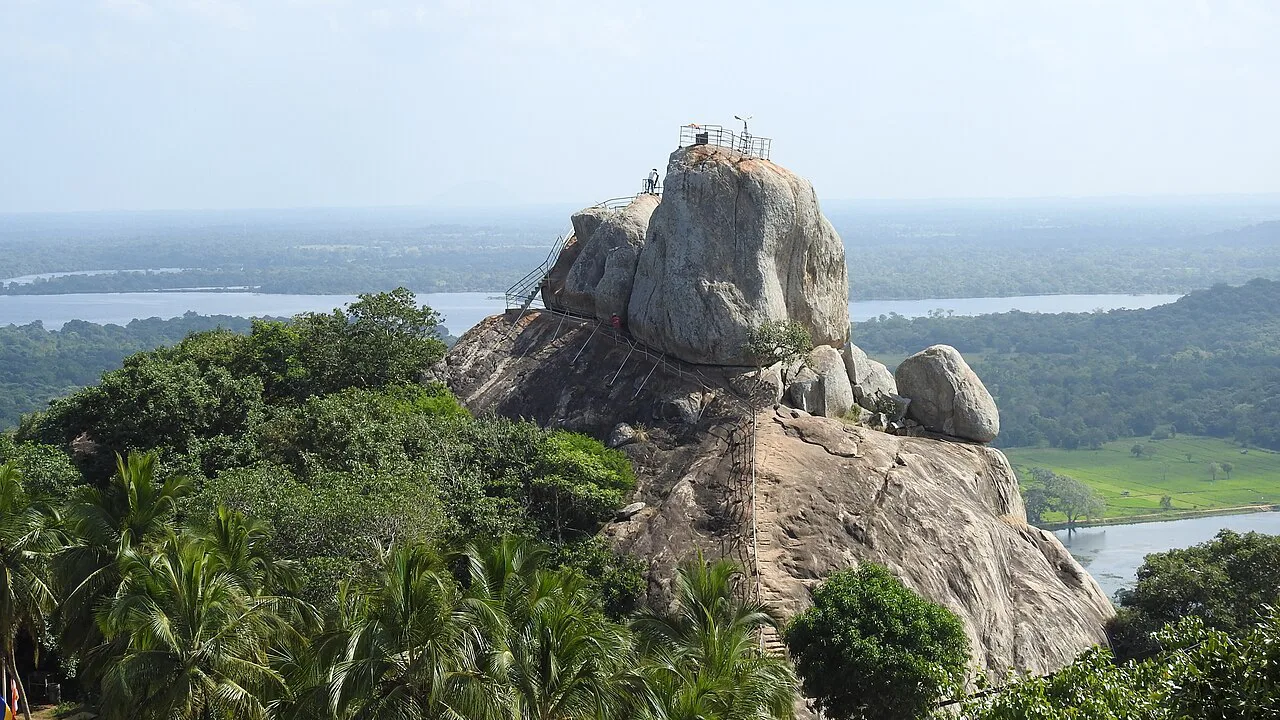
The Cultural Triangle, Sri Lanka
Mihintale
A king chasing a deer up a mountainside in 247 BCE stumbled instead into a conversation that would define an entire civilisation’s religious identity for the next 2,300 years.
On the full moon day of the month of Poson, King Devanampiya Tissa was doing what Sri Lankan kings did for sport, chasing a stag through the forested hills east of his capital, when a voice called out his name from a rock ledge above him, and Sri Lankan history changed forever.
Quick Facts
| Location | About 13 km east of Anuradhapura |
| Ancient name | Missaka Pabbata (Missaka Mountain) |
| Key event | Meeting of the monk Mahinda and King Devanampiya Tissa, 247 BCE |
| Significance | Traditionally regarded as the birthplace of Buddhism in Sri Lanka |
| Main stairway | 1,840 ancient granite steps to the summit |
| Key annual festival | Poson Poya, marking the anniversary of the meeting |
Commonly searched as: Mihintale · Mihintale Sri Lanka · birthplace of Buddhism Sri Lanka · Mahinda King Devanampiya Tissa · things to do near Anuradhapura
A Deer Hunt That Became a Turning Point
According to the Mahavamsa, Sri Lanka’s great chronicle, the monk Mahinda, son of the Indian emperor Ashoka, arrived in Sri Lanka along with his companions on the full moon day of Poson (June) in 247 BCE, landing on Missaka Pabbata, the mountain now known as Mihintale. King Devanampiya Tissa was, that same day, out on a ceremonial royal deer hunt through the surrounding forested hills, a formal expedition befitting his rank rather than a casual pursuit. As he chased a magnificent stag up the rocky slopes, a voice suddenly called out across the hillside, “Tissa! Tissa!” The startled king looked up to find a calm, radiant monk standing on a rock ledge, later named Aradhana Gala, the “Rock of Invitation,” who somehow already knew his name.
Before launching into any religious teaching, Mahinda reportedly tested the king’s intelligence with a series of pointed questions about a mango tree, assessing whether Devanampiya Tissa possessed the wisdom needed to grasp deeper philosophical concepts. Satisfied with the king’s answers, Mahinda delivered the Chullahatthipadopama Sutta, and according to the chronicle, the king and some 40,000 of his subjects attained the first stage of enlightenment on the spot, becoming stream-enterers who had glimpsed the truth of Buddhist teaching for the first time.
From a Single Meeting to a National Religion
What followed reshaped Sri Lankan civilisation. The king invited Mahinda to Anuradhapura, where further preaching in the royal Mahamegha Park led to the establishment of the Mahavihara monastery, the ordination of the first Sri Lankan monks, and eventually a formal request to Emperor Ashoka for his daughter Sanghamitta to travel to the island and establish an order of Buddhist nuns, arriving with a sapling from the Buddha’s own Bodhi tree that would become the Sri Maha Bodhi. Mahinda himself spent the remainder of his life on the island, dying at Mihintale in 202 BCE, and after a grand funeral, his ashes were enshrined in stupas across the country, including on the very mountain where he first met the king.
A Mountain Full of Monuments
Today Mihintale holds a dense cluster of ancient structures documenting both the founding meeting and the monastic community that grew up around it afterward: a ruined hospital, the Kantaka Chetiya stupa, the monks’ refectory, the Ambasthala Dagoba marking the meeting spot itself, Mahinda’s cave, the Maha Stupa, and Aradhana Gala, the rock where the king first heard his name called.
Chronicles also record that the king had 68 caves prepared on the mountain for resident monks, several of which survive today, one bearing an inscription confirming it was prepared specifically for one of the king’s own brothers, a detail that underscores just how quickly and thoroughly the royal family itself embraced the new religion following that single fateful hunting trip.
Visiting Tips
- Wear comfortable shoes for the 1,840-step climb, and bring socks for sections requiring bare feet on hot stone.
- Visit during Poson Poya (June) for the site’s most significant annual festival, though expect very large crowds.
- Start early in the morning to avoid both the heat and the busiest visitor periods.
- Combine with Anuradhapura, given Mihintale’s short distance and shared historical significance.
Where It Sits on the Map
Mihintale, near Anuradhapura, Sri Lanka Open in Google Maps ↗
Frequently Asked Questions
Why is Mihintale called the birthplace of Buddhism in Sri Lanka?
It’s the traditional site where the monk Mahinda first met King Devanampiya Tissa in 247 BCE and introduced Buddhism to the island.
What happened during that first meeting?
According to the Mahavamsa, Mahinda tested the king’s wisdom, then preached the Chullahatthipadopama Sutta, after which the king and thousands of subjects reportedly attained the first stage of enlightenment.
How many steps lead to Mihintale’s summit?
1,840 ancient granite steps, passing numerous ruins and monuments along the way.
What happened to Mahinda after this meeting?
He remained in Sri Lanka for the rest of his life, dying at Mihintale in 202 BCE, with his ashes later enshrined in stupas across the country.
← Sri Lanka: The Complete Guide — see all 258 places by region
Related News
A guide to Sri Lanka's Cultural Triangle: Sigiriya, Polonnaruwa, Anuradhapura, Dambulla and Mihintale, with travel tips.

A complete guide to Sigiriya Rock Fortress: King Kashyapa's parricide, the water gardens, the famous frescoes, visiting tips and map.
A guide to the ancient city of Polonnaruwa: from Chola conquest to Parakramabahu the Great's garden-city, visiting tips and map.













