

Dsigngo is a Graphic Design and Digital Marketing Company.
Write what you are looking for and press enter to begin your search!

The Cultural Triangle, Sri Lanka
Sigiriya
A king who walled his own father alive inside a dam, then fled to a 200-metre rock and built one of the ancient world’s most sophisticated palace complexes, driven entirely by fear of his brother’s revenge.
Sigiriya’s story begins with a betrayal so severe it still colours how the site is understood 1,500 years later: King Kashyapa I seized his father’s throne, had him walled up alive in a reservoir dam, and then spent nearly two decades building an impregnable palace atop a sheer rock, waiting for the brother he’d wronged to return for revenge.
Quick Facts
| Location | Central Cultural Triangle, near Dambulla |
| Sinhala name | Sihagiri (‘Lion Rock’) |
| Built | 477 to 495 CE, under King Kashyapa I |
| Rock height | About 200 metres above the surrounding plain |
| UNESCO status | World Heritage Site since 1982 |
| Frescoes | 22 surviving ‘Sigiriya Damsels’ paintings, possibly from an original 500 |
Commonly searched as: Sigiriya · Sigiriya Rock Fortress · King Kashyapa Sigiriya · Sigiriya frescoes · things to do in the Cultural Triangle
A Crime That Created a Kingdom
Kashyapa was the son of King Dhatusena, born to a consort of lower status, while his half-brother Moggallana, born to a queen of full royal blood, held the stronger claim to the throne. In 477 CE, capitalising on a personal grievance held by Migara, Dhatusena’s own army commander and Kashyapa’s brother-in-law, Kashyapa imprisoned his father and demanded to know the location of the royal treasury. Dhatusena led him to the great Kalawewa reservoir he had built and reportedly said, “This is my only treasure,” referring to the irrigation works sustaining his kingdom’s agriculture rather than any hoard of gold. Enraged, Kashyapa had his father walled up alive within the very dam, a slow, brutal death that earned him the lasting epithet Pithru Ghathaka Kashyapa, “Kashyapa the Patricide.”
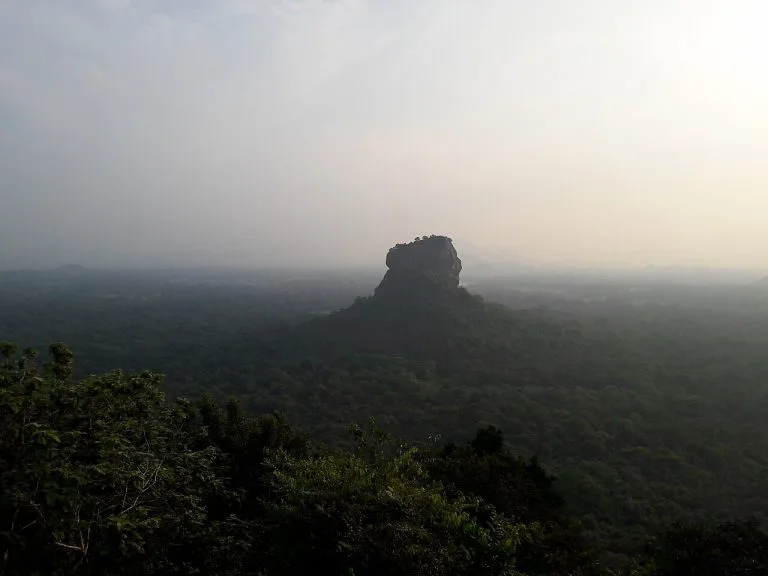
Moggallana fled to South India, vowing to return with an army, and Kashyapa, knowing his traditional capital at Anuradhapura offered no real security against that threat, searched for a genuinely defensible alternative. He found it in a colossal, reddish-orange granite outcrop rising roughly 200 metres from the flat surrounding jungle, visible for miles in every direction, a natural fortress that would become Sigiriya.
Eighteen Years of Extraordinary Construction
What Kashyapa built over the following 18 years genuinely defies easy categorisation. At the base of the rock, his engineers created symmetrical water gardens fed by sophisticated hydraulic systems, among the oldest surviving landscaped gardens anywhere in Asia, complete with fountains that, remarkably, still function during the rainy season some 1,500 years later. Partway up the rock, sheltered beneath a natural overhang, artists painted the now-famous frescoes of celestial maidens, the “Sigiriya Damsels,” originally numbering perhaps as many as 500 individual paintings, of which 22 survive today, their colours still vibrant after a millennium and a half.
The rock’s approach passes through the Mirror Wall, a smoothly polished surface once capable of reflecting a visitor’s own image, and the massive stone paws of a lion statue, all that remains of an entrance structure that once took the form of a giant lion’s head and body, giving the rock its Sinhala name, Sihagiri, “Lion Rock.” At the summit, foundations of Kashyapa’s royal palace remain, offering commanding views over the jungle plains in every direction, precisely the visibility Kashyapa needed to spot an approaching army long before it arrived.
A Fortress That Failed Its Purpose
Despite the scale of the undertaking, Sigiriya ultimately didn’t save Kashyapa. In 495 CE, Moggallana returned with South Indian forces, and the two armies met near Dambadeniya. According to the Mahavamsa chronicle, Kashyapa’s own elephant turned aside during the battle to avoid a bog, and his soldiers, misreading the manoeuvre as a retreat, panicked and broke ranks. Facing certain defeat and refusing to be captured, Kashyapa took his own life on the battlefield. Moggallana subsequently abandoned Sigiriya as a royal capital, and the site was used for a time as a Buddhist monastery before eventually being abandoned altogether, rediscovered only in the 19th century by British colonial explorers.
Visiting Tips
- Climb early morning, ideally by 7 am, to avoid both the heat and the largest crowds on the exposed upper sections.
- Allow 2 to 3 hours for the full climb, including time at the frescoes, the Mirror Wall, the Lion’s Paw platform, and the summit.
- Photography of the frescoes is generally restricted to specific angles; follow posted guidance.
- Combine with the nearby Dambulla Cave Temples and Pidurangala Rock, which offers an alternative, less crowded view of Sigiriya itself from a neighbouring peak.
Where It Sits on the Map
Sigiriya, Cultural Triangle, Sri Lanka Open in Google Maps ↗
Frequently Asked Questions
Why did King Kashyapa build Sigiriya?
After seizing the throne by having his father killed, he feared retaliation from his exiled half-brother Moggallana and needed a defensible new capital away from Anuradhapura.
What happened to King Kashyapa?
In 495 CE, his half-brother returned with an army; Kashyapa’s forces broke ranks during battle, and facing defeat, he took his own life rather than be captured.
What are the Sigiriya frescoes?
Paintings of celestial maidens sheltered on a rock overhang partway up the climb, of which 22 survive from an original set possibly numbering as many as 500.
How tall is Sigiriya rock?
About 200 metres above the surrounding plain, and the site has been a UNESCO World Heritage Site since 1982.
← Sri Lanka: The Complete Guide — see all 258 places by region
Related News
A guide to Sri Lanka's Cultural Triangle: Sigiriya, Polonnaruwa, Anuradhapura, Dambulla and Mihintale, with travel tips.

A guide to the ancient city of Polonnaruwa: from Chola conquest to Parakramabahu the Great's garden-city, visiting tips and map.
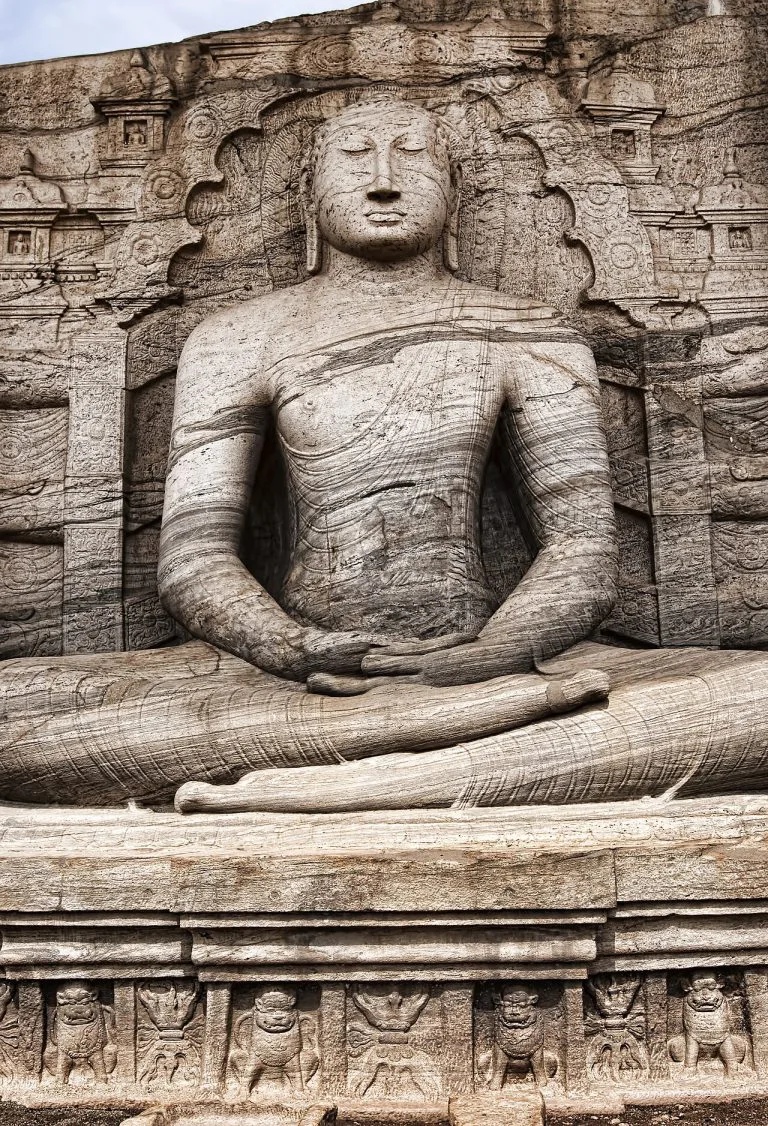
A guide to Gal Vihara at Polonnaruwa: four monumental Buddha statues carved from one rock face, the sorrowful expression debate, visiting tips and map.













