

Dsigngo is a Graphic Design and Digital Marketing Company.
Write what you are looking for and press enter to begin your search!

Polonnaruwa, Cultural Triangle
Gal Vihara
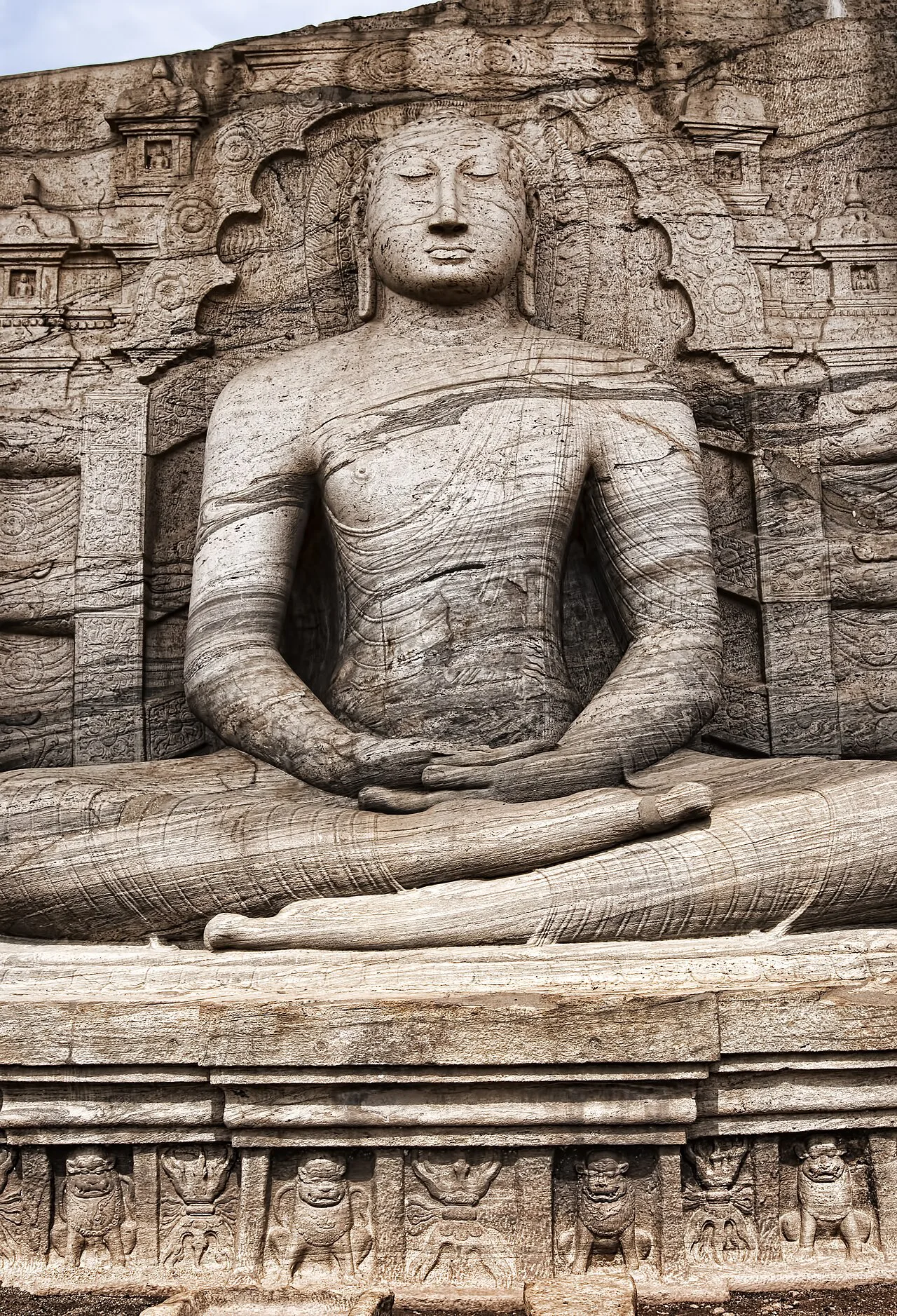
A 46-foot reclining Buddha, a 23-foot standing figure, and two seated statues, all carved from a single continuous granite wall, commissioned by the same king who built an entire garden-city around them.
Gal Vihara translates simply as ‘rock temple,’ a modest name for what is widely considered Polonnaruwa’s single greatest artistic achievement: four monumental Buddha statues, each carved directly from the same continuous granite outcrop.
Quick Facts
| Location | Within the Polonnaruwa archaeological park |
| Commissioned by | King Parakramabahu I (1153 to 1186) |
| Number of statues | Four, carved from a single rock face |
| Reclining Buddha length | 46 feet (14 metres) |
| Standing Buddha height | 23 feet (7 metres) |
| Additional figure | A statue believed to depict Ananda, the Buddha’s chief disciple |
Commonly searched as: Gal Vihara Polonnaruwa · Gal Viharaya Buddha statues · Polonnaruwa rock temple · Sri Lanka ancient sculpture · things to do in Polonnaruwa
Four Statues, One Rock
Gal Vihara was commissioned during the 12th century by King Parakramabahu I, part of his sweeping building programme that transformed Polonnaruwa into a genuine garden-city. Rather than carving separate statues from individual blocks, Parakramabahu’s craftsmen worked directly into a single continuous wall of granite, producing four distinct Buddha images that share the same underlying rock, an approach that demanded extraordinary planning and precision given the scale and number of figures involved.
The most celebrated of the four is the reclining Buddha, measuring 46 feet (14 metres) in length, depicting the Buddha’s Parinirvana, his passing into final release from the cycle of rebirth. Nearby stands a 23-foot (7-metre) standing Buddha figure, its proportions and posture rendered with the same careful attention to naturalistic detail that characterises Polonnaruwa’s finest Buddhist sculpture more broadly.
The Debate Over a Sorrowful Expression
One of Gal Vihara’s more discussed features involves the standing Buddha figure, whose expression some observers have interpreted as displaying an unusual note of sorrow or melancholy, a characteristic quite uncharacteristic for traditional Buddha depictions, which typically aim for serene detachment rather than visible emotion. That observation has fuelled ongoing scholarly and popular debate about the statue’s intended meaning, with some interpretations suggesting it may actually depict Ananda, the Buddha’s grief-stricken chief disciple, mourning at the moment of his teacher’s passing, rather than the Buddha himself, a reading that would make emotional sense of an otherwise unusual expression within the broader composition of the reclining and standing figures together.
Craftsmanship at the Height of Polonnaruwa’s Golden Age
Gal Vihara represents Polonnaruwa’s sculptural artistry at its most accomplished, produced during precisely the period, Parakramabahu’s 1153 to 1186 reign, when the kingdom’s wealth, stability and royal patronage of Buddhism were all at their peak. The statues’ survival in such remarkably good condition, despite centuries of exposure and the eventual abandonment of the city around them, speaks to both the quality of the original stonework and the relatively favourable, dry climate of the Cultural Triangle region.
Modern scholars and conservators continue to study the statues both for what they reveal about 12th-century Sinhalese sculptural technique and for what they suggest about religious interpretation within Polonnaruwa’s Buddhist community at the height of royal patronage. The site’s protective shelter, added in more recent decades, has helped preserve the granite surfaces against further weathering, ensuring the statues remain as legible to visitors today as they likely were to pilgrims and courtiers visiting under Parakramabahu’s own rule.
Visiting Tips
- Visit as part of a broader Polonnaruwa archaeological park tour, ideally by bicycle, given the site’s central location within the wider ruins.
- Dress modestly and remove shoes or hats before approaching the statues, treated as active objects of Buddhist reverence rather than purely historical artefacts.
- Visit early morning for the most comfortable temperatures and the best light on the carved granite surfaces.
- Combine with the nearby Royal Palace ruins and the Quadrangle for a full sense of Parakramabahu’s building legacy.
Where It Sits on the Map
Gal Vihara, Polonnaruwa archaeological park Open in Google Maps ↗
Frequently Asked Questions
Who commissioned Gal Vihara?
King Parakramabahu I, during his 1153 to 1186 reign, as part of his broader transformation of Polonnaruwa into a garden-city.
How many statues make up Gal Vihara?
Four Buddha images, carved from a single continuous granite rock face, including a 46-foot reclining Buddha and a 23-foot standing Buddha.
Why is the standing Buddha’s expression debated?
It shows an unusual hint of sorrow, uncharacteristic for Buddha imagery, leading some scholars to suggest it may actually depict Ananda, the Buddha’s grieving chief disciple, rather than the Buddha himself.
Is Gal Vihara part of a larger site?
Yes, it sits within the wider Polonnaruwa archaeological park, alongside the Royal Palace ruins and the Quadrangle.
← Sri Lanka: The Complete Guide — see all 258 places by region
Related News
A guide to Sri Lanka's Cultural Triangle: Sigiriya, Polonnaruwa, Anuradhapura, Dambulla and Mihintale, with travel tips.

A complete guide to Sigiriya Rock Fortress: King Kashyapa's parricide, the water gardens, the famous frescoes, visiting tips and map.
A guide to the ancient city of Polonnaruwa: from Chola conquest to Parakramabahu the Great's garden-city, visiting tips and map.













