

Dsigngo is a Graphic Design and Digital Marketing Company.
Write what you are looking for and press enter to begin your search!

The Cultural Triangle, Sri Lanka
Dambulla Cave Temples
A king hid from South Indian invaders in these caves for over a decade, protected by resident monks, and when he finally reclaimed his throne, he spent the rest of his gratitude turning their shelter into Sri Lanka’s grandest cave temple.
Long before it became Sri Lanka’s largest and best-preserved cave temple complex, Dambulla was simply a hiding place, a set of natural rock shelters where Buddhist monks sheltered a fugitive king for fifteen years while South Indian invaders occupied his capital.
Quick Facts
| Location | 148 km from Colombo, 72 km north of Kandy |
| Also known as | The Golden Temple of Dambulla, Rangiri Dambulu Rajamaha Viharaya |
| Rock height | 160 metres above the surrounding plains |
| Founded as temple | 1st century BCE, by King Valagamba (Vattagamini Abhaya) |
| UNESCO status | World Heritage Site since 1991 |
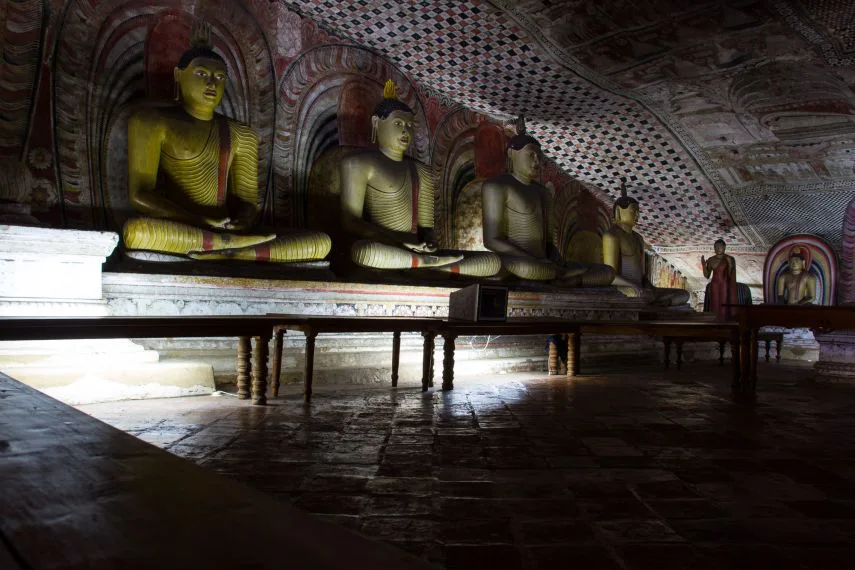
| Contents | 153 Buddha statues, 3 statues of kings, 4 of gods, across 5 caves |
Commonly searched as: Dambulla Cave Temple · Golden Temple of Dambulla · King Valagamba caves · Dambulla Buddha statues · things to do in Dambulla
A King’s Debt to the Monks Who Sheltered Him
Dambulla‘s caves were already in use long before Buddhism arrived in Sri Lanka; excavations at nearby Ibbankatuwa have uncovered burial sites with human remains estimated at roughly 2,700 years old, and archaeological evidence suggests the caves functioned as one of the island’s largest and most important monasteries as early as the 3rd and 2nd centuries BCE. Their documented Buddhist history, though, begins with King Valagamba, also known as Vattagamini Abhaya, who was driven from his throne at Anuradhapura by invading South Indian forces in the 1st century BCE. For a period most sources place at around 14 to 15 years, Valagamba lived in exile, and Buddhist monks meditating in the caves at Dambulla sheltered and protected the fugitive king from his enemies throughout that long ordeal.
When Valagamba finally reclaimed his throne, he didn’t forget the debt. He commissioned a magnificent rock temple at Dambulla specifically as an act of gratitude toward the monks who had protected him, converting the natural caves into a formal religious complex that would go on to attract the patronage of nearly every significant Sri Lankan king who followed. In 1190, King Nissanka Malla of Polonnaruwa gilded the caves and added roughly 70 further Buddha statues, and centuries later, the Kingdom of Kandy carried out a major 18th-century restoration, repainting large sections of the murals and adding the arched colonnades and gabled cave-front entrances still visible today.
Five Caves, Each With Its Own Character
The complex consists of five main caves carved beneath a single vast overhanging rock face, together housing 153 Buddha statues, three statues of Sri Lankan kings, and four statues of Hindu deities including Vishnu and Ganesha. The largest and most elaborate, the Cave of the Divine King, holds a 14-metre reclining Buddha statue, the largest in the complex, its walls covered in murals depicting scenes from the Buddha’s life and various Jataka tales. The second cave, the Cave of the Great King, ranks among the most visually striking of the five, roughly 125 by 75 feet, housing statues of both King Valagamba and King Nissanka Malla, the temple’s two most significant royal patrons, alongside a life-size granite Buddha statue and an urn positioned to catch water dripping from the cave’s ceiling, channelled away through an underground drainage system that has controlled moisture inside the cave for centuries.
The remaining caves each carry their own distinct character: one features a dagoba said, according to local folklore, to contain jewellery belonging to Queen Somawati, Valagamba’s wife, alongside a statue of Vishnu, while the final cave, used purely as a storeroom until the early 19th century, was only later converted into a small shrine featuring a reclining Buddha and seated Buddha statues sheltered beneath a carved hooded cobra, notably made of brick and plaster rather than carved directly from the rock like the statues elsewhere in the complex.
Murals Covering Over 2,000 Square Metres
Dambulla’s painted surfaces are as significant as its statuary, covering more than 2,100 square metres across the complex’s ceilings and walls, one of the largest concentrations of ancient Buddhist mural art anywhere in Sri Lanka, continuously maintained and periodically restored across two millennia of active religious use.
Visiting Tips
- Purchase tickets at the south entrance booth, not at the Golden Temple entrance below, where no ticket counter exists.
- Budget 1.5 to 2 hours to properly explore all five caves without rushing.
- Expect roughly 350 to 400 steps to reach the cave temple; pace yourself, especially in the heat.
- Dress modestly, covering shoulders and knees, as required at this active, continuously used monastery.
Where It Sits on the Map
Dambulla Cave Temple, central Sri Lanka Open in Google Maps ↗
Frequently Asked Questions
Why was the Dambulla Cave Temple built?
King Valagamba commissioned it in the 1st century BCE as an act of gratitude toward the Buddhist monks who sheltered him at the site during his 14 to 15 years in exile from Anuradhapura.
How many Buddha statues are at Dambulla?
153, alongside 3 statues of Sri Lankan kings and 4 statues of Hindu deities, spread across the complex’s five caves.
Why is Dambulla also called the Golden Temple?
The site’s exterior and surrounding area feature a golden facade and a large modern golden Buddha statue, giving the complex its popular nickname.
Is Dambulla a UNESCO World Heritage Site?
Yes, it was designated in 1991, recognised as Sri Lanka’s largest and best-preserved cave temple complex.
← Sri Lanka: The Complete Guide — see all 258 places by region
Related News
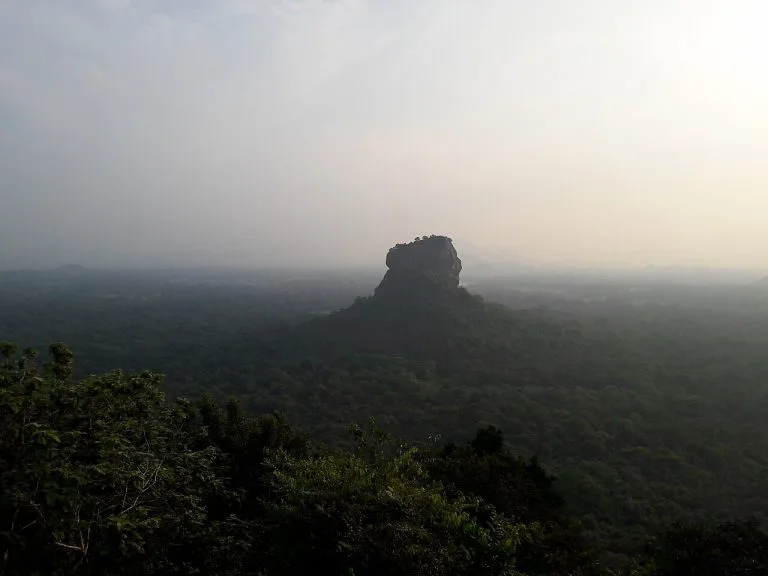
A guide to Sri Lanka's Cultural Triangle: Sigiriya, Polonnaruwa, Anuradhapura, Dambulla and Mihintale, with travel tips.

A complete guide to Sigiriya Rock Fortress: King Kashyapa's parricide, the water gardens, the famous frescoes, visiting tips and map.
A guide to the ancient city of Polonnaruwa: from Chola conquest to Parakramabahu the Great's garden-city, visiting tips and map.













