

Dsigngo is a Graphic Design and Digital Marketing Company.
Write what you are looking for and press enter to begin your search!

The Cultural Triangle, Sri Lanka
Ritigala
A king troubled by his monks growing too comfortable sent them to the harshest mountain he could find, founding a monastery for ascetics who deliberately wore rags rather than fine robes.
Long before it became a monastery, Ritigala was already famous in legend, the spot, according to the Ramayana, where the monkey god Hanuman accidentally dropped a fragment of the Himalayas while racing to save a wounded prince, explaining, in local telling, why the mountain’s plant life looks nothing like the dry-zone landscape surrounding it.
Quick Facts
| Location | North Central Province, between Anuradhapura and Habarana |
| Legendary origin | A fragment of the Himalayas dropped by Hanuman, per the Ramayana |
| Historical monastery founded | 833 CE, by King Sena I |
| Resident monks | The Pansukulika (‘rag-robe wearers’), a reformist ascetic order |
| Protection status | Ritigala Strict Nature Reserve, 3,776 acres |
| Botanical significance | 417 recorded plant species, including 3 found nowhere else on Earth |
Commonly searched as: Ritigala · Ritigala monastery · Pansukulika monks · Ritigala Ramayana legend · things to do in the Cultural Triangle
A Mountain Fallen From the Himalayas
According to the most widely told version of the legend, the monkey god Hanuman journeyed to the Himalayas seeking specific medicinal herbs to heal Rama’s brother Lakshmana, gravely wounded in battle against the demon king Ravana. Unable to identify the exact herbs required, Hanuman instead tore away an entire section of mountain, laden with medicinal plants, and began carrying it back toward the battlefield. During that flight across the Palk Strait, a fragment slipped from his grasp, falling onto Sri Lanka and forming Ritigala, explaining, in local tradition, why the mountain’s summit vegetation looks so strikingly different from the surrounding dry-zone plains. A related tradition holds that Ritigala later served as Hanuman’s own launching point for his leap back toward India, after he had located Sita.
Beyond legend, Ritigala’s documented history reaches back to the 3rd century BCE, when Prince Pandukabhaya reportedly took refuge here, and the Chulavamsa records King Jettatissa organising his army at Ritigala before a campaign against Indian invaders. A Buddhist temple, Sanka Vihara, was built at the mountain’s foot as early as the 2nd century BCE, and rock inscriptions dating to the 1st century BCE confirm the presence of hermit monks on the mountain well before its most significant construction period began.
A Monastery Built for Rebellious Monks
Ritigala’s defining historical chapter arrived in 833 CE, when King Sena I, troubled by what he saw as growing wealth and laxity among the established monastic institutions of Anuradhapura, built an extensive new monastery complex high on Ritigala’s slopes, specifically for a reformist ascetic movement known as the Pansukulikas, literally “the rag-robe wearers.” Their name captured their entire philosophy: rejecting the increasingly comfortable, well-endowed lifestyle of city monasteries in favour of a deliberately austere, forest-dwelling existence, wearing robes made from discarded rags rather than fine cloth.
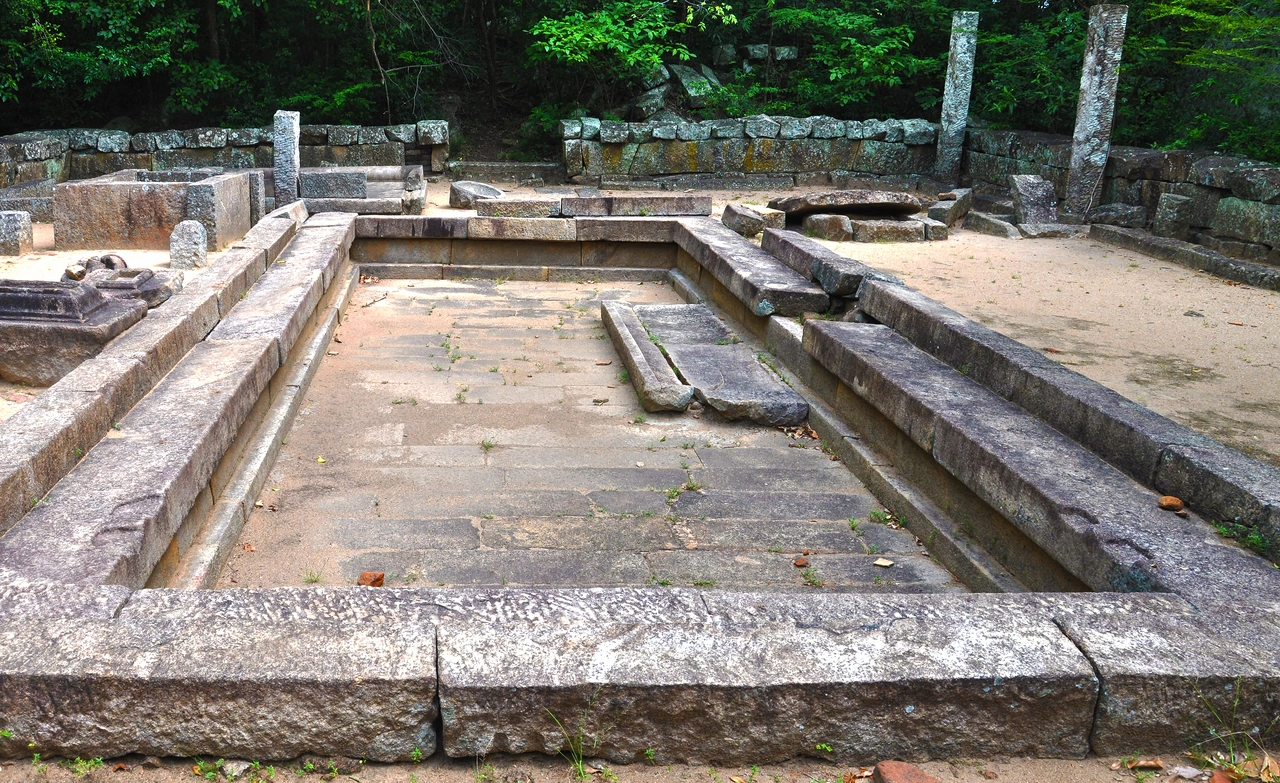
The ruins visitors encounter today largely date to this Pansukulika-era complex, characterised by a distinctive minimalist architectural style, stone pathways, meditation platforms, and quiet bathing ponds integrated directly into the natural forest landscape, a deliberate contrast to the towering stupas and elaborate carvings found at more conventional Sri Lankan Buddhist sites. Most of these monasteries were later damaged during Chola invasions around 1200 CE, ending Ritigala’s active use as a major monastic centre.
A Genuine Botanical Anomaly
Modern botanical surveys have recorded 417 distinct plant species on Ritigala, 96 of which are used in traditional Ayurvedic medicine, and three species, including Plectranthus elongatus, Madhuca clavata, and Thunbergia fragrans, found nowhere else on Earth. That density of medicinal and unique flora has genuinely puzzled researchers for generations, offering an intriguing scientific counterpart to the mountain’s mythological reputation as a source of powerful healing herbs.
Visiting Tips
- Arrange a tuk-tuk or private driver, since Ritigala sits off the main tourist circuit and isn’t easily reached by public transport.
- Wear sturdy footwear given the forested, uneven terrain throughout the site.
- Combine with a visit to Habarana or Anuradhapura, both within reasonable driving distance.
- Watch for wildlife along the approach road, including occasional elephants in the surrounding area.
Where It Sits on the Map
Ritigala Strict Nature Reserve, North Central Province Open in Google Maps ↗
Frequently Asked Questions
What is the Ramayana legend associated with Ritigala?
According to tradition, the monkey god Hanuman dropped a fragment of the Himalayas here while carrying medicinal herbs to heal the wounded Prince Lakshmana, explaining the mountain’s unusual flora.
Who built the monastery at Ritigala?
King Sena I, in 833 CE, specifically for the Pansukulikas, a reformist order of ascetic monks who wore rag robes and rejected the comforts of established city monasteries.
Why is Ritigala botanically significant?
It hosts 417 recorded plant species, including three found nowhere else on Earth, an unusual concentration for the surrounding dry-zone region.
Is Ritigala easy to visit?
It’s relatively off the beaten path, best reached by tuk-tuk or private car, and sees far fewer visitors than Sigiriya or Anuradhapura.
← Sri Lanka: The Complete Guide — see all 258 places by region
Related News
A guide to Sri Lanka's Cultural Triangle: Sigiriya, Polonnaruwa, Anuradhapura, Dambulla and Mihintale, with travel tips.

A complete guide to Sigiriya Rock Fortress: King Kashyapa's parricide, the water gardens, the famous frescoes, visiting tips and map.
A guide to the ancient city of Polonnaruwa: from Chola conquest to Parakramabahu the Great's garden-city, visiting tips and map.













