

Dsigngo is a Graphic Design and Digital Marketing Company.
Write what you are looking for and press enter to begin your search!

The Cultural Triangle, Sri Lanka
Panduwas Nuwara
Local legend holds that a princess was once locked inside a round stone tower here by her own brothers, fulfilling a prophecy that her son would kill his uncles, a story with no archaeological proof but genuine staying power.
Panduwasnuwara’s name ties it to a king who supposedly ruled in the 6th century BCE, but most of what visitors actually walk through today dates from an entirely different era, the 12th-century temporary capital of the man who would go on to become Sri Lanka’s most celebrated builder-king.
Quick Facts
| Location | Northwestern Province, near Hettipola |
| Legendary founder | King Panduwasdeva, 504 to 474 BCE |
| Reservoir | Panda Wewa, built around 450 BCE, possibly the world’s first large man-made reservoir |
| Actual ruins date to | 12th century CE, under Parakramabahu I as sub-king of Dakkhinadesa |
| Site size | About 20 hectares, the largest excavation site in the North Western Province |
| Notable structure | A circular palace tower (Chakrawalaya) surrounded by a wide moat |
Commonly searched as: Panduwasnuwara · Panduwas Nuwara ancient city · Parakramabahu temporary capital · Panduwasnuwara round tower · things to do in the Cultural Triangle
A Name Older Than the Ruins Themselves
Panduwasnuwara’s name traces back to King Panduwasdeva, who according to tradition ruled from 504 to 474 BCE and is credited with building the Panda Wewa reservoir around 450 BCE, an engineering feat some accounts describe as possibly the first large man-made reservoir constructed anywhere in the world. That deep historical association, however, appears to be largely legendary rather than archaeologically confirmed: the structures visitors actually encounter at the site today date almost entirely to a much later period, the 12th century CE, when Prince Parakramabahu, who would go on to become Parakramabahu the Great, established Panduwasnuwara (then called Parakramapura) as his temporary capital while ruling the sub-kingdom of Dakkhinadesa, decades before unifying the island and moving his court to Polonnaruwa.
The name “Panduwasnuwara” itself is believed to have come into common use only during the later Kurunegala period, well after Parakramabahu’s time, retroactively linking the site back to the earlier, semi-legendary king despite limited archaeological evidence directly connecting the two.
A Princess, a Tower, and a Prophecy
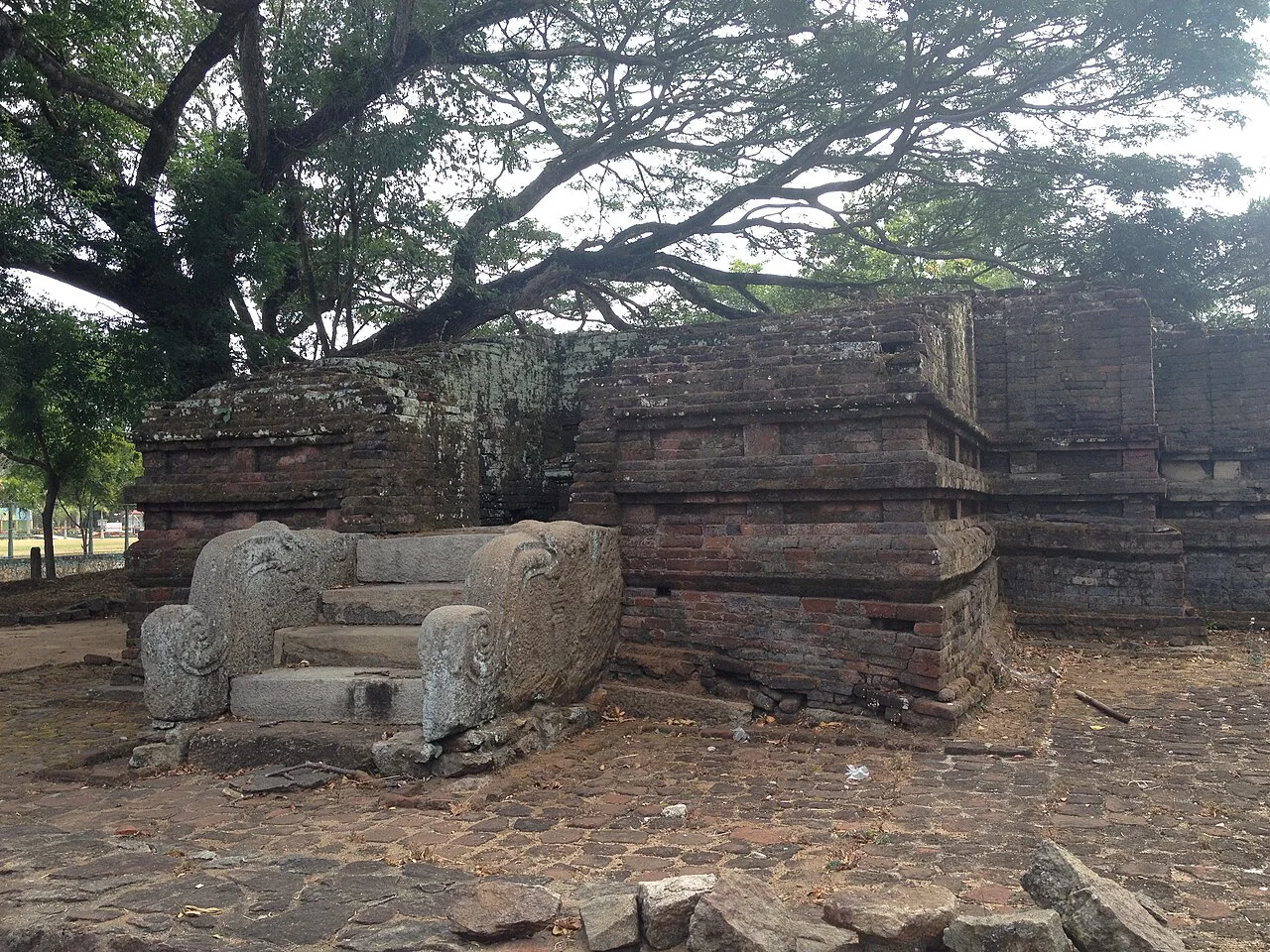
The site’s most enduring local legend centres on a circular stone structure known as the Chakrawalaya, or Ektemge, said to be where Princess Unmada Chitra was confined by her own brothers, acting on a prophecy that her future son would grow up to kill his uncles. Nearby, a village called Dorabawa is popularly linked to the childhood home of Prince Pandukabhaya, the figure at the centre of that same prophecy legend. Historians are careful to note that no archaeological evidence actually supports these specific identifications, the round tower most likely belongs to the 12th-century Polonnaruwa-era palace complex rather than the far earlier legendary period, but the story remains a genuinely popular and frequently repeated part of how local guides and visitors alike experience the site.
A City in Layers
Beyond the round tower, Panduwasnuwara’s roughly 20-hectare site includes the ruins of a moated palace complex, a Temple of the Tooth, distinct from the far more famous Kandy shrine, once believed to have briefly held the sacred relic after its return from India, and several monastery complexes, including the Damila Adhikarige Vihara, built by a Tamil minister serving under Parakramabahu I and later expanded by a general under King Nissanka Malla, whose Tamil-language dedicatory inscription still survives at the entrance.
Visiting Tips
- Approach the site with modest expectations if short on time, most guides agree it’s a worthwhile but non-essential stop rather than a must-see for a tight itinerary.
- Look for the circular moat surrounding the palace tower, the site’s most visually distinctive feature.
- Combine with nearby Yapahuwa, about 20 km away, for a fuller day covering both lesser-visited Cultural Triangle ruins.
- Bring a guide or reference material, since much of the site’s context, including its legends, isn’t well signposted on-site.
Where It Sits on the Map
Panduwasnuwara (Parakramapura), near Hettipola, North Western Province Open in Google Maps ↗
Frequently Asked Questions
Who is Panduwasnuwara named after?
King Panduwasdeva, traditionally dated to 504 to 474 BCE, though most surviving ruins actually date to the 12th-century reign of Parakramabahu I.
What is the legend of the round tower?
Local tradition holds it as the prison of Princess Unmada Chitra, confined by her brothers due to a prophecy that her son would kill them; historians note this isn’t archaeologically confirmed.
Was Panduwasnuwara ever a capital?
Yes, briefly, as Parakramapura, the temporary capital of Prince Parakramabahu (later Parakramabahu the Great) while ruling the sub-kingdom of Dakkhinadesa in the 12th century.
Is Panduwasnuwara a must-visit site?
It’s generally considered a worthwhile secondary stop rather than an essential one for travellers with limited time in the Cultural Triangle.
← Sri Lanka: The Complete Guide — see all 258 places by region
Related News
A guide to Sri Lanka's Cultural Triangle: Sigiriya, Polonnaruwa, Anuradhapura, Dambulla and Mihintale, with travel tips.

A complete guide to Sigiriya Rock Fortress: King Kashyapa's parricide, the water gardens, the famous frescoes, visiting tips and map.
A guide to the ancient city of Polonnaruwa: from Chola conquest to Parakramabahu the Great's garden-city, visiting tips and map.













