

Dsigngo is a Graphic Design and Digital Marketing Company.
Write what you are looking for and press enter to begin your search!

The Cultural Triangle, Sri Lanka
Yapahuwa
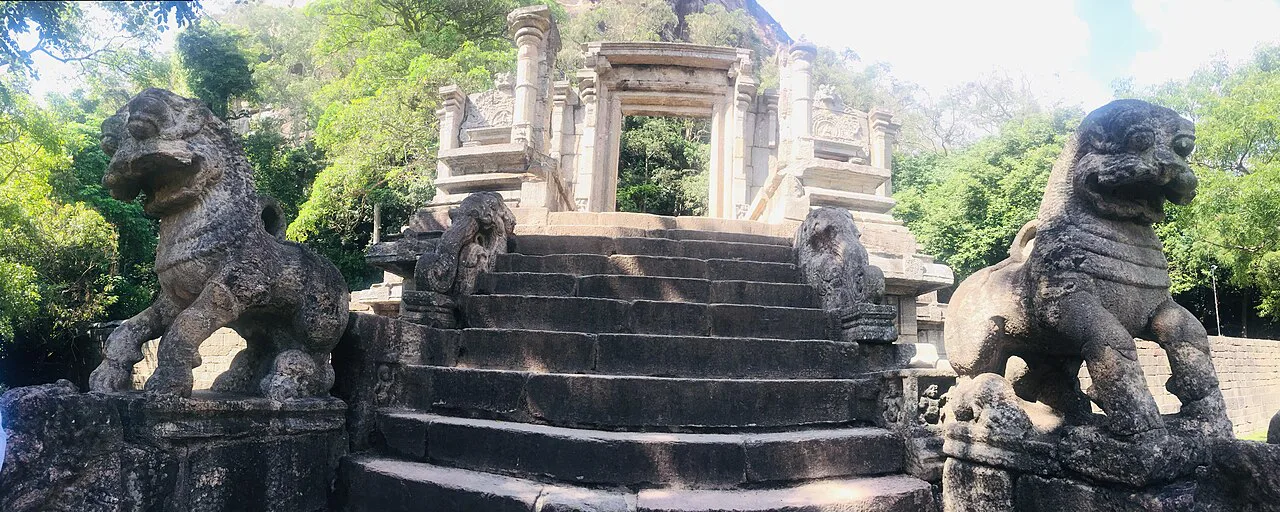
For just twelve years, this granite rock served as Sri Lanka’s capital, and the lion carvings flanking its staircase became so iconic they eventually found their way onto the national flag.
Yapahuwa’s reign as Sri Lanka’s capital lasted barely a dozen years, yet in that brief window it produced a staircase so ornately carved, and lion sculptures so striking, that they’ve outlived every other physical trace of the kingdom that built them.
Quick Facts
| Location | North Western Province, between Kurunegala and Anuradhapura |
| Original name | Subha Pabbata (later corrupted to Yapahuwa) |
| Capital period | 1272 to 1284 CE |
| Founded by | King Bhuvanekabahu I, moving from Polonnaruwa |
| Rock height | 90 metres (300 ft) |
| Fell to | Pandyan invasion from South India, 1284 CE |
Commonly searched as: Yapahuwa Rock Fortress · Yapahuwa lion staircase · Yapahuwa Tooth Relic · Sri Lanka national flag lion · things to do in the Cultural Triangle
A Twelve-Year Capital, Built to Protect a Relic
In 1272, King Bhuvanekabahu I moved Sri Lanka’s capital from Polonnaruwa to Yapahuwa, a massive granite rock rising 90 metres above the surrounding plains, chosen specifically for its natural defensive advantages against continued South Indian invasion. The move brought with it the island’s most politically significant object: the Sacred Tooth Relic of the Buddha, whose possession, according to long-held Sri Lankan tradition, conferred the right to rule the land. Bhuvanekabahu constructed a specially built temple within the fortress to house the relic, continuing an ancient tradition of tying royal legitimacy directly to guardianship of this single sacred object.
That arrangement proved tragically short-lived. Following King Bhuvanekabahu’s death in 1284, Pandyan forces from South India invaded and successfully captured Yapahuwa, seizing the Sacred Tooth Relic and carrying it back to their own territory, a devastating blow to Sinhalese sovereignty and Buddhist religious life. The relic was eventually recovered, brought back to Sri Lanka in 1288 by King Parakramabahu III, but Yapahuwa itself never regained its status as capital, and the fortress was subsequently abandoned as a seat of political power, later inhabited instead by Buddhist monks and religious ascetics.
The Staircase That Outlasted the Kingdom
Yapahuwa’s most celebrated feature is its ornamental stone staircase, roughly 73 to 100 steps depending on the source, ascending at a deliberately steep angle, said to have been designed specifically to give defending soldiers a strategic advantage on the high ground against any attacking force. Flanking the staircase near its summit stand a pair of stone lion sculptures, carved with a level of artistry that has made them one of the most recognisable individual pieces of medieval Sri Lankan sculpture. Those lion carvings achieved a lasting legacy well beyond their original fortress: they directly inspired the design of the lion appearing on Sri Lanka’s national flag, and one of the lions was even featured on a former 10-rupee banknote, a genuinely rare example of 13th-century military architecture leaving a visible mark on 20th and 21st-century national symbolism.
Destroyed by the Portuguese, Restored by Archaeologists
Yapahuwa suffered further destruction in the mid-16th century, when Portuguese forces demolished most of the fortress’s remaining buildings, leaving it largely in ruins. During the 18th-century reign of King Kirti Sri Rajasingha, part of the site was refurbished as a cave temple, and more recent archaeological excavation has helped preserve and document what survives, including an on-site museum displaying artefacts recovered from the ruins.
Visiting Tips
- Climb the ornamental staircase for a close look at the lion carvings, best photographed in morning light.
- Visit the on-site archaeological museum for context on the fortress’s brief but eventful history.
- Combine with nearby Panduwasnuwara, about 20 km away, for a fuller day covering both lesser-visited Cultural Triangle sites.
- Wear sturdy footwear, given the steep angle of the historic staircase.
Where It Sits on the Map
Yapahuwa Rock Fortress, North Western Province Open in Google Maps ↗
Frequently Asked Questions
How long was Yapahuwa Sri Lanka’s capital?
Just twelve years, from 1272 to 1284 CE, under King Bhuvanekabahu I, before Pandyan forces from South India invaded and captured it.
Why did the king move the capital to Yapahuwa?
The rock’s natural defensive height offered protection against continuing South Indian invasions, and it was chosen specifically to safeguard the Sacred Tooth Relic.
What happened to the Sacred Tooth Relic?
It was seized by Pandyan invaders in 1284 and carried to South India, before being recovered and brought back to Sri Lanka in 1288 by King Parakramabahu III.
Why are Yapahuwa’s lion carvings significant?
They inspired the design of the lion on Sri Lanka’s national flag and once appeared on a former 10-rupee banknote.
← Sri Lanka: The Complete Guide — see all 258 places by region
Related News
A guide to Sri Lanka's Cultural Triangle: Sigiriya, Polonnaruwa, Anuradhapura, Dambulla and Mihintale, with travel tips.

A complete guide to Sigiriya Rock Fortress: King Kashyapa's parricide, the water gardens, the famous frescoes, visiting tips and map.
A guide to the ancient city of Polonnaruwa: from Chola conquest to Parakramabahu the Great's garden-city, visiting tips and map.













