

Dsigngo is a Graphic Design and Digital Marketing Company.
Write what you are looking for and press enter to begin your search!

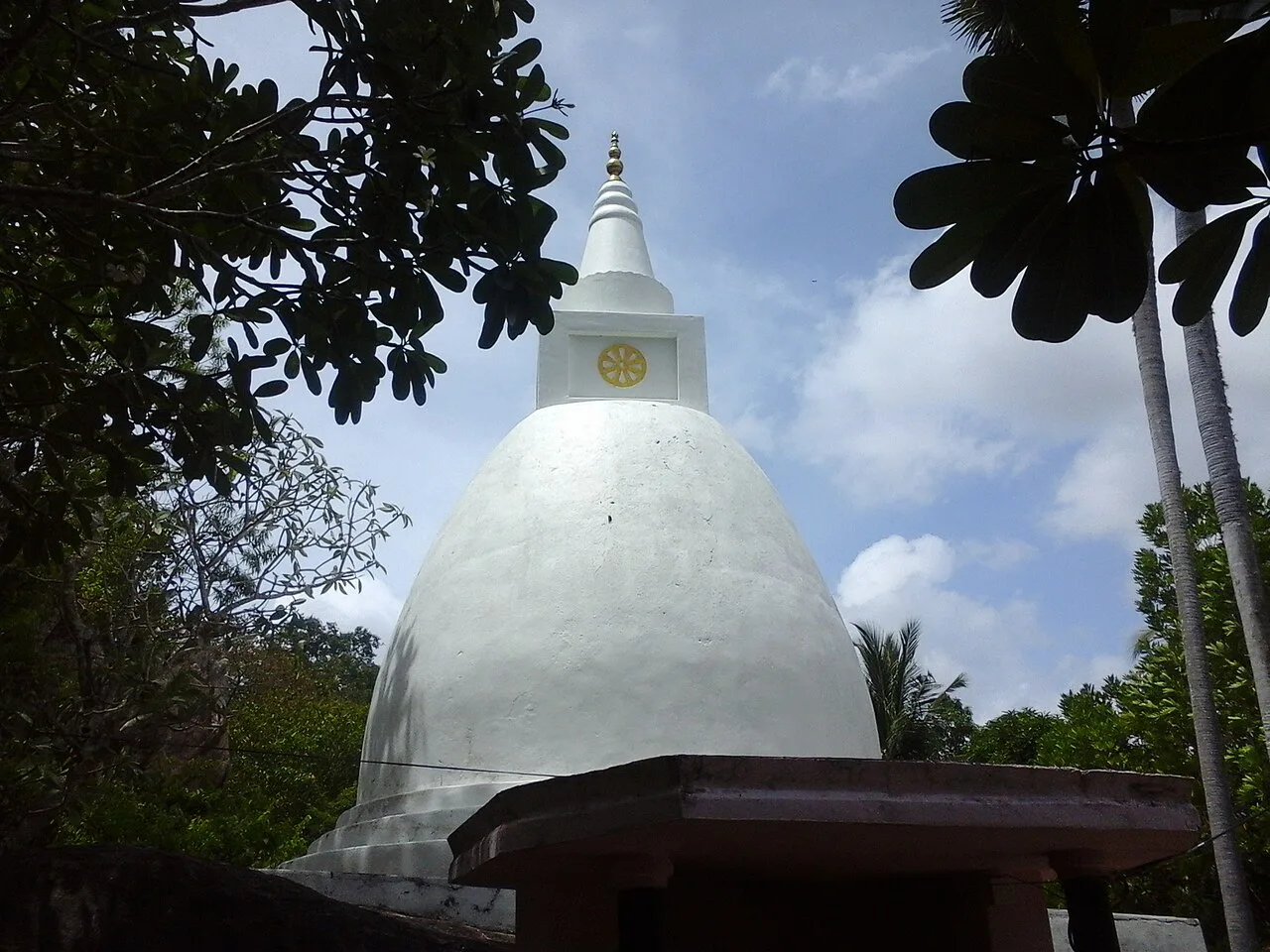
Near Tangalle, The South
Mulgirigala
A rock temple carved into a 205-metre boulder in the southern hinterland, so architecturally similar to Dambulla that it’s often called the Dambulla of the South, and where a lost portion of the Mahavamsa chronicle was rediscovered.
Mistaken by 17th-century Dutch visitors for the biblical Adam’s Peak, and once home to a library where a British colonial scholar recovered lost portions of Sri Lanka’s ancient royal chronicle, Mulgirigala carries a genuinely layered history to match its five tiers of rock-cut shrines.
Quick Facts
| Location | 17 km northwest of Tangalle, Hambantota District |
| Rock size | About 205 metres long, flanked by four smaller rocks |
| Earliest use | Cave shelters used by monks since at least the 2nd century BCE |
| Royal patronage | Traditionally founded under King Saddhatissa (3rd century BCE); stupa added by King Dhatusena (5th century CE) |
| Major restoration | 18th century, under King Kirti Sri Rajasinha |
| Historic nickname | ‘Adam’s Berg,’ given by Dutch colonists who confused it with Adam’s Peak |
Commonly searched as: Mulgirigala rock temple · Mulkirigala Sri Lanka · Dambulla of the South · Tangalle rock temple · things to do near Tangalle
Two Thousand Years of Continuous Use
Mulgirigala’s history as a place of monastic retreat stretches back to at least the 2nd century BCE, when Buddhist monks first used natural shelters within the rock for meditation, a period confirmed by an early rock inscription referencing Upasona, a reciter of the Majjhima Nikaya from the Pali Canon, providing direct epigraphic evidence of pre-Christian Buddhist activity at the site. The Mahavamsa, Sri Lanka’s ancient chronicle, credits King Saddhatissa with formally establishing the temple in the 3rd century BCE, and later King Dhatusena, reigning from around 459 to 477 CE, added a stupa during his own building programme.
The temple’s most significant renovation came far later, in the mid-18th century, under King Kirti Sri Rajasinha of Kandy, whose patronage produced the vivid Kandyan-period murals still visible in several caves today. This revival was carried out under the guidance of a disciple of Saranankara Thero, the founder of Sri Lanka’s Syam Nikaya monastic order, who had personally travelled to Siam (modern Thailand) to reintroduce a valid line of ordination and restore Buddhist monastic life on the island after a period of decline.
Mistaken for Adam’s Peak
During the 17th and 18th centuries, Dutch colonists who controlled Ceylon’s maritime provinces referred to Mulgirigala’s rock as “Adamsberg,” genuinely believing, in a case of geographic confusion, that the tombs of Adam and Eve were located there, apparently conflating it with the far more famous Adam’s Peak (Sri Pada) elsewhere on the island. Dutch writer Albrecht Herport recorded seeing “the image of Adam formed on earth, of remarkable size, lying on the hill,” a description that likely refers to one of the temple’s large reclining Buddha statues, misread through an unfamiliar religious lens.
A Lost Chronicle, Recovered
Mulgirigala holds a genuinely important place in the modern rediscovery of Sri Lankan history. It was in the library of the Mulkirigala monastery that British colonial officer and scholar George Turnour, alongside contributing significantly to deciphering the inscriptions on Ashoka’s pillars, discovered missing sections of the Mahavamsa chronicle in the 19th century, along with detailed commentaries on the text. That find played a crucial role in reconstructing Sri Lanka’s ancient historical record as understood today.
Climbing the Rock
Visitors ascend roughly 500 steps across five terraced levels, each holding cave temples carved into the rock face: image houses with reclining, seated and standing Buddha statues, devalayas dedicated to guardian deities, a commemorative stupa honouring Vatarakgoda Dhammapala (the temple’s 18th-century refounder), and murals depicting Jataka tales and scenes from the Buddha’s life, including well-known depictions titled “Anotatta Vila,” “Uturu Kuru Divayina,” and the birth of Prince Siddhartha at Lumbini. The climb culminates at the summit, where a white dagoba and sweeping coastal views reward the effort.
Visiting Tips
- Wear sturdy, comfortable shoes for the roughly 500-step climb, and avoid visiting during the monsoon when steps can be slippery.
- Visit November to April for the most comfortable climbing conditions.
- Look closely at the Kandyan-era murals in the upper caves, among the finest examples of that painting style outside the Cultural Triangle.
- Combine with a wider Tangalle-area itinerary, given the temple’s relatively short distance from the coast.
Where It Sits on the Map
Mulgirigala Rock Temple, near Tangalle, Hambantota District Open in Google Maps ↗
Frequently Asked Questions
Why is Mulgirigala called the ‘Dambulla of the South’?
Because its architecture, a series of Buddhist cave shrines carved into a large rock outcrop across multiple terraced levels, closely resembles the more famous Dambulla cave temple complex in the Cultural Triangle.
How old is Mulgirigala?
Monks used cave shelters here since at least the 2nd century BCE, with the temple traditionally credited to King Saddhatissa in the 3rd century BCE and later expanded by King Dhatusena and King Kirti Sri Rajasinha.
Why did the Dutch call it ‘Adamsberg’?
Dutch colonists mistakenly believed the site held the tombs of Adam and Eve, apparently confusing it with Sri Lanka’s more famous Adam’s Peak (Sri Pada).
What historically significant discovery happened at Mulgirigala?
British scholar George Turnour discovered missing portions of the Mahavamsa chronicle in the temple’s monastery library during the 19th century, a major contribution to reconstructing Sri Lanka’s ancient history.
← Sri Lanka: The Complete Guide — see all 258 places by region
Related News
A guide to Southern Sri Lanka, from Galle to Kataragama: beaches, wildlife safaris, colonial forts, and travel tips.

A complete guide to Galle Fort: history from Ptolemy to the Dutch, walking the ramparts, top sights, and visiting tips.
A guide to the Dutch Reformed Church in Galle Fort: the story behind its 1755 completion, the tombstone floor, visiting tips and map.













