

Dsigngo is a Graphic Design and Digital Marketing Company.
Write what you are looking for and press enter to begin your search!

Anuradhapura, Cultural Triangle
Kuttam Pokuna and the Samadhi Buddha
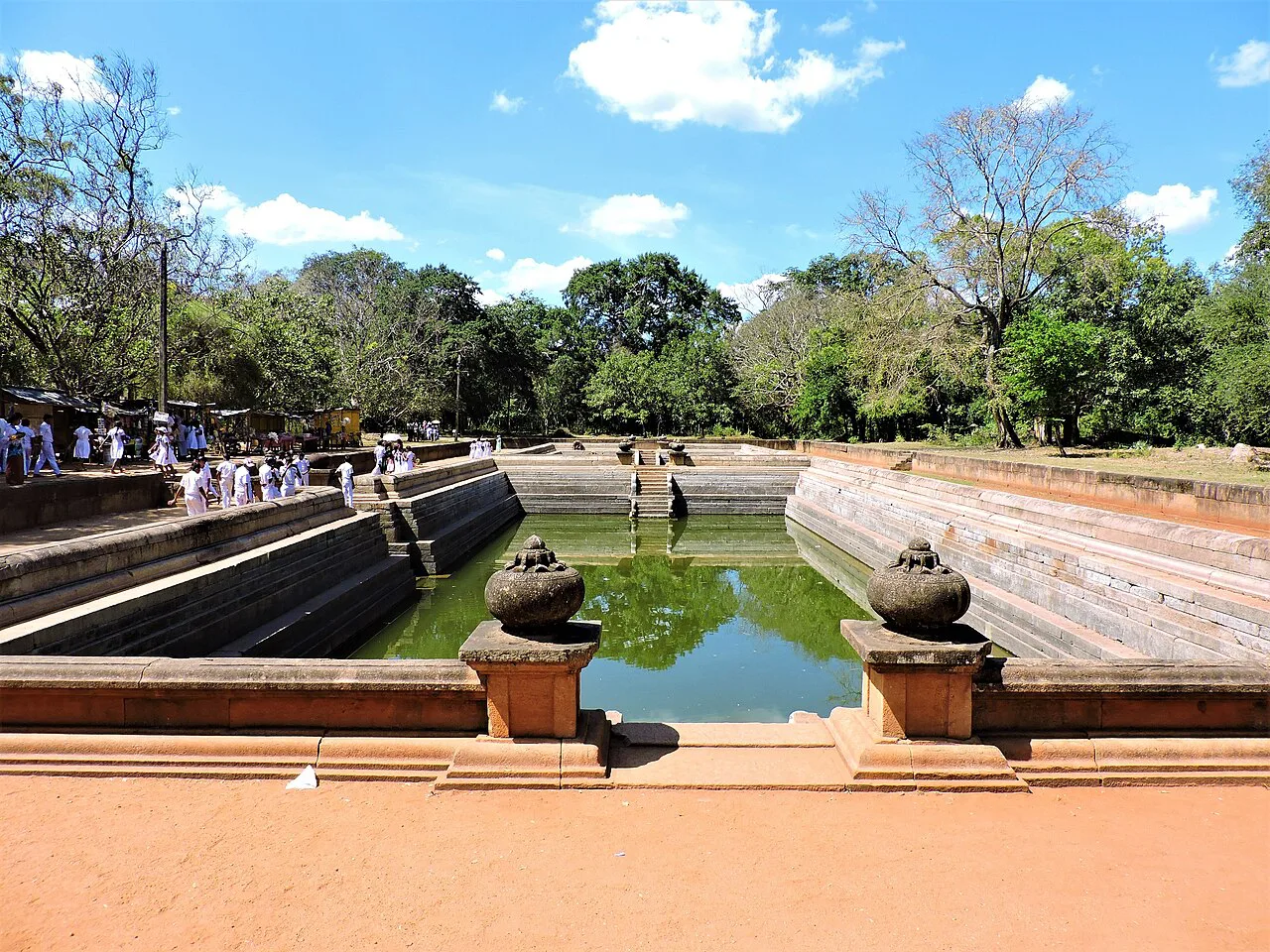
Two deliberately mismatched bathing pools built for monastic ritual, standing beside a serene granite Buddha statue that was already damaged when 19th-century excavators first uncovered it.
Despite their name, Kuttam Pokuna’s two ponds aren’t actually twins at all, one measures 40 metres long, the other just 28, a deliberate asymmetry that hasn’t stopped visitors for over a thousand years from admiring them as one of ancient Sri Lanka’s most elegant feats of hydraulic engineering.
Quick Facts
| Location | Within the Abhayagiri Monastery complex, Anuradhapura |
| Meaning of name | ‘Kuttam Pokuna’ translates to ‘Twin Ponds’ |
| Dating | Estimated 6th to 8th century CE (some sources cite King Aggabodhi I’s reign) |
| Pond sizes | Northern pond 40 m long, southern pond 28 m long |
| Function | Ritual bathing pools for monks of Abhayagiri Monastery |
| Nearby feature | The Samadhi Buddha statue, roughly 4th century CE |
Commonly searched as: Kuttam Pokuna · Twin Ponds Anuradhapura · Samadhi Buddha statue · Abhayagiri bathing pools · things to do in Anuradhapura
Engineering Precision Disguised as Simplicity
Kuttam Pokuna, “Twin Ponds,” were built within the Abhayagiri Monastery complex specifically for the ritual bathing needs of its resident monks, most historians dating their construction to somewhere between the 6th and 8th centuries CE, with some sources crediting the reign of King Aggabodhi I. Despite the “twin” name, the two pools are noticeably different sizes, the northern pond stretches about 40 metres, while the southern measures roughly 28, a discrepancy that has led some historians to suggest the pools were actually built during different periods rather than as a single, simultaneous project.
Whatever their exact construction history, the ponds represent a genuine masterpiece of ancient Sinhalese hydraulic and architectural design. Gracefully carved stone steps descend symmetrically from all sides into the water, and the surrounding stonework has survived remarkably well, allowing modern visitors to appreciate essentially the same elegant, carefully proportioned bathing pools that Abhayagiri’s monks would have used well over a thousand years ago.
A Buddha Found Already Broken
A short walk from the Twin Ponds sits the Samadhi Buddha statue, carved from a single block of granite and dated to approximately the 4th century CE, depicting the Buddha in Samadhi, the seated meditation posture associated with his path to enlightenment. Widely regarded as one of the finest surviving examples of ancient Sri Lankan Buddhist sculpture, the statue’s serene, deeply contemplative expression has drawn admiration from visitors and scholars alike for generations.
The statue’s modern history carries its own quiet poignancy: when it was rediscovered during 19th-century excavations, it was already found partially damaged, its exact original condition and setting lost to the centuries of jungle overgrowth that had swallowed much of Anuradhapura following the city’s political decline. Even in its damaged state, the statue’s calm expression has become one of the most reproduced and recognisable images associated with Sri Lankan Buddhist art.
That widespread recognition extends well beyond Sri Lanka itself. Reproductions and photographs of the Samadhi Buddha have circulated internationally for decades, making it one of the more globally familiar images of ancient Sinhalese art, often used to represent Sri Lankan Buddhist sculpture in art history references and museum contexts far from Anuradhapura. Standing before the original in person, rather than a reproduction, gives visitors a sense of scale and texture, the cool weight of the granite, the precise, unhurried carving of the face, that photographs alone can’t fully convey.
Part of a Larger Monastic Landscape
Both the Twin Ponds and the Samadhi Buddha sit within the broader Abhayagiri Monastery complex, alongside other notable water features including the Eth Pokuna (Elephant Pond), the largest man-made pond anywhere in Anuradhapura, and the Yathuru Pokuna (Key Pond), together illustrating just how central water management and ritual bathing were to daily monastic life at the height of Abhayagiri’s influence.
Visiting Tips
- Visit both sites together, given their close proximity within the wider Abhayagiri complex.
- Take time to appreciate the carved stone steps at Kuttam Pokuna up close, a genuinely fine example of ancient stonework.
- Approach the Samadhi Buddha statue quietly and respectfully, given its role as an active object of Buddhist veneration.
- Combine with a wider tour of Abhayagiri Monastery and its stupa for a fuller half-day in this section of Anuradhapura.
Where It Sits on the Map
Kuttam Pokuna and Samadhi Buddha, Abhayagiri Monastery complex, Anuradhapura Open in Google Maps ↗
Frequently Asked Questions
Why are the Kuttam Pokuna ponds called ‘twins’ if they’re different sizes?
The name reflects their paired function as monastic bathing pools rather than identical dimensions; the northern pond is about 40 metres long, the southern about 28 metres.
What were the ponds used for?
Ritual bathing by monks of the Abhayagiri Monastery, likely as part of purification practices before religious observance.
How old is the Samadhi Buddha statue?
Approximately 4th century CE, carved from a single block of granite in the Samadhi meditation posture.
Was the Samadhi Buddha statue always in its current condition?
No, it was already partially damaged when rediscovered during 19th-century excavations, following centuries of jungle overgrowth after Anuradhapura’s political decline.
← Sri Lanka: The Complete Guide — see all 258 places by region
Related News
A guide to Sri Lanka's Cultural Triangle: Sigiriya, Polonnaruwa, Anuradhapura, Dambulla and Mihintale, with travel tips.

A complete guide to Sigiriya Rock Fortress: King Kashyapa's parricide, the water gardens, the famous frescoes, visiting tips and map.
A guide to the ancient city of Polonnaruwa: from Chola conquest to Parakramabahu the Great's garden-city, visiting tips and map.













