

Dsigngo is a Graphic Design and Digital Marketing Company.
Write what you are looking for and press enter to begin your search!

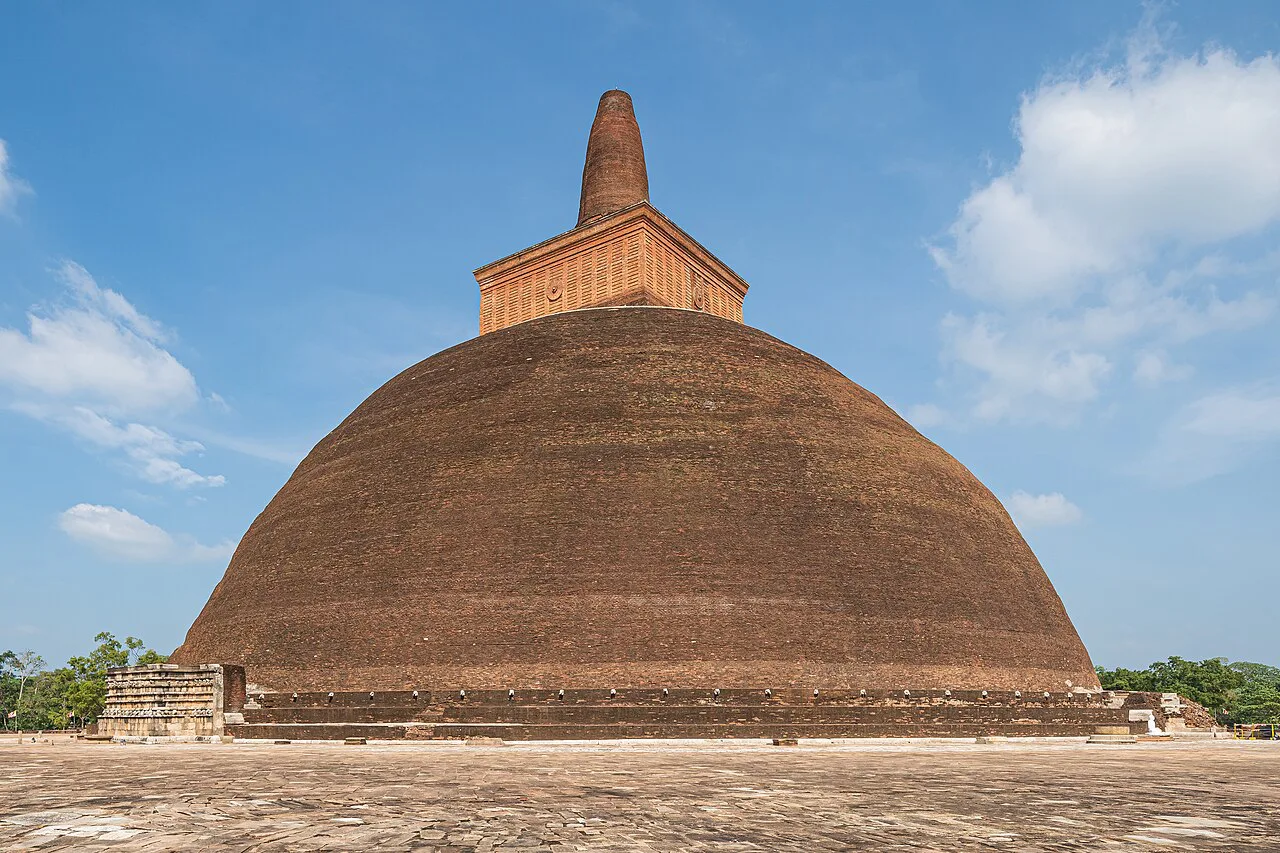
Anuradhapura, Cultural Triangle
Abhayagiri Monastery
A king, fleeing his own capital during a Tamil invasion, overheard a rival religious leader mocking his retreat, and swore that if he ever returned to power, he’d build a monastery on that very spot.
Abhayagiri’s origin story is one of the most personal in all of Anuradhapura’s history: a king humiliated in exile, a mocking insult he never forgot, and a monastery built years later as both religious devotion and pointed retribution.
Quick Facts
| Location | Northwestern Anuradhapura Sacred City |
| Founded by | King Valagamba (Vattagamini Abhaya), 88 BCE |
| Site history | Built on the site of a demolished rival temple, Nigantharamaya |
| Peak population | Around 5,000 monks |
| Complex size | Over 200 hectares |
| Stupa height | Originally around 115 m (or 400 ft by some accounts), now about 70 to 75 m |
Commonly searched as: Abhayagiri Monastery · Abhayagiri Dagoba Anuradhapura · King Valagamba · Abhayagiri sect Buddhism · things to do in Anuradhapura
An Insult the King Never Forgot
In the 1st century BCE, King Valagamba, also recorded as Vattagamini Abhaya, was forced to flee Anuradhapura during a Tamil Chola invasion. As he retreated, hiding from the invaders, he reportedly passed near a temple belonging to a Hindu ascetic named Giri, a Nigantha, who mocked the fleeing king aloud, remarking sarcastically that “the great Sinhala giant is fleeing.” Valagamba, humiliated but determined, eventually reclaimed his throne, and true to what tradition describes as a vow made in that moment of retreat, he demolished Giri’s temple, Nigantharamaya, and built an entirely new Buddhist monastery on the exact same ground: Abhayagiri.
That founding, part genuine religious devotion, part personal vindication, gave the new monastery a name that itself carried meaning, generally understood to reference the king’s own name (Abhaya) combined with the site’s earlier association with Giri, the very priest whose mockery had prompted its construction.
The Largest Monastery in the Kingdom
Abhayagiri grew rapidly into the most significant religious institution in Anuradhapura, eventually covering over 200 hectares and, by the 5th century CE, housing as many as 5,000 monks, the largest and most dynamic monastic community anywhere in Sri Lanka at the time. The monastery became home to its own distinct Buddhist sect, the Abhayagiri Nikaya, which developed following a schism with the older Mahavihara monastery, embracing both Theravada and Mahayana teachings and building a reputation for scholarship that drew visiting monks from across Asia, including the celebrated Chinese pilgrim Fa-hien, who documented his stay there in the early 5th century.
The monastery maintained a substantial library, though historical records indicate it was destroyed at points during the reigns of later kings hostile to the Abhayagiri sect’s teachings, part of the recurring doctrinal tension that shaped religious politics throughout Anuradhapura’s history.
That tension between Abhayagiri and the more conservative Mahavihara monastery ran through Anuradhapura’s entire religious history, occasionally spilling over into royal politics whenever a king favoured one institution’s teachings over the other. Abhayagiri’s willingness to engage with Mahayana ideas, unusual for a Theravada-majority island, made it a genuinely distinctive centre within the wider Buddhist world, one reason foreign monks like Fa-hien specifically sought it out during their travels rather than settling at one of the capital’s other major monasteries.
The Abhayagiri Stupa
At the heart of the complex stands the Abhayagiri Dagoba itself, a massive brick stupa that a 5th-century Chinese visiting monk recorded as standing some 400 feet tall. Today, having lost its pinnacle and suffered centuries of weathering, the stupa stands at roughly 70 to 75 metres, still an imposing presence despite the reduction from its original height.
A Fa-Hien Museum
A dedicated museum at the site, established in memory of the Chinese pilgrim Fa-hien, preserves and displays treasures recovered from excavations across the complex: gold and gem-studded ornaments and jewellery, ancient coins, metal objects, moulds and crucibles used in their manufacture, ceramics, pottery, glass, tiles and sculptures, offering a genuinely rich material record of daily and religious life at the height of the monastery’s influence.
Visiting Tips
- Combine with the nearby Kuttam Pokuna twin ponds and Samadhi Buddha statue, both part of the same wider monastic complex.
- Visit the Fa-hien memorial museum to see artefacts recovered from the site’s excavations.
- Rent a bicycle to comfortably cover the complex’s considerable size, spread across 200 hectares.
- Dress modestly and remove shoes near the stupa and shrine areas.
Where It Sits on the Map
Abhayagiri Monastery, northwestern Anuradhapura Open in Google Maps ↗
Frequently Asked Questions
Why was Abhayagiri Monastery built where it was?
King Valagamba demolished a rival temple belonging to a Hindu ascetic named Giri, who had mocked him during his flight from Anuradhapura, and built the monastery on the same site after reclaiming his throne.
How large was Abhayagiri at its peak?
It covered over 200 hectares and housed as many as 5,000 monks by the 5th century CE, making it the largest monastic community in Sri Lanka at the time.
How tall is the Abhayagiri Dagoba?
It originally stood around 400 feet according to a 5th-century Chinese visitor’s account, though today it stands at roughly 70 to 75 metres.
What is the Fa-hien Museum?
A museum at the site named after the Chinese Buddhist pilgrim who documented his stay at Abhayagiri, displaying artefacts including jewellery, coins and sculptures recovered from excavations.
← Sri Lanka: The Complete Guide — see all 258 places by region
Related News
A guide to Sri Lanka's Cultural Triangle: Sigiriya, Polonnaruwa, Anuradhapura, Dambulla and Mihintale, with travel tips.

A complete guide to Sigiriya Rock Fortress: King Kashyapa's parricide, the water gardens, the famous frescoes, visiting tips and map.
A guide to the ancient city of Polonnaruwa: from Chola conquest to Parakramabahu the Great's garden-city, visiting tips and map.













