

Dsigngo is a Graphic Design and Digital Marketing Company.
Write what you are looking for and press enter to begin your search!

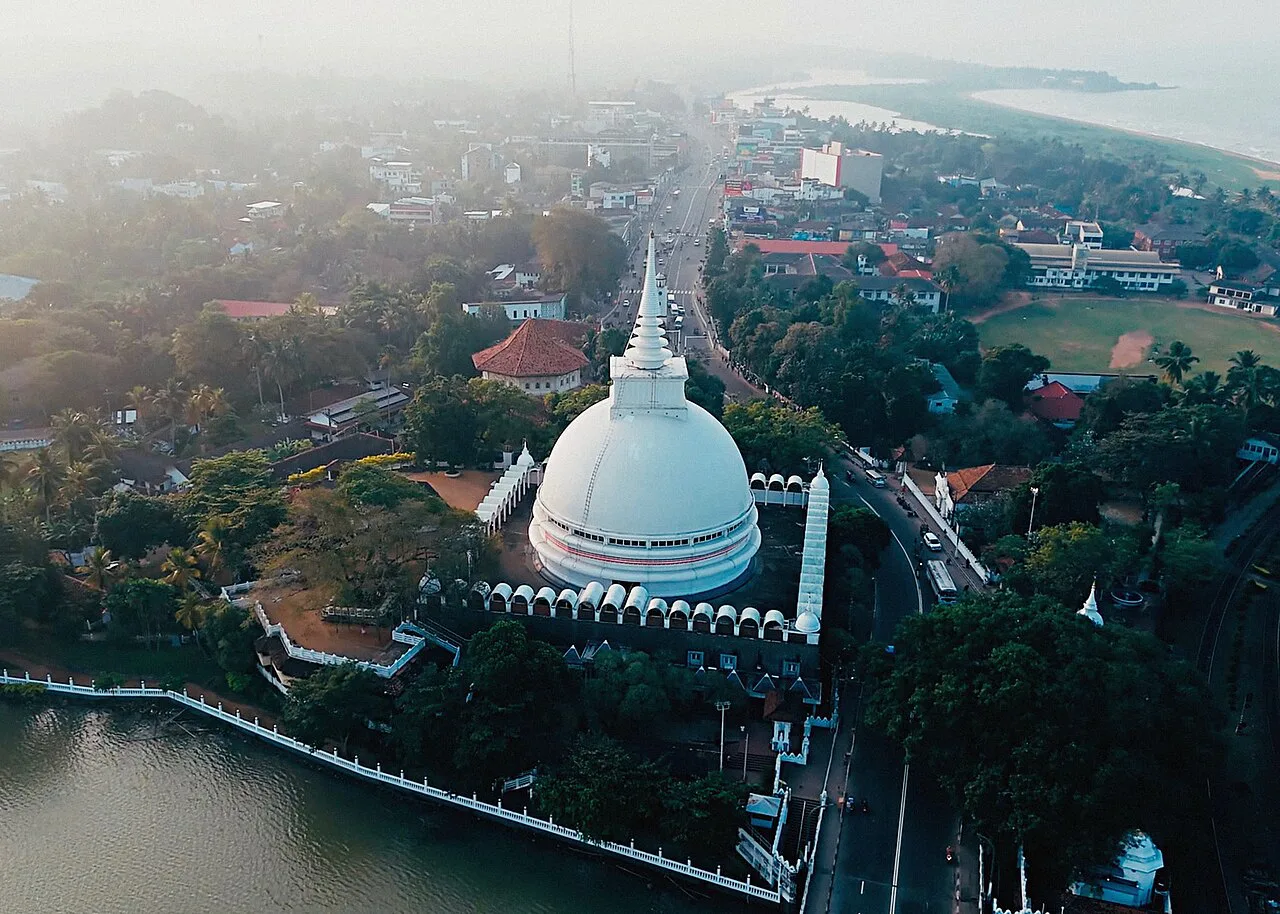
West Coast, Sri Lanka
Kalutara
A river-mouth coastal town about 40 km south of Colombo, home to the world’s only hollow Buddhist stupa and a fairy-tale Edwardian mansion.
Most travellers passing along the coastal highway south of Colombo know Kalutara for one thing: the huge white stupa that seems to float beside the road where the Kalu Ganga meets the sea. Stop for longer, though, and the town reveals a genuinely varied character, part pilgrimage site, part colonial curiosity, part working river town.
Quick Facts
| Location | Western Province, about 40 km south of Colombo |
| River | Sits at the mouth of the Kalu Ganga (Black River) |
| Best known for | Kalutara Bodhiya and Chaitya, Richmond Castle |
| Local industries | Coir manufacturing and traditional handicrafts |
| Nearby natural sights | Thudugala Ella waterfall, river boat rides |
| Getting there | Train or bus from Colombo Fort, or the A2/Southern Expressway |
Commonly searched as: Kalutara Sri Lanka · Kalutara Bodhiya · Richmond Castle Kalutara · Kalu Ganga river town · things to do in Kalutara
A River Town With a Sacred Centre
Kalutara sits where the Kalu Ganga, whose name translates to “Black River,” reaches the Indian Ocean, a natural crossing point that has shaped the town’s role as a link between Colombo and the south coast for centuries. That river-mouth position gave Kalutara early importance as a trading and administrative centre, and it remains today one of the West Coast’s more substantial towns rather than a purely resort-oriented beach stop.
The town’s spiritual centre is the Kalutara Bodhiya complex, anchored by a sacred Bodhi tree believed to be one of 32 saplings taken from the original Jaya Sri Maha Bodhi in Anuradhapura, itself grown from a sapling of the very tree under which the Buddha attained enlightenment in Bodh Gaya, India. That lineage, running from Bodh Gaya through Anuradhapura to Kalutara, makes this one of the more spiritually significant Bodhi tree sites on the island, drawing pilgrims travelling between Colombo and the south coast to stop and pay respects.
Beyond the Stupa
Kalutara has long been a centre for coir manufacturing, the production of rope, matting and other goods from coconut fibre, alongside broader traditional handicrafts, reflecting the region’s deep connection to coconut cultivation along the coastal belt. The town’s golden beaches, while less internationally famous than Bentota or Hikkaduwa further south, offer a quieter alternative for travellers passing through, and the surrounding countryside holds smaller natural attractions like the Thudugala Ella waterfall and opportunities for river boat rides along the Kalu Ganga.
Richmond Castle
A short drive from central Kalutara, this early 20th-century Edwardian mansion, built by a wealthy local Mudaliyar, adds an unexpected colonial-era curiosity to the town’s sightseeing list, well worth combining with a visit to the Bodhiya.
Visiting Tips
- Time a visit to the Kalutara Bodhiya for early morning or late afternoon, when pilgrim activity and light conditions are both at their best.
- Combine the Bodhiya with a visit to nearby Richmond Castle for a fuller day covering both spiritual and colonial history.
- Kalutara makes a convenient stop between Colombo and the more resort-heavy towns of Bentota and Hikkaduwa further south.
- Look for coir and handicraft workshops if you’re interested in traditional Sri Lankan crafts.
A Practical Stop, Not Just a Photo Op
It’s worth resisting the temptation to treat Kalutara as a five-minute photo stop from a moving vehicle, which is how many travellers experience it on the way to the more famous beaches further south. The town rewards a proper pause: the Bodhiya complex alone deserves at least half an hour to appreciate the murals inside the hollow stupa, and the surrounding town offers a genuine slice of everyday coastal Sri Lankan life, working coir workshops, riverside activity, and local food stalls, that’s easy to miss when Kalutara is treated purely as a waypoint between Colombo and Bentota or Hikkaduwa.
The Kalutara Bridge itself, spanning the river mouth, is worth a moment of attention too. It links the country’s Western and Southern coastal regions and offers a good vantage point for photographing the white stupa against the water, particularly at sunset when the light picks up the river’s reflection alongside the temple’s pale dome.
Where It Sits on the Map
Kalutara, Western Province, Sri Lanka Open in Google Maps ↗
Frequently Asked Questions
What is Kalutara best known for?
The Kalutara Bodhiya and its adjoining hollow stupa (Kalutara Chaitya), along with the nearby colonial-era Richmond Castle.
Why is Kalutara’s location significant?
It sits at the mouth of the Kalu Ganga River, a natural crossing point that made it an important trading and administrative centre along the coast.
What industries is Kalutara known for?
Coir manufacturing (coconut fibre products) and traditional handicrafts, reflecting the region’s coconut cultivation.
How far is Kalutara from Colombo?
About 40 km, roughly a 45-minute to one-hour drive via the A2 highway or Southern Expressway, and also reachable by train or bus.
← Sri Lanka: The Complete Guide — see all 258 places by region
Related News
A guide to Sri Lanka's West Coast region, from Kalpitiya to Hikkaduwa: beaches, history, wildlife and travel tips.
A complete guide to Negombo, Sri Lanka: history, the fish market, Dutch canal, churches, and visiting tips near the airport.

A guide to Sri Munneswaram Temple near Chilaw, Sri Lanka: history, the Ramayana legend, festivals, visiting tips and map.













