

Dsigngo is a Graphic Design and Digital Marketing Company.
Write what you are looking for and press enter to begin your search!

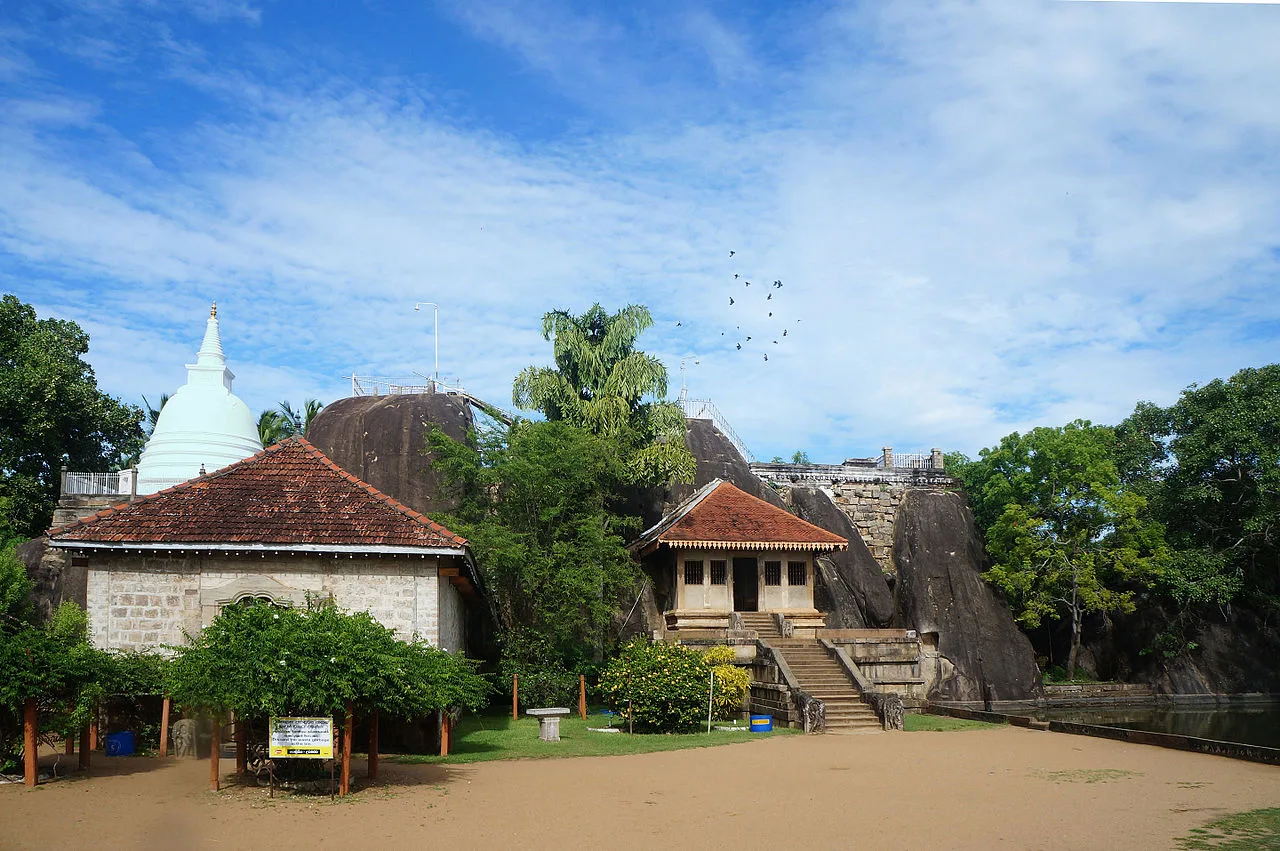
Anuradhapura, Cultural Triangle
Issurumuniya Temple
A rock-cut monastery built to house 500 ordained children, now famous for a stone carving of two seated lovers whose exact identity and meaning scholars still can’t fully agree on.
Issurumuniya’s most famous carving depicts a man with a woman seated on his lap, her finger raised in a gesture some read as coyness, and centuries later, historians, art critics and tour guides still haven’t settled on who these two figures actually are.
Quick Facts
| Location | Beside Tissa Wewa reservoir, Anuradhapura |
| Also known as | Meghagiri Vihara |
| Built by | King Devanampiya Tissa, 3rd century BCE |
| Original purpose | Monastic complex housing 500 ordained children |
| Renamed by | King Kashyapa I, who called it ‘Boupulvan Kasubgiri Radmaha Vehera’ |
| Notable carvings | The Isurumuniya Lovers, Elephant Pond, Royal Family, Horseman |
Commonly searched as: Issurumuniya Temple · Isurumuniya Lovers carving · Isurumuniya Anuradhapura · Tissa Wewa temple · things to do in Anuradhapura
Built for 500 Ordained Children
Issurumuniya’s origins trace to King Devanampiya Tissa, the same 3rd-century BCE ruler responsible for Thuparama and the planting of the Sri Maha Bodhi. During his reign, 500 children from high-caste families were ordained into the monkhood, and Issurumuniya was built specifically as a monastic complex to house them, a genuinely significant undertaking reflecting the scale of Buddhism’s rapid early establishment on the island. The temple was later renovated and renamed by King Kashyapa I, the same ruler who built Sigiriya, who called it “Boupulvan Kasubgiri Radmaha Vehera,” a name combining his own with those of his two daughters.
The temple is built into and around a striking natural rock formation, with a cave connected to a cliff face above it, upon which a small dagoba was added during a later period. At the picturesque entrance, twin rocks rise on either side of a natural crevice, appearing almost to emerge directly from an adjoining pond, one of the more visually distinctive approaches to any temple in Anuradhapura.
The Isurumuniya Lovers
Issurumuniya’s most celebrated feature is a stone carving popularly known as the “Isurumuniya Lovers,” depicting a man with a woman seated on his lap, her finger raised in a gesture many visitors interpret as an expression of feminine coyness. The carving’s exact subject remains genuinely debated: some traditions link it to Prince Saliya, son of King Dutugemunu, and Asokamala, the woman he loved and reportedly gave up his claim to the throne to marry, a romance said to have unfolded in the nearby Royal Pleasure Garden. The original sculpture has since been relocated to the Isurumuniya Archaeological Museum for preservation, with the granite slab that once supported it still visible at the temple itself.
Beyond the lovers, the temple grounds hold several other notable carvings: a pond edged with cheerful, playfully rendered elephants at play carved directly into the rock face, along with reliefs depicting a horseman and a royal family, together forming one of the richest collections of ancient Sri Lankan sculptural art gathered in a single, compact site.
A Site Tangled in Royal Romance
Issurumuniya’s proximity to the Royal Pleasure Garden, where legend places the meeting of Prince Saliya and Asokamala, gives the temple’s carvings an added layer of narrative resonance for visitors familiar with the story, whether or not the “lovers” carving genuinely depicts that specific couple.
That ambiguity, a beloved carving whose subject remains genuinely uncertain even after generations of scholarly and popular interpretation, is arguably part of what keeps Issurumuniya so consistently compelling to visitors. Rather than a settled, fully explained historical fact, the Lovers carving functions almost as an open invitation, letting each visitor bring their own reading to a scene of quiet, centuries-old intimacy carved directly into stone.
Visiting Tips
- Visit the adjoining Isurumuniya Archaeological Museum to see the original Lovers carving up close.
- Note that Issurumuniya requires a separate entry ticket from the main Anuradhapura Cultural Heritage Ticket.
- Combine with a stroll along Tissa Wewa and a visit to the nearby Royal Pleasure Garden (Goldfish Park).
- Look closely at the carved elephant pond, easy to overlook next to the more famous lovers carving.
Where It Sits on the Map
Issurumuniya Temple, beside Tissa Wewa, Anuradhapura Open in Google Maps ↗
Frequently Asked Questions
What was Issurumuniya originally built for?
King Devanampiya Tissa built it as a monastic complex to house 500 children ordained as monks from high-caste families.
Who are the ‘Isurumuniya Lovers’ depicted in the temple’s famous carving?
Their exact identity is debated, though local tradition often links them to Prince Saliya, son of King Dutugemunu, and his beloved Asokamala.
Is there a separate ticket needed for Issurumuniya?
Yes, along with Sri Maha Bodhi, it requires a separate entry ticket from the main Anuradhapura Cultural Heritage Ticket.
Where is the original Lovers carving now?
It has been moved to the Isurumuniya Archaeological Museum for preservation; the original granite slab remains visible at the temple site.
← Sri Lanka: The Complete Guide — see all 258 places by region
Related News
A guide to Sri Lanka's Cultural Triangle: Sigiriya, Polonnaruwa, Anuradhapura, Dambulla and Mihintale, with travel tips.

A complete guide to Sigiriya Rock Fortress: King Kashyapa's parricide, the water gardens, the famous frescoes, visiting tips and map.
A guide to the ancient city of Polonnaruwa: from Chola conquest to Parakramabahu the Great's garden-city, visiting tips and map.













