

Dsigngo is a Graphic Design and Digital Marketing Company.
Write what you are looking for and press enter to begin your search!

Kandy, Hill Country
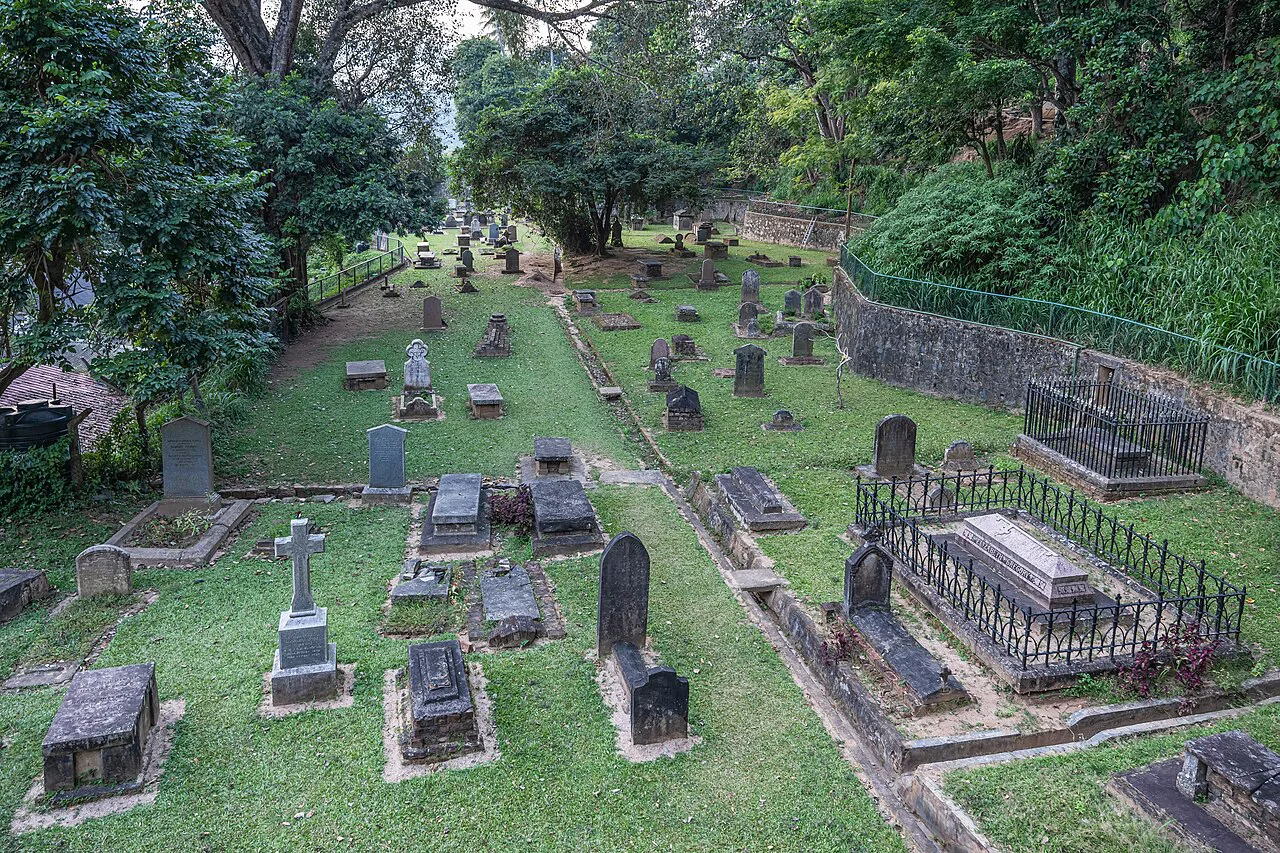
British Garrison Cemetery
A quiet colonial burial ground where the average age at death was barely into adulthood, its 195 graves recording death by malaria, cholera, charging elephants, and one disgraced ‘traitor.’
Walk through the British Garrison Cemetery and a pattern emerges quickly: most of the names belong to people who died astonishingly young, in their twenties or younger, victims of a tropical climate, wild animals, and diseases that colonial-era medicine had little defence against.
Quick Facts
| Location | Behind the Temple of the Tooth, bordered by Udawattekele Sanctuary |
| Established | 1817, shortly after the British took control of Kandy |
| Main burial period | 1822 to 1873 (burials within municipal limits banned in 1873) |
| Last burial | 1951, Annie Fritz, under special provision for relatives |
| Number of graves | 195 |
| Restored | 1998, with funding from the Commonwealth War Graves Commission |
Commonly searched as: British Garrison Cemetery Kandy · Kandy colonial cemetery · John D’Oyly grave · things to do in Kandy · Kandy Kandyan Convention history
A Resting Place for a Short-Lived Colonial Community
Established in 1817, just two years after the British takeover of Kandy, the Garrison Cemetery served as the main burial ground for the town’s British and European colonial community until a municipal ban on burials within town limits took effect in 1873. Special provision allowed relatives of those already interred to continue being buried there afterward, and the very last burial, of Annie Fritz, took place as late as 1951, closing out well over a century of use.
The 195 recorded graves paint a genuinely stark picture of colonial-era mortality. Tropical diseases, malaria and cholera especially, claimed the largest share of lives, and the average age at death recorded on the headstones sits astonishingly low, one visitor account noted an average of around 23 years, with only a handful of individuals surviving past 50. Writing before 1913, historian J.P. Lewis noted that the actual number of burials likely exceeded the number of graves still bearing legible inscriptions, meaning the true toll may be even higher than the visible headstones suggest.
Notable Graves
Sir John D’Oyly
The cemetery’s most historically significant grave belongs to Sir John D’Oyly, the British diplomat who drafted the 1815 Kandyan Convention, the very document that formally ended the Kandyan Kingdom. D’Oyly went on to become the first British commissioner administering Kandyan affairs, residing in the former royal palace, and was remembered for his scholarship in the Sinhala language. His grave, marked by a broken fluted masonry column with a marble tablet, remains one of the cemetery’s most prominent features.
Death by Elephant
John Spottiswood Robertson (1823 to 1856) holds the grim distinction of being the seventh and last European in Ceylon recorded as killed by a wild elephant, one of several similarly dramatic causes of death recorded here, alongside deaths from horse-riding accidents, lightning strikes, and collapsing houses.
A Disgraced ‘Traitor’
Among the more unusual stories associated with the cemetery is that of a British official remembered locally as a disgraced “traitor,” who reportedly had a musket at hand but failed to use it while thousands of Sinhalese attacked his building, a decision that cost him his community’s respect even though, as one visitor account notes, it may simply have been the choice any reasonable person facing overwhelming odds would make.
Visiting Tips
- If available, ask the on-site caretaker for a guided walk-through; several visitor accounts describe caretakers who know detailed stories behind individual graves from memory.
- Entry is typically by donation; visit before noon on weekdays for the best chance of finding the gates open.
- Combine with the Temple of the Tooth, St Paul’s Church, and Udawattekele Sanctuary, all within easy walking distance.
- The Kandy War Cemetery, a separate site near the Peradeniya Botanical Gardens holding WWII-era Commonwealth graves, offers a complementary stop for those interested in the region’s later colonial and wartime history.
A Quiet Counter-Narrative to Kandy’s Grand History
Most of Kandy’s major sights, the Temple of the Tooth, the devales, the National Museum, tell the story of Kandyan royal and religious life on a grand, ceremonial scale. The Garrison Cemetery tells a much smaller, more human story: the ordinary, often brief lives of the colonial administrators, soldiers and family members who found themselves stationed in a tropical hill town far from home, with limited medical care and unfamiliar hazards on every side. Reading name after name, age after age, most well under thirty, offers a sobering counterweight to the more triumphant historical narratives told elsewhere in the city, a reminder that colonial rule carried real personal cost even for those doing the colonising.
Where It Sits on the Map
British Garrison Cemetery, behind the Temple of the Tooth, Kandy Open in Google Maps ↗
Frequently Asked Questions
How many graves are at the British Garrison Cemetery?
195, dating from 1817 to 1951, with most burials occurring between 1822 and 1873.
Who is the most historically significant person buried there?
Sir John D’Oyly, the British diplomat who drafted the 1815 Kandyan Convention that ended the Kandyan Kingdom.
What were the most common causes of death recorded?
Tropical diseases such as malaria and cholera, alongside deaths from wild elephant attacks, horse-riding accidents, and other colonial-era hazards.
When was the cemetery restored?
In 1998, with financial support from the Commonwealth War Graves Commission.
← Sri Lanka: The Complete Guide — see all 258 places by region
Related News
A guide to Sri Lanka's Hill Country: Kandy, tea plantations, Ella, Adam's Peak, Horton Plains, and travel tips.
A complete guide to Kandy: the last Sinhalese kingdom's fall in 1815, the Temple of the Tooth, Kandy Lake, and visiting tips.
A guide to Kandy Lake, built by the last king of Kandy in 1807: its dark construction history, the island retreat, walking the shore, and...













