

Dsigngo is a Graphic Design and Digital Marketing Company.
Write what you are looking for and press enter to begin your search!

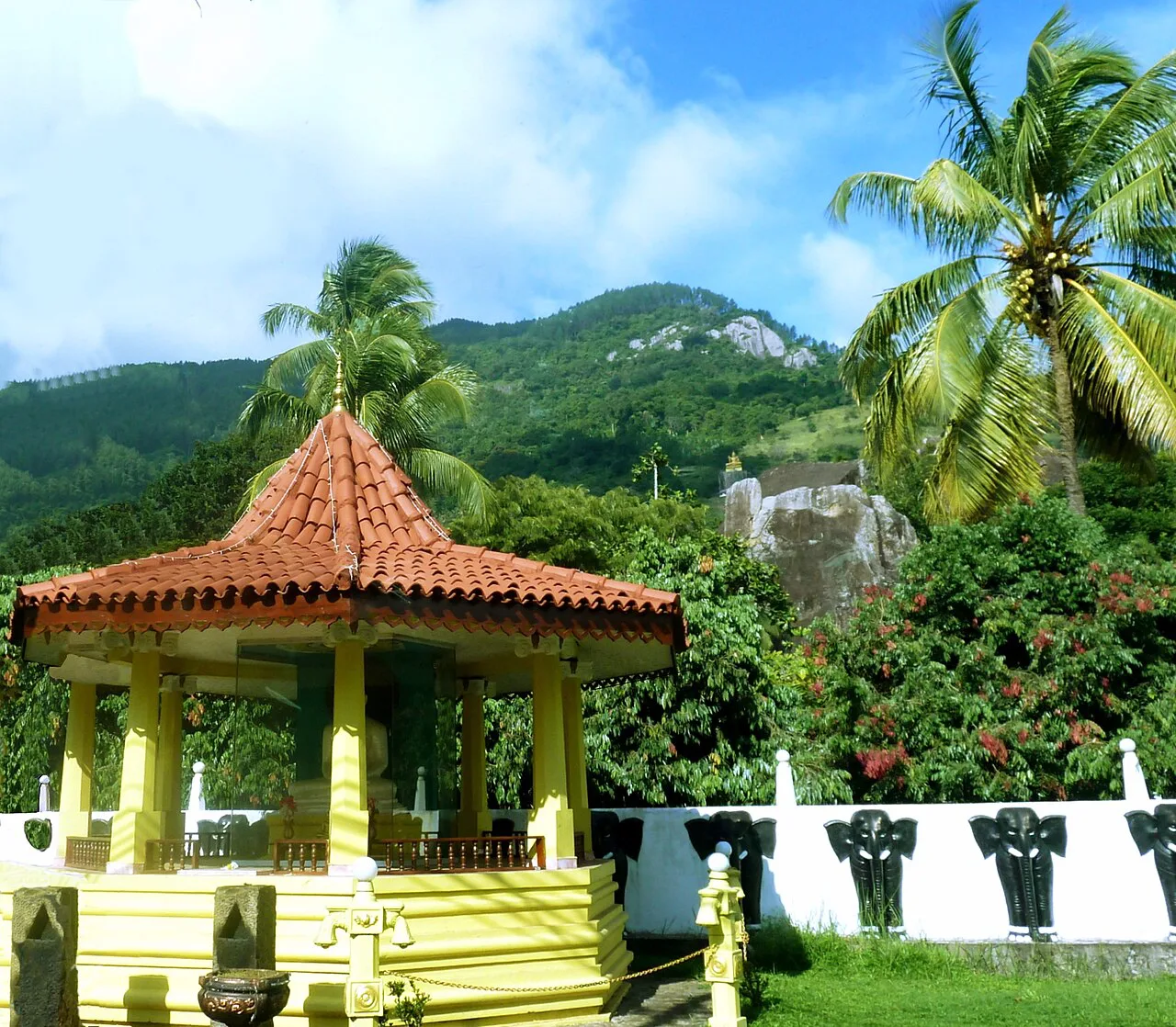
Matale, Cultural Triangle
Aluvihare
Five hundred monks spent over three years transcribing Buddhism’s entire oral scripture onto palm leaves here, a monumental act of preservation that British troops set fire to almost two thousand years later.
Aluvihare holds an achievement and a tragedy in equal measure: it’s the site where Buddhism’s entire oral scripture was first committed to writing, and, nearly two millennia later, the site where much of that written record was deliberately burned by colonial troops suppressing a rebellion that had nothing to do with the temple itself.
Quick Facts
| Location | About 30 km north of Kandy, on the Matale-Dambulla road |
| Founded by | King Devanampiyatissa, 3rd century BCE |
| Key event | First complete written transcription of the Pali Canon, 1st century BCE |
| Circumstances | Written during a 12-year famine, fearing loss of oral teachings amid invasion |
| Destroyed | By British forces in 1848, suppressing the Matale Rebellion |
| Recompilation completed | 1982, after decades of painstaking monastic work |
Commonly searched as: Aluvihare Rock Temple · Pali Canon written Matale · Aluvihare 1848 · Matale rock temple · things to do in Matale
Where an Oral Tradition Became a Written One
Aluvihare’s origins reach back to the 3rd century BCE and King Devanampiyatissa, credited with building the site’s original dagoba and planting a Bo tree sapling shortly after Buddhism’s introduction to the island. The temple’s truly monumental moment came centuries later, in the 1st century BCE, during the reign of King Valagamba, when Sri Lanka endured a devastating 12-year famine known as Baminithiyasaya. Amid the chaos and repeated South Indian invasions of that period, Buddhist leaders grew genuinely concerned that the entire body of the Buddha’s teachings, preserved for centuries purely through oral memorisation and recitation, could be lost forever if the monks holding that knowledge died without passing it on.
In response, roughly 500 scholarly monks gathered at Aluvihare for what’s remembered as the Fourth Buddhist Council, spending three years, three months and three days reciting, cross-checking, and finally transcribing the complete Tripitaka, the Vinaya, Sutta and Abhidhamma sections of the Pali Canon, onto palm leaves. The process itself required considerable preparation: leaves were boiled, dried, and treated with sandalwood oil to prevent decay before monks inscribed the text using a metal stylus, producing what became known as puskola poth, or palm-leaf books. This transcription marked the first time Buddhism’s core scripture existed in complete written form anywhere in the world, previously known to scholars only through later Chinese and Tibetan translations, since the original Sanskrit source texts had never survived intact in India itself.
Destroyed, Not Once But Repeatedly
Aluvihare’s library survived Dutch-era destruction in the 17th century and an earlier British attack in 1803, remarkable resilience for a collection of fragile palm-leaf manuscripts. Its luck ran out in 1848, when British colonial forces, suppressing the Matale Rebellion, an uprising with no direct connection to the temple itself, attacked Aluvihare, burning the library and destroying significant portions of the surrounding image house, including statues and frescoes. The oldest surviving ola-leaf manuscript of the Tipitaka was lost in the fire, an irreplaceable loss even though the broader text survived in other regional copies.
Recompiling what was lost took generations. Monks worked painstakingly to reconstruct the destroyed texts by hand, and remarkably, the very first of the three “baskets” of the Tripitaka wasn’t fully recompiled until 1982, well over a century after the original fire, underscoring just how enormous and painstaking the original transcription effort, and its later reconstruction, genuinely was.
What Survives to See Today
Visitors climbing the temple’s stone steps encounter thirteen natural rock caves, including a main image house with Kandyan-style murals and statues, a cave holding a large reclining Buddha, and, in a detail that draws considerable visitor attention, a cave decorated with vivid depictions of hell and the punishments awaiting sinners. A dedicated museum near the base of the site displays surviving palm-leaf manuscripts, and a steep stairway leads up past the cave once inhabited by the scholar-monk Buddhaghosa, who visited Aluvihare in the 5th century CE to study Buddhist commentaries, to a small stupa at the summit offering sweeping views over Matale and the surrounding hills.
Visiting Tips
- Visit the palm-leaf manuscript museum near the base of the site for direct context on the temple’s central historical significance.
- Climb the stairway to the summit stupa for panoramic views over Matale, worth the extra effort.
- Dress modestly, given the temple’s status as an active place of Buddhist worship.
- Combine with a visit to Matale town and the Sri Muthumariamman Thevasthanam, both a short drive away.
Where It Sits on the Map
Aluvihare Rock Temple, near Matale Open in Google Maps ↗
Frequently Asked Questions
Why is Aluvihare historically significant?
It’s the site where the Pali Canon, the core scripture of Theravada Buddhism, was first written down in complete form, in the 1st century BCE, after being preserved purely through oral tradition for centuries.
What happened to Aluvihare in 1848?
British colonial forces suppressing the Matale Rebellion attacked the temple, burning its library and destroying many original palm-leaf manuscripts, along with parts of the image house.
How long did it take to recompile the lost texts?
The reconstruction was so extensive that the first of the Tripitaka’s three sections wasn’t fully recompiled until 1982, well over a century after the 1848 fire.
What can visitors see at Aluvihare today?
Thirteen rock caves including a museum of palm-leaf manuscripts, a large reclining Buddha, vivid murals depicting Buddhist hell realms, and a summit stupa with views over Matale.
← Sri Lanka: The Complete Guide — see all 258 places by region
Related News
A guide to Sri Lanka's Cultural Triangle: Sigiriya, Polonnaruwa, Anuradhapura, Dambulla and Mihintale, with travel tips.

A complete guide to Sigiriya Rock Fortress: King Kashyapa's parricide, the water gardens, the famous frescoes, visiting tips and map.
A guide to the ancient city of Polonnaruwa: from Chola conquest to Parakramabahu the Great's garden-city, visiting tips and map.













