

Dsigngo is a Graphic Design and Digital Marketing Company.
Write what you are looking for and press enter to begin your search!

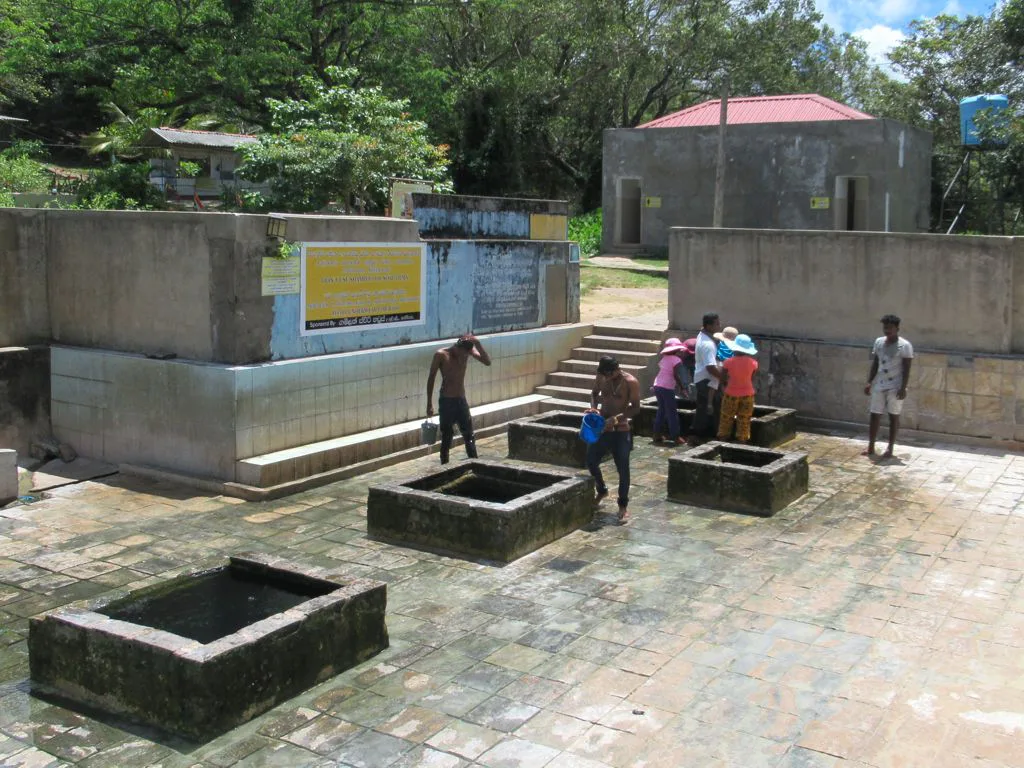
Near Trincomalee, The East
Kanniya Hot Wells
Legend holds that the demon king Ravana struck the earth with his sword to perform his mother’s funeral rites, and seven hot springs sprang from the exact spots his blade landed.
According to a story with genuine staying power among local Tamil communities, the demon king Ravana, needing water to perform his ailing mother’s funeral rites, struck the ground with his sword at several points, and hot water sprang from each spot where the blade landed, forming the seven wells that still sit here today.
Quick Facts
| Location | Kanniya, about 8 km from Trincomalee town |
| Layout | Seven square wells arranged in a rectangular formation |
| Well depth | About 3 to 4 feet, with a clearly visible bottom |
| Temperature | Varies noticeably between individual wells |
| Archaeological finds | A stupa mound and inscription from the Anuradhapura period |
| Religious significance | Sacred to Buddhists, Hindus and Muslims alike |
Commonly searched as: Kanniya Hot Wells · Kanniya Hot Springs Trincomalee · Ravana hot springs legend · Trincomalee hot springs · things to do near Trincomalee
A Demon King’s Grief, Turned to Springs
The most widely told legend behind Kanniya ties directly into the broader Ramayana story associated with nearby Koneswaram Temple. According to the tale, Ravana and his mother worshipped Shiva at Koneswaram, and when his mother’s health began failing, Ravana wanted to move the temple closer to ease her worship. As he attempted to heave the sacred rock, Shiva intervened, forcing him to drop his sword. Needing water to perform his mother’s funeral rites after her death, Ravana struck the earth with that same sword at several points, and hot springs emerged wherever the blade landed, becoming the seven wells that still bear his legend today.
That story, connecting a figure from the Ramayana directly to a physical, visitable site, has given Kanniya lasting devotional significance among Sri Lankan Tamils, who continue to perform religious rituals dedicated to lost loved ones at the springs, a practice folklore attributes directly back to Ravana’s own grieving ritual thousands of years ago.
Seven Wells, Seven Temperatures
Kanniya’s seven wells are arranged in a distinctive square formation, each roughly 3 to 4 feet deep with a clearly visible bottom, and each running dry after only 10 to 15 buckets are drawn, a detail that adds a slightly mysterious, almost otherworldly quality to what is otherwise a fairly modest physical site. What genuinely puzzles visitors and locals alike is the temperature variation between the individual wells, noticeably different from one to the next despite their close proximity, a phenomenon that has never been definitively explained but adds real weight to the springs’ reputation for holding some kind of natural or supernatural significance.
A Site Shared Across Faiths
A 1955 travellers’ handbook described the seven springs as sacred to Buddhists, Hindus and Muslims alike, with the ruins of a dagoba, a Vishnu temple and a mosque reportedly standing together near the site, a genuinely rare example of shared, overlapping religious sanctity. Archaeological excavations have since confirmed part of that deep history, uncovering a stupa mound dating to the early Anuradhapura period, along with an inscription from the 1st or 2nd century CE, physical evidence that this site held religious significance many centuries before any version of the Ravana legend was likely first told in its current form.
Visiting Tips
- Combine with a wider Trincomalee itinerary, given Kanniya’s short distance from town.
- Approach the springs respectfully, since Tamil devotees continue to perform genuine religious rituals here.
- Don’t expect a large bathing pool, the wells are shallow and small; this is a cultural and historical stop rather than a spa experience.
- Ask a local guide about the temperature differences between wells, a genuinely interesting unsolved detail of the site.
Where It Sits on the Map
Kanniya Hot Wells, near Trincomalee Open in Google Maps ↗
Frequently Asked Questions
What is the legend behind Kanniya Hot Wells?
According to tradition, the demon king Ravana struck the ground with his sword at several points to find water for his mother’s funeral rites, and hot springs emerged from each spot, forming the seven wells.
How many wells are there and how deep are they?
Seven, arranged in a square formation, each roughly 3 to 4 feet deep with a clearly visible bottom.
Why do the wells have different temperatures?
The temperature varies noticeably between individual wells despite their close proximity, a phenomenon that has never been definitively explained.
Is the site significant to more than one religion?
Yes, it’s historically described as sacred to Buddhists, Hindus and Muslims alike, with archaeological evidence confirming religious use dating back to the Anuradhapura period.
← Sri Lanka: The Complete Guide — see all 258 places by region
Related News
A guide to Sri Lanka's East Coast: Trincomalee, Batticaloa, Arugam Bay, wildlife parks, and the region's unique dry-season timing.
A guide to Trincomalee: one of the world's finest natural harbours, its ancient temple, colonial and WWII history, visiting tips and map.
A guide to Fort Frederick in Trincomalee: built from a demolished temple's stones, still an active Sri Lankan military base, its resident deer, visiting tips...













