

Dsigngo is a Graphic Design and Digital Marketing Company.
Write what you are looking for and press enter to begin your search!

Kudawella, near Dickwella
Hummanaya Blow Hole
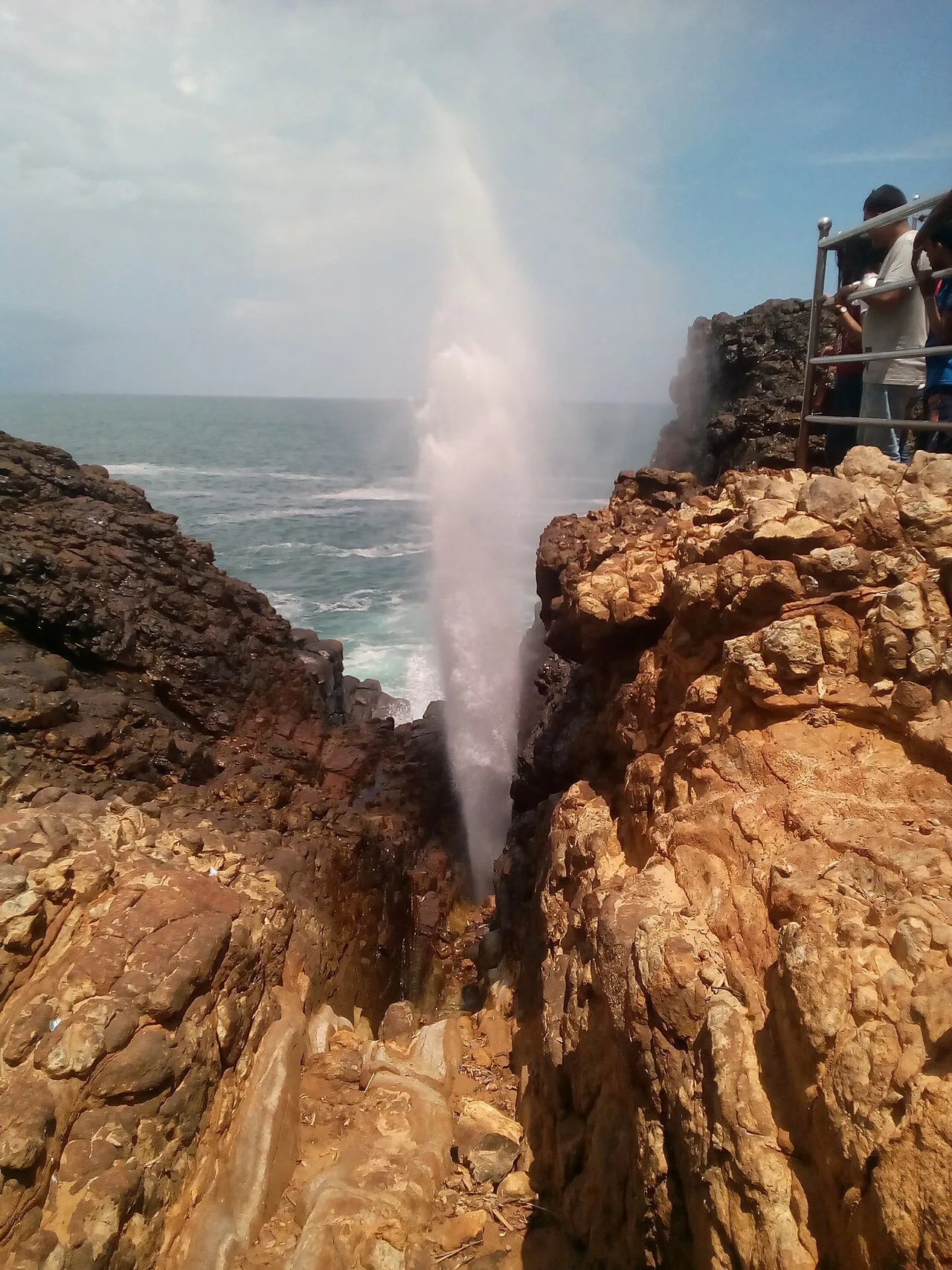
Sri Lanka’s only known blowhole and reportedly the second largest in the world, named for the deep ‘hoo’ sound it makes as seawater erupts through a narrow rock fissure.
Long before Hummanaya became a fixture on South Coast tour itineraries, local fishermen already knew its rhythms intimately, using the blowhole’s booming eruptions as a kind of natural gauge for reading the ocean’s mood and navigating the surrounding waters safely.
Quick Facts
| Location | Near the fishing village of Kudawella, close to Dickwella, Hambantota District |
| Status | Sri Lanka’s only known blowhole; reportedly the second largest in the world |
| Name origin | From the deep ‘hoo’ or humming sound produced during eruptions |
| Height above sea level | About 13 metres |
| Spout height | Estimates range widely, commonly cited at up to 25 to 30 m in strong conditions |
| Most active season | May to September, during the southwest monsoon |
Commonly searched as: Hummanaya Blow Hole · Kudawella blow hole · Sri Lanka only blowhole · Dickwella attractions · things to do near Tangalle
A Natural Landmark Woven Into Local Life
There’s no documented date for when Hummanaya was first discovered or recognised as significant, its history is instead woven into generations of oral tradition among the fishing communities of Kudawella and the surrounding coast. Long before tourism arrived, local fishermen used the blowhole’s activity as a practical reference point, gauging sea conditions and using its booming sound as an aid to navigation in the surrounding waters. That everyday, functional relationship with the phenomenon has only gradually given way to its current status as a major South Coast tourist attraction in more recent decades.
The Physics Behind the Spectacle
Hummanaya forms through a straightforward but visually dramatic process of wave hydraulics. Incoming waves force seawater into a submerged rock cavern, compressing the air trapped inside; as pressure builds, water and air are forced explosively upward through a narrow surface crevice, producing a spout of water that can shoot many metres into the air, accompanied by the deep, resonant “hoo” sound that gives the site its name. Estimates of the maximum spout height vary considerably between sources, ranging from a more conservative 18 metres up to reported figures of 25 to 30 metres during the most forceful conditions, generally during the southwest monsoon between May and September, when rougher seas produce more powerful eruptions.
Only a handful of active blowholes exist anywhere in the world with comparable force and reliability, which is part of why Hummanaya draws visitors from well beyond Sri Lanka’s own borders, alongside the steady stream of domestic tourists for whom it has long been a familiar feature of the southern coastline.
Getting There
The blowhole sits inland from the coastal road near Kudawella, reached via a short walk, generally 10 to 20 minutes depending on the specific route and source, through a small village where local vendors sell handicrafts, snacks and refreshments along the way. The final stretch involves navigating rugged rocky terrain before reaching a viewing area near the blowhole itself.
Along that walk, small kiosks selling cold drinks, fried snacks, and the local catch of the day give the approach its own modest character, part nature excursion, part small-scale village economy built entirely around a single geological curiosity.
Visiting Tips
- Visit during the southwest monsoon season (May to September) for the most dramatic and forceful eruptions.
- Wear sturdy footwear given the rocky terrain leading to the viewing area.
- Keep a safe distance from the immediate blowhole area, since eruption timing and force can be unpredictable.
- Combine with a visit to nearby Wewurukannala Vihara, both easily reached from Dickwella or Tangalle.
A Landmark Shaped Entirely by the Ocean
Unlike most of the built and religious landmarks that dominate a typical Sri Lankan sightseeing itinerary, Hummanaya owes its existence entirely to geology and wave action rather than human construction or historical event. That distinction gives it a different kind of appeal, there’s no temple to admire, no colonial history to trace, just the raw, unpredictable power of the ocean forcing its way through solid rock on its own schedule. Visitors sometimes wait a while for a particularly dramatic eruption, and sometimes catch an impressive one within minutes of arriving, a reminder that unlike a scheduled cultural performance or a fixed monument, Hummanaya operates entirely on nature’s own timetable.
Where It Sits on the Map
Hummanaya Blow Hole, Kudawella, near Dickwella Open in Google Maps ↗
Frequently Asked Questions
What makes Hummanaya unique?
It’s Sri Lanka’s only known blowhole and is reportedly the second largest of its kind in the world.
Why is it called Hummanaya?
The name comes from the deep ‘hoo’ or humming sound the blowhole produces as water and compressed air erupt through the rock fissure.
When is the best time to see it in action?
During the southwest monsoon, roughly May to September, when rougher seas produce the most forceful and frequent eruptions.
How do visitors reach the blowhole?
Via a short walk, roughly 10 to 20 minutes, from a parking area near Kudawella village, followed by a final stretch over rocky terrain to the viewing spot.
← Sri Lanka: The Complete Guide — see all 258 places by region
Related News
A guide to Southern Sri Lanka, from Galle to Kataragama: beaches, wildlife safaris, colonial forts, and travel tips.

A complete guide to Galle Fort: history from Ptolemy to the Dutch, walking the ramparts, top sights, and visiting tips.
A guide to the Dutch Reformed Church in Galle Fort: the story behind its 1755 completion, the tombstone floor, visiting tips and map.













