

Dsigngo is a Graphic Design and Digital Marketing Company.
Write what you are looking for and press enter to begin your search!

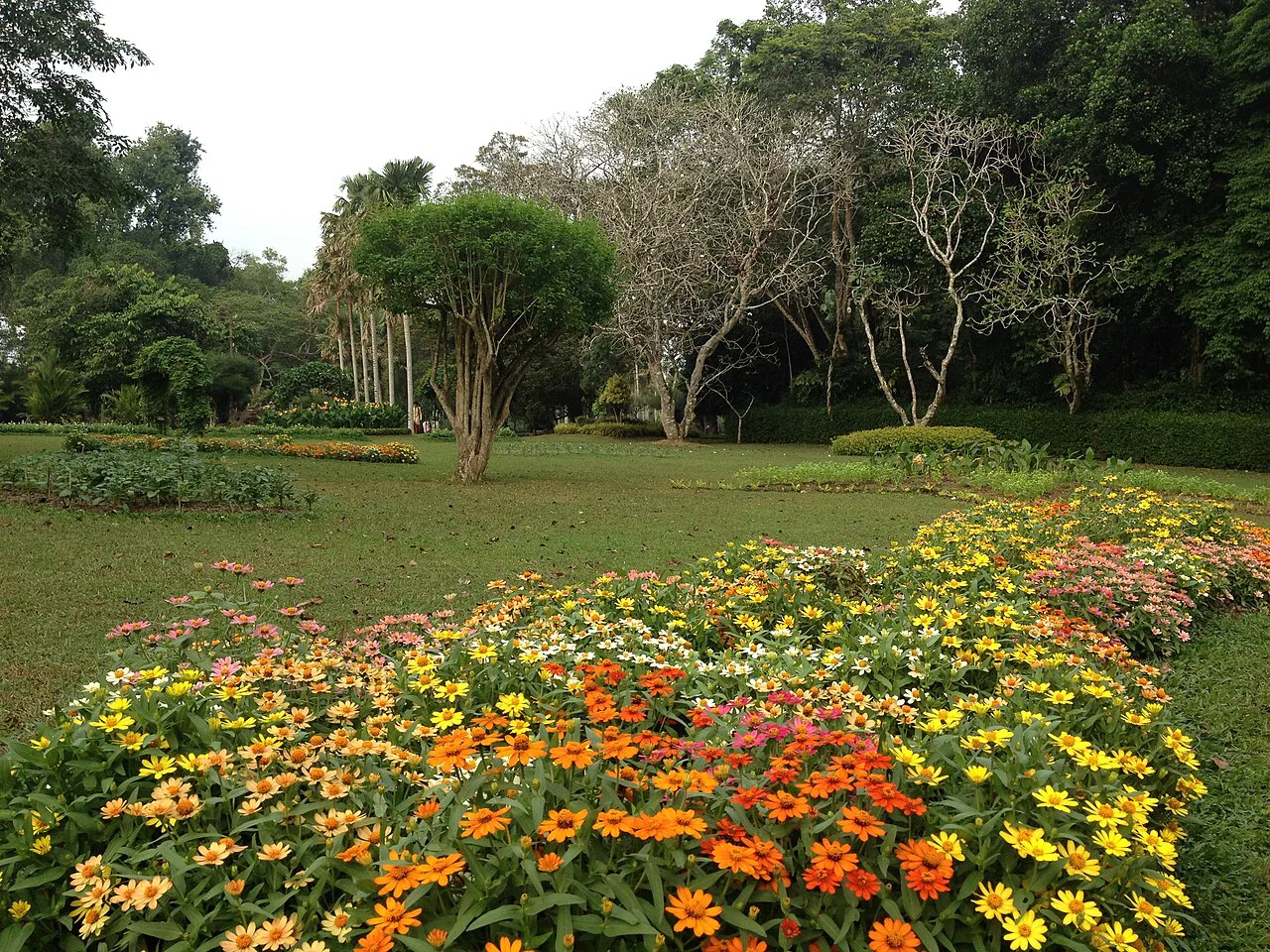
Gampaha, West Coast
Henarathgoda Botanical Garden
A quiet botanical garden near Gampaha that quietly ended Brazil’s rubber monopoly, home to the first rubber trees successfully grown outside the Amazon.
It’s a strange thing to find one of the most economically consequential botanical experiments in modern history tucked into a modest 43-acre garden outside Gampaha, but that’s exactly what Henarathgoda Botanical Garden represents. This unassuming site quietly reshaped the global rubber industry, shifting it from the forests of the Amazon to the plantations of South and Southeast Asia.
Quick Facts
| Location | Gampaha, roughly 30 km northeast of Colombo |
| Established | 1876, originally as an experimental cinchona garden |
| Historic significance | First successful rubber tree cultivation outside Brazil |
| Rubber seeds planted | 1,919 seedlings from Amazon-collected seeds via Kew Gardens |
| Size | About 43 acres (17 hectares) |
| Key monument | Remnants of the original rubber trees, protected as a national monument |
Commonly searched as: Henarathgoda Botanical Garden · Gampaha rubber trees · Sri Lanka rubber history · Ceylon rubber industry · things to do near Colombo
A Garden Built to Break a Brazilian Monopoly
The story of Henarathgoda Botanical Garden begins not in Sri Lanka but in Brazil, where Henry Alexander Wickham famously collected rubber tree (Hevea brasiliensis) seeds from the Santarem area of the Amazon in 1876. Wickham brought the seeds to Kew Gardens near London, but Britain’s cooler climate proved unsuitable for growing them, so the seeds were dispatched instead to Britain’s tropical colonial territories in Africa and Asia. British naturalists had already attempted rubber trials in India without success, and it was in Ceylon, whose environmental conditions closely matched those of the Amazon basin, that the experiment finally worked.
In 1876, 1,919 rubber seedlings were planted at what would become Henarathgoda Botanical Garden, originally established that same year as an experimental garden for cinchona trees, the source of quinine used to treat malaria. The rubber trees blossomed by 1880, and from 1881 onward, seeds harvested from this single Ceylonese garden were distributed not just across Sri Lanka but to other British colonies throughout South and Southeast Asia, including South India, Malaysia and Myanmar.
The End of the Amazon Rubber Boom
The consequences of this modest garden’s success were genuinely global. Rubber grown on organised Asian plantations turned out to be far more efficient to harvest than rubber gathered from scattered wild trees deep in the Brazilian rainforest, and Brazilian rubber production was further hampered by tree-leaf fungus and other diseases that plantation cultivation in Asia largely avoided. Within a few decades, the balance of global rubber production had shifted decisively from South America to Asia, effectively ending the Amazon rubber boom that had made cities like Manaus fabulously wealthy. Some historians point directly to the modest planting at Henarathgoda as the starting point of that shift.
What Remains Today
The oldest of the original rubber trees collapsed following a severe storm in 1988, but the surviving specimens from that first 19th-century planting are preserved as a national monument, alongside a broader collection of tropical trees, shrubs, flowers and medicinal plants that has grown since the garden’s original establishment. The Forest Department took over responsibility for major plant introductions at the garden from 1887, and in 1919 the world’s first dedicated rubber exhibition was held at the related Royal Botanical Gardens in Peradeniya, cementing Ceylon’s new status as a rubber powerhouse.
Visiting Tips
- Look specifically for the preserved rubber tree remnants, the garden’s most historically significant feature.
- Combine with a wider day trip through Gampaha district, which also includes Muthurajawela Wetlands and Kelaniya Raja Maha Vihara.
- The garden makes a peaceful, uncrowded stop compared to the more famous Royal Botanical Gardens at Peradeniya.
- Visit in the cooler morning hours for the most comfortable walking conditions.
A Reminder That Small Gardens Can Change the World
It’s easy to overlook a modest 43-acre botanical garden in favour of Sri Lanka’s more visually dramatic attractions, but few sites on the island can claim quite the same scale of unintended global economic impact. A relatively small planting of stolen seeds, tested almost as an afterthought after failed trials in India, ended up redirecting an entire global industry away from the region that had defined it for centuries. For visitors interested in economic history as much as botany, Henarathgoda offers a rare chance to stand at the literal starting point of that shift, among descendants of the very trees that made it happen.
Where It Sits on the Map
Henarathgoda Botanical Garden, Gampaha, West Coast Open in Google Maps ↗
Frequently Asked Questions
Why is Henarathgoda Botanical Garden historically significant?
It was the site where rubber trees from Brazil were first successfully cultivated outside the Amazon, launching the Asian rubber plantation industry that eventually overtook Brazilian production.
When was the garden established?
In 1876, initially as an experimental garden for cinchona trees before becoming known for its rubber cultivation.
Can visitors still see the original rubber trees?
The very oldest tree collapsed in a 1988 storm, but surviving trees from the original 19th-century planting are preserved as a national monument within the garden.
How big is the garden?
About 43 acres (17 hectares), making it considerably smaller and quieter than the larger Royal Botanical Gardens at Peradeniya near Kandy.
← Sri Lanka: The Complete Guide — see all 258 places by region
Related News
A guide to Sri Lanka's West Coast region, from Kalpitiya to Hikkaduwa: beaches, history, wildlife and travel tips.
A complete guide to Negombo, Sri Lanka: history, the fish market, Dutch canal, churches, and visiting tips near the airport.

A guide to Sri Munneswaram Temple near Chilaw, Sri Lanka: history, the Ramayana legend, festivals, visiting tips and map.













