

Dsigngo is a Graphic Design and Digital Marketing Company.
Write what you are looking for and press enter to begin your search!

Dambulla, Cultural Triangle
Golden Temple Buddhist Museum
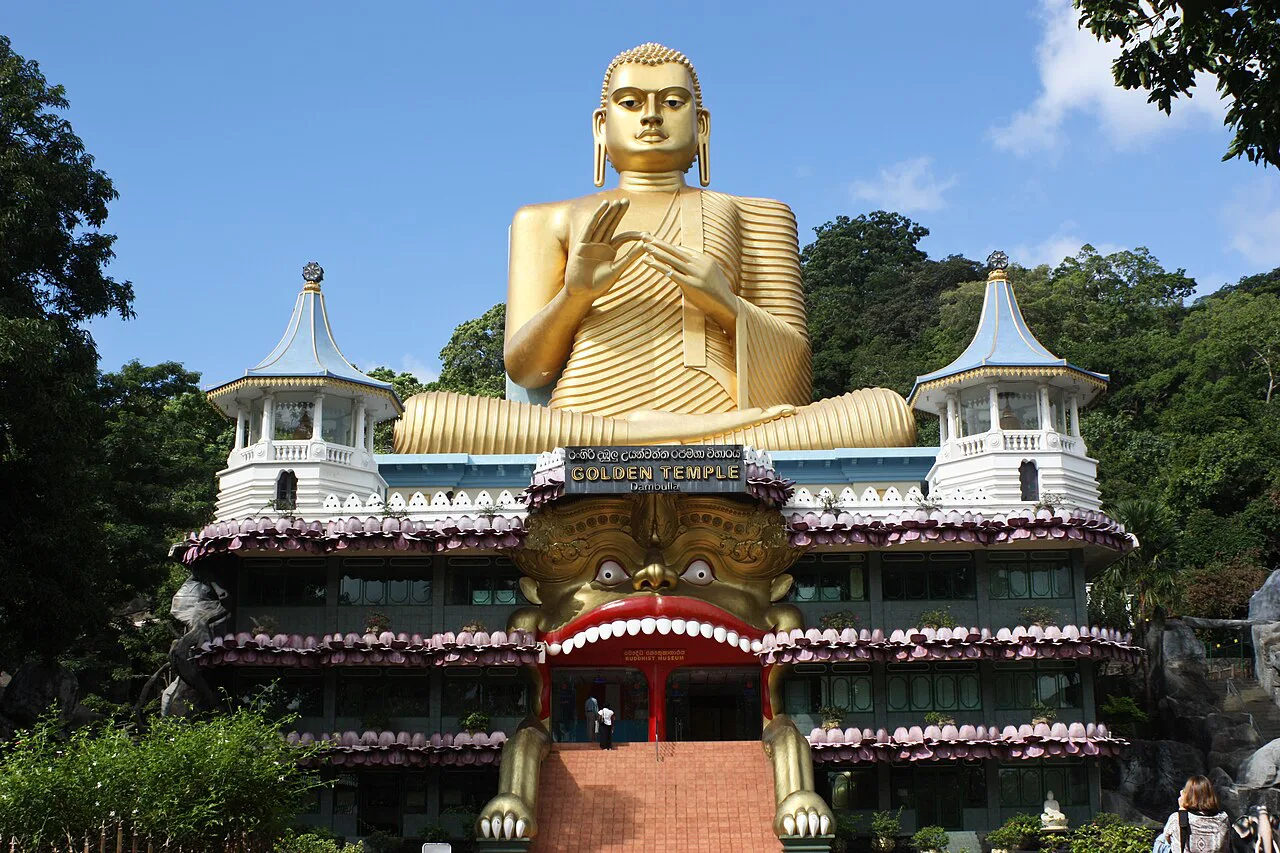
Built in 2000 with a Japanese grant beneath one of the tallest Buddha statues depicting the ‘Wheel of Dharma’ pose anywhere in the world, this museum was conceived as the first dedicated solely to Buddhism as a global tradition.
Most visitors encounter the Golden Temple Buddhist Museum without quite meaning to, it sits directly at the base of Dambulla rock, beneath the unmistakable 30-metre golden Buddha statue that greets every visitor before they even begin the climb up to the cave temples themselves.
Quick Facts
| Location | Base of Dambulla rock, before the ascent to the cave temples |
| Built | 2000, with funding from a Japanese grant |
| Notable feature | A 30-metre golden Buddha statue in Dharmachakra Mudra (‘Wheel of Dharma’ pose) |
| Collection size | Over 2,000 artefacts |
| Content | Paintings, sculptures, and relics tracing Buddhism’s history across Asia |
| Positioning | Marketed as the first museum dedicated solely to Buddhism |
Commonly searched as: Golden Temple Buddhist Museum Dambulla · Dambulla golden Buddha statue · Dambulla museum · things to do in Dambulla · Dharmachakra Mudra Buddha
A Modern Addition to an Ancient Site
While Dambulla‘s cave temples date back over two thousand years, the Golden Temple complex at the base of the rock is a distinctly modern addition, built in 2000 with the support of a Japanese grant. Its centrepiece, and the reason most visitors photograph the site even before entering, is a 30-metre golden Buddha statue depicted in the Dharmachakra Mudra, the “Wheel of Dharma” hand gesture associated with the Buddha’s first sermon following his enlightenment. The statue is said to be among the tallest anywhere in the world depicting this specific posture, a striking modern counterpart to the far older statues waiting in the caves above.
A Museum With Global Ambitions
Housed within the same complex, the Buddhist Museum holds a collection of more than 2,000 artefacts, ranging from paintings and sculptures to religious relics, assembled with the stated aim of documenting Buddhism’s evolution and cultural expression not just in Sri Lanka but across the wider Asian world. The museum has been described, at least in its own promotional framing, as the first institution dedicated solely to Buddhism as a subject, an ambitious positioning for what is, in practice, a modestly sized collection attached to a working pilgrimage site.
Visitor reactions to the museum itself are genuinely mixed. Some describe the experience as underwhelming, statues displayed without much explanatory context in what can feel like a fairly sparse space, while others appreciate specific exhibits, including a detailed model depicting an elephant procession honouring the Buddha’s tooth relic, and value the museum’s broader effort to represent Buddhist statues and iconography from multiple countries and traditions under one roof.
A Practical Stop Before the Climb
For most visitors, the Golden Temple and its museum function as a natural staging point rather than a dedicated destination in its own right, a place to take photos of the golden Buddha, use the facilities, and get oriented before beginning the climb up to Dambulla’s genuinely significant cave temples above.
That role, threshold rather than destination, isn’t necessarily a criticism. Major heritage sites around the world often benefit from having a modern, accessible entry point that eases visitors into the experience ahead, and the Golden Temple’s giant statue and orientation facilities serve exactly that function for Dambulla, giving first-time visitors a clear, unmissable landmark to organise their visit around before tackling the genuinely ancient, more physically demanding climb that follows.
Visiting Tips
- Treat this as a quick add-on before or after the main cave temple climb, rather than a lengthy standalone visit.
- Photograph the golden Buddha statue in the morning for the best light.
- Keep expectations modest for the museum’s interpretive depth, based on mixed visitor feedback.
- Purchase your cave temple entry ticket at the south entrance booth, separate from the Golden Temple itself.
Where It Sits on the Map
Golden Temple Buddhist Museum, base of Dambulla rock Open in Google Maps ↗
Frequently Asked Questions
When was the Golden Temple built?
In 2000, with funding from a Japanese grant, as a modern addition at the base of the ancient Dambulla cave temple complex.
What is the golden Buddha statue depicting?
The Buddha in Dharmachakra Mudra, the ‘Wheel of Dharma’ hand gesture associated with his first sermon, standing about 30 metres tall.
What does the Buddhist Museum contain?
Over 2,000 artefacts including paintings, sculptures and relics documenting Buddhism’s history and cultural expression across Asia.
Is the museum worth a dedicated visit?
Visitor opinions are mixed; most treat it as a brief stop before or after the main cave temple climb rather than a standalone destination.
← Sri Lanka: The Complete Guide — see all 258 places by region
Related News
A guide to Sri Lanka's Cultural Triangle: Sigiriya, Polonnaruwa, Anuradhapura, Dambulla and Mihintale, with travel tips.

A complete guide to Sigiriya Rock Fortress: King Kashyapa's parricide, the water gardens, the famous frescoes, visiting tips and map.
A guide to the ancient city of Polonnaruwa: from Chola conquest to Parakramabahu the Great's garden-city, visiting tips and map.













