

Dsigngo is a Graphic Design and Digital Marketing Company.
Write what you are looking for and press enter to begin your search!

The East, Sri Lanka
Maduru Oya National Park
Built to protect the catchment of five separate reservoirs under one of Sri Lanka’s most ambitious 20th-century development schemes, this park’s boundaries also happen to enclose one of the last homelands of the island’s indigenous Vedda people.
Maduru Oya’s boundaries were drawn not primarily to protect wildlife, but to safeguard the water catchment feeding five separate reservoirs built under the sweeping Mahaweli development project, a piece of practical infrastructure planning that ended up creating one of Sri Lanka’s more ecologically and culturally significant protected areas almost as a byproduct.
Quick Facts
| Location | Eastern and Uva Provinces, near Polonnaruwa |
| Size | 58,850 hectares |
| Designated | 9 November 1983, under the Mahaweli development project |
| Purpose | Wildlife sanctuary and catchment protection for five reservoirs |
| Elephant population | Roughly 150 to 200 (2007 study) |
| Indigenous community | Vedda people living at Henanigala, within the park boundary |
Commonly searched as: Maduru Oya National Park · Maduru Oya elephants · Vedda people Sri Lanka · Mahaweli development project · things to do in the East Sri Lanka
Born From an Ambitious Irrigation Scheme
Maduru Oya National Park owes its existence to the Mahaweli development project, a sweeping infrastructure programme launched in the late 1970s that reshaped much of Sri Lanka’s dry-zone interior through new dams, reservoirs and irrigation schemes. Designated on 9 November 1983, the park’s stated purpose was twofold: providing sanctuary for wildlife, particularly elephants, while protecting the immediate catchment areas of five separate reservoirs the Mahaweli project depended on. That practical, infrastructure-first origin makes Maduru Oya a genuinely different kind of national park from something like Yala, established more directly for its wildlife rather than as a side effect of water management planning.
Geologically, the park’s landscape reflects the gradual degradation of ancient Precambrian rock, forming a mature, gently undulating peneplain punctuated by prominent rocky outcrops and ridges where erosion has been less complete, giving Maduru Oya a genuinely distinctive terrain compared to the flatter grasslands found at some other Sri Lankan parks.
Home to Descendants of the Island’s First People
What makes Maduru Oya genuinely distinctive among Sri Lanka’s national parks is that its boundaries enclose an active indigenous community: Vedda people, said by tradition to descend from the union of the island’s first Sinhalese king, Vijaya, and the Yaksha princess Kuveni, continue living within the park at Henanigala, predating both the Sinhalese majority’s arrival on the island around 543 BCE and, obviously, the park’s own 1983 designation. Historically semi-nomadic hunter-gatherers, many Vedda communities have since adopted more settled small-scale cultivation alongside their traditional practices, a genuine living link to Sri Lanka’s earliest human history persisting within a modern protected area.
The park’s cultural layers run deeper still: Buddhist ruins, including shrines, temples, dagobas and hermitages spanning various historical periods, have been documented at Henanigala, Kudawila, Gurukumbura and several other locations within the park, alongside early Brahmi inscriptions found at Kandegamakanda dating from the 1st to 3rd centuries CE.
Wildlife Beyond the Elephants
An estimated 150 to 200 elephants inhabit Maduru Oya, alongside sloth bears, leopards, water buffalo, sambar and spotted deer, wild boar, toque macaques, purple-faced leaf monkeys, and the nocturnal slender loris, giving the park a genuinely rich wildlife profile despite receiving considerably fewer visitors than Sri Lanka’s more famous safari destinations.
Visiting Tips
- Book a jeep safari through the park office, which sits directly in front of the Maduru Oya reservoir.
- Consider staying at one of the two circuit bungalows or the dormitory at the park office, or the Ulhitiya campsite for a more immersive stay.
- Visit the wildlife museum at the park entrance for useful context before heading out on safari.
- Approach the park’s Vedda community, if encountered, with genuine respect for their status as one of the island’s last indigenous groups.
Where It Sits on the Map
Maduru Oya National Park, Eastern/Uva Provinces, near Polonnaruwa Open in Google Maps ↗
Frequently Asked Questions
Why was Maduru Oya National Park established?
Under the Mahaweli development project in 1983, primarily to protect the catchment areas of five reservoirs while also providing wildlife sanctuary, particularly for elephants.
Who lives within the park’s boundaries?
A community of Vedda people, Sri Lanka’s indigenous ethnic group, at Henanigala, alongside wildlife including elephants, leopards and sloth bears.
How many elephants live in Maduru Oya?
An estimated 150 to 200, according to a 2007 study.
What historical sites exist within the park?
Buddhist ruins including shrines, temples and dagobas at several locations, along with early Brahmi inscriptions from the 1st to 3rd centuries CE at Kandegamakanda.
← Sri Lanka: The Complete Guide — see all 258 places by region
Related News
A guide to Sri Lanka's East Coast: Trincomalee, Batticaloa, Arugam Bay, wildlife parks, and the region's unique dry-season timing.
A guide to Trincomalee: one of the world's finest natural harbours, its ancient temple, colonial and WWII history, visiting tips and map.
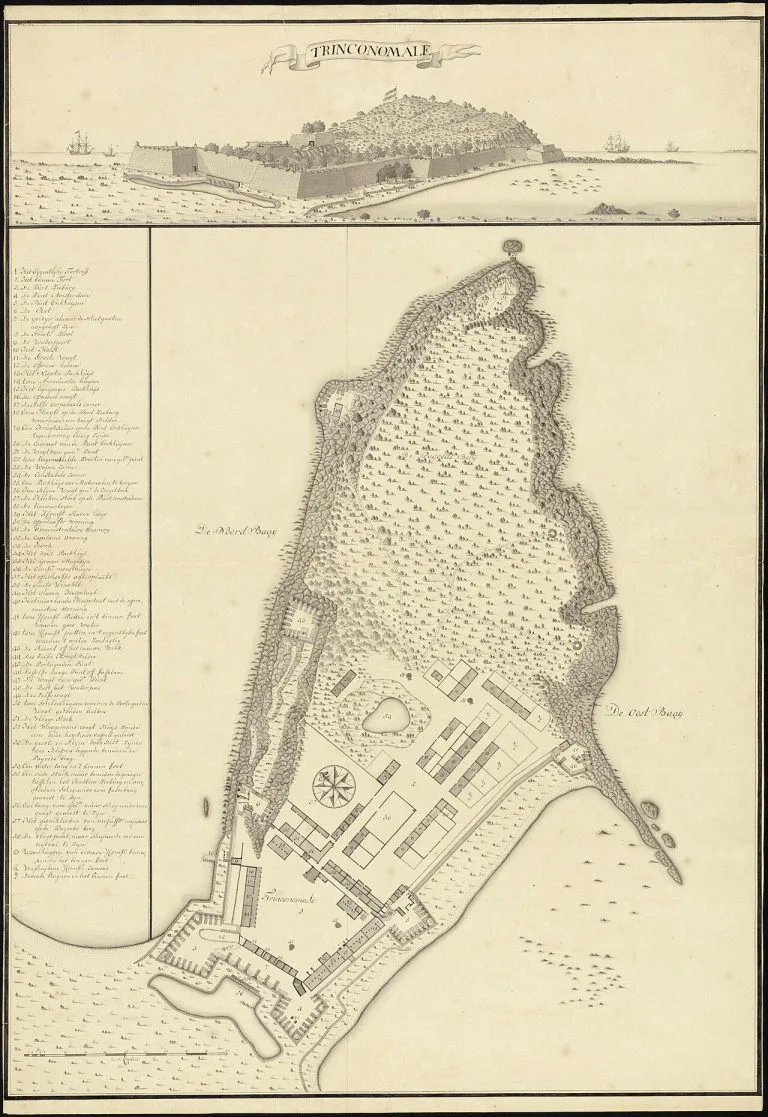
A guide to Fort Frederick in Trincomalee: built from a demolished temple's stones, still an active Sri Lankan military base, its resident deer, visiting tips...













