

Dsigngo is a Graphic Design and Digital Marketing Company.
Write what you are looking for and press enter to begin your search!

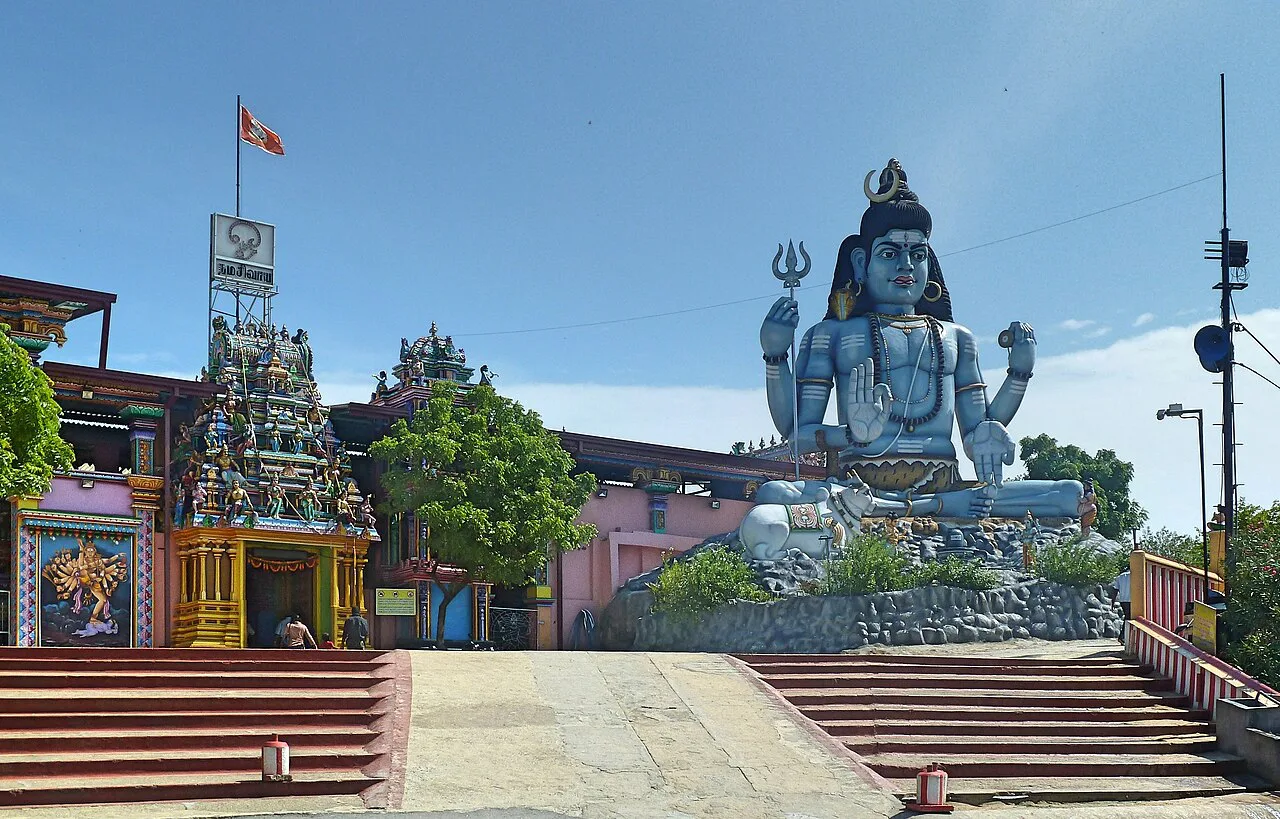
Trincomalee, The East
Koneswaram Kovil and Lover’s Leap
For centuries, visitors were told a heartbroken Dutch girl leapt to her death from this clifftop, until historical records surfaced showing she’d actually survived, married, and had children eight years later.
Koneswaram sits at the very edge of Swami Rock, 426 feet above the Bay of Bengal, one of only five Pancha Ishwarams, fixed abodes of the Hindu god Shiva, recognised across the whole of South Asia, sharing its clifftop with a much younger, and considerably less reliable, colonial-era legend.
Quick Facts
| Location | Swami Rock, within the Fort Frederick grounds, Trincomalee |
| Also known as | Thirukonamalai Konesar Kovil, Temple of a Thousand Columns |
| Status | One of the five Pancha Ishwarams of Shiva |
| Active since | At least the 7th century CE |
| Destroyed | 1624, by the Portuguese |
| Lover’s Leap legend | Involves Francina van Rhede, a Dutch official’s daughter, 1687 |
Commonly searched as: Koneswaram Temple · Lover’s Leap Trincomalee · Swami Rock temple · Pancha Ishwarams Sri Lanka · things to do in Trincomalee
One of Five Sacred Sites in All of South Asia
Koneswaram Temple’s religious significance extends well beyond Sri Lanka itself: it’s counted among the Pancha Ishwarams, five fixed abodes of Lord Shiva recognised across the entire Hindu world, a designation that places it in the same sacred category as major shrines elsewhere in South Asia. Historical evidence confirms the temple was an active shrine by at least the 7th century CE, and some traditions trace its origins considerably further back still. Known historically as Thirukonamalai Konesar Kovil, or the Temple of a Thousand Columns, it drew pilgrims and devotees from across the region for centuries before European colonial powers ever arrived on Sri Lanka’s shores.
That long, uninterrupted religious history was violently disrupted in 1624, when Portuguese forces demolished the temple entirely, using its stone to build Fort Frederick on the same clifftop site and discarding unusable fragments over the cliff edge into the sea below. The temple has since been rebuilt on the same sacred ground, and recovered fragments of the original structure, retrieved from the ocean floor in later archaeological efforts, offer a tangible physical link back to the pre-colonial shrine.
The Legend of Lover’s Leap
Just beside the temple stands Lover’s Leap, a dramatic cliff edge marked by a lone granite pillar, subject of one of Trincomalee‘s most enduring, and most thoroughly debunked, local legends. According to the traditional story, Francina van Rhede, daughter of a Dutch official, threw herself from the cliff into the sea in 1687 after her lover abandoned her, and her grieving father supposedly erected the pillar in her memory. It’s a genuinely tragic, romantic tale, repeated to visitors for generations.
There’s just one problem: later historical records suggest Francina van Rhede actually survived, going on to marry and have children some eight years after her supposed death, casting serious doubt on the entire legend as traditionally told. Whether the story was invented outright, confused with a different, unrecorded incident, or simply embellished over generations of retelling, it remains one of Trincomalee’s most persistently repeated stories despite the historical record working against it.
What Visitors See Today
Beyond the temple and Lover’s Leap, the site includes a towering, golden-hued statue of a seated Shiva gazing out over the bay, one of the tallest of its kind in Sri Lanka, along with the Pavanasam Theertham, a holy well preserved as part of the temple’s sacred geography and used in festival rituals. The temple’s most significant annual event, the Koneswaram Ther Thiruvilah chariot festival, draws large crowds and extends its ritual geography to include the nearby Bhadrakali temple and the Back Bay coastline.
Visiting Tips
- Dress modestly, covering shoulders and knees, and remove shoes before entering the temple’s inner precincts.
- Visit in the late afternoon for golden-hour light on the Shiva statue and panoramic ocean views.
- Reach the site via the road through Fort Frederick, a short walk or tuk-tuk ride from central Trincomalee.
- Photography is generally permitted in outer courtyards but may be restricted near the main sanctum; follow temple staff guidance.
Where It Sits on the Map
Koneswaram Temple and Lover’s Leap, Swami Rock, Trincomalee Open in Google Maps ↗
Frequently Asked Questions
Why is Koneswaram Temple significant?
It’s one of only five Pancha Ishwarams, fixed abodes of Shiva recognised across South Asia, and has been an active shrine since at least the 7th century CE.
What happened to the original temple?
Portuguese forces demolished it in 1624, using its stones to build Fort Frederick on the same site; the temple was later rebuilt, and fragments of the original have since been recovered from the sea.
What is the Lover’s Leap legend?
A story that a Dutch official’s daughter, Francina van Rhede, jumped to her death from the cliff in 1687 after being abandoned by her lover, though later records suggest she actually survived and married years afterward.
What is the temple’s biggest annual festival?
The Koneswaram Ther Thiruvilah, a chariot festival that draws large crowds and extends its ritual geography across several nearby sacred sites.
← Sri Lanka: The Complete Guide — see all 258 places by region
Related News
A guide to Sri Lanka's East Coast: Trincomalee, Batticaloa, Arugam Bay, wildlife parks, and the region's unique dry-season timing.
A guide to Trincomalee: one of the world's finest natural harbours, its ancient temple, colonial and WWII history, visiting tips and map.
A guide to Fort Frederick in Trincomalee: built from a demolished temple's stones, still an active Sri Lankan military base, its resident deer, visiting tips...













